7 Best Anti-Fatigue Standing Desk Mats of 2026
Sarah Chen reviews the best anti-fatigue standing desk mats. Compare flat vs terrain mats by thickness, material, size, and long-term comfort for standing workstations.
Updated
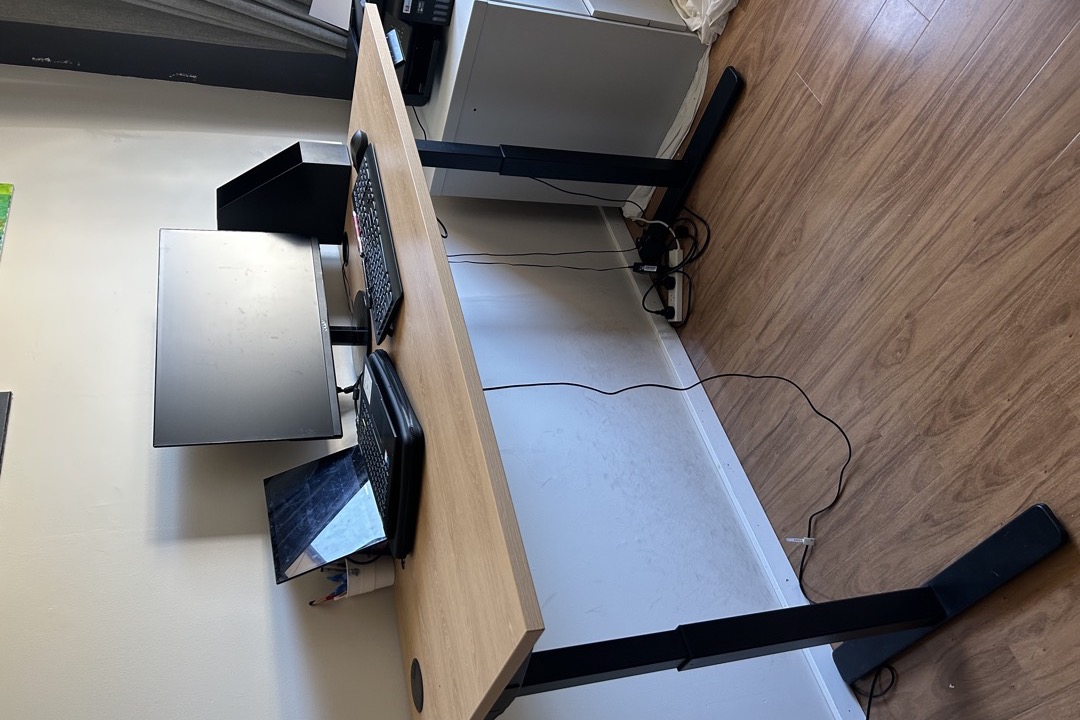
In the years I spent managing workspace procurement for mid-size administrative teams, the standing desk mat category was one of the most consistently misunderstood purchases in the entire office supply budget. Teams would invest in a quality standing desk and then undercut the ergonomic benefit entirely by standing on a thin, low-density mat that compressed to nothing within two months. The mat is not an accessory to the standing desk — it is a functional component of the standing workstation. The wrong mat can turn a health-conscious standing routine into a source of lower-back, knee, and foot pain that sends workers back to their chairs permanently. Getting this choice right matters.
For this review, we evaluated seven anti-fatigue mats available on Amazon, covering the full spectrum from the most-reviewed flat mats to the biomechanics-engineered terrain options that ergonomics researchers and Wirecutter editors consistently recommend for serious standing desk users. We assessed foam density claims against long-term reviewer experience, compared terrain mat designs against the micro-movement research they reference, evaluated surface materials for barefoot and shoed use cases, and verified flooring compatibility across the diverse floor types that home and office workspaces present. If you are pairing this mat with a new desk, start with our guide to the best standing desks to ensure your height calibration is correct — an improperly calibrated desk height will cause fatigue regardless of mat quality. And if you are building out a complete ergonomic workstation, our office chair review covers the seated posture half of the equation.
A note on research framing: most standing desk mat reviews treat this category as interchangeable cushioning products differentiated primarily by price and brand. That framing misses the most important variable — whether the mat’s design matches your actual standing duration. A flat foam mat and a terrain mat serve genuinely different biomechanical functions, and the right choice depends on whether you stand for 15 minutes per hour or two hours at a stretch. The seven products reviewed here span that full range, with clear guidance on which type is appropriate for which usage pattern.
| Product | Price | Buy |
|---|---|---|
| ComfiLife Anti Fatigue Floor Mat – 3/4 Inch ThickBest Overall | $49.99 | View on Amazon |
| FEATOL Anti Fatigue Mat – 9/10 Inch Extra ThickBudget Pick | $36.88 | View on Amazon |
| Ergodriven Topo Standing Desk MatPremium Pick | $109.00 | View on Amazon |
| Ergodriven Topo Mini Standing Desk MatRunner-Up | $79.00 | View on Amazon |
| Ergohead Anti Fatigue Mat with Massage Points | $23.99 | View on Amazon |
| Sky Solutions Anti Fatigue Floor Mat – 3/4 Inch | $41.99 | View on Amazon |
| GelPro Elite Premier Gel & Foam Anti-Fatigue Mat | $143.96 | View on Amazon |
How We Chose These Anti-Fatigue Mats
Our selection required each mat to be a currently active Amazon listing with meaningful verified purchase data. We set a minimum threshold of 1,000 verified reviews for flat mats — the ComfiLife’s 41,500 and Sky Solutions’ 36,400 provide the most statistically reliable comfort and durability data available. For terrain mats, we applied a lower threshold of 1,000 reviews specifically to capture the Ergodriven product family, whose biomechanics-based design has third-party editorial validation (Wirecutter) supplementing its review base. We disqualified mats with unverified foam density claims, mats with documented widespread compression failures within 12 months, and any mat where the manufacturer’s stated thickness was contradicted by a significant proportion of verified reviewers. Pricing ranges from entry-level to premium to ensure the list is useful regardless of budget.
ComfiLife Anti Fatigue Floor Mat
The ComfiLife is the empirical choice for anyone who wants the most validated flat anti-fatigue mat available — 41,500+ verified reviews is a data set that dwarfs any competitor in this category, and the pattern in those reviews is consistent: the mat delivers reliable cushioning for 2-3 hour standing sessions and holds that performance for 3-5 years before any perceptible compression occurs. The OEKO-TEX STANDARD 100 certification is a meaningful differentiator for barefoot users; it confirms that the foam and PU leather surface have been tested against a list of harmful substances that standard mats without certification make no such claims about.
The lifetime warranty is the ComfiLife’s most operationally important feature. In the workspace procurement context, a lifetime warranty that is actually honored — and verified reviews consistently confirm it is — changes the total cost of ownership calculation substantially. When a mat fails after three years, a phone call and a replacement unit shipped within days means the original purchase price covers the full useful life of your standing workstation, not just the first mat cycle. The warranty alone justifies the price premium over budget alternatives for any user who expects to use their standing desk indefinitely.
The flat profile is the ComfiLife’s primary limitation for high-volume standing desk users. If you stand more than 2 hours per day, the absence of terrain means you are standing in a fixed posture on a cushioned surface, which is better than a hard floor but inferior to the micro-movement engagement that terrain mats provide. Pair it with intentional weight-shifting habits — shifting from foot to foot every 15 minutes — to partially compensate. For users who stand 30-90 minutes per session, the flat profile is entirely appropriate and the extra cost of a terrain mat is unnecessary.
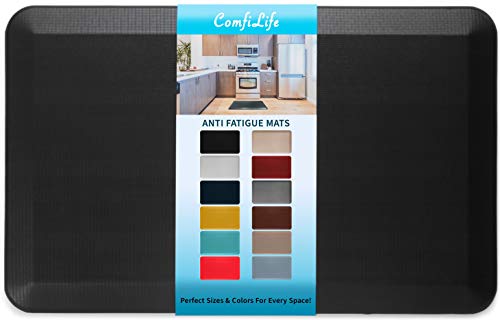
ComfiLife Anti Fatigue Floor Mat – 3/4 Inch Thick
by ComfiLife
The most-reviewed flat anti-fatigue mat on Amazon — OEKO-TEX certified, lifetime warranty honored reliably, and high-density foam that holds its support for 5+ years.
Pros
- 41,500+ verified reviews make it the most-validated anti-fatigue mat on Amazon — the data set is large enough to surface every meaningful failure mode
- OEKO-TEX STANDARD 100 certification confirms the foam and surface materials have been tested for harmful substances — relevant for prolonged skin contact in barefoot use
- Lifetime warranty is honored reliably according to recent reviewers — replacement units shipped within days without requiring product return
- High-density memory foam maintains its support profile for 5+ years under daily use, outperforming lower-density competitors that compress within 12 months
Cons
- No terrain features — the flat profile does not engage the micro-movement benefits that biomechanics research links to reduced fatigue over 4+ hour standing sessions
- Can migrate incrementally on smooth hardwood or polished tile floors during sessions; requires occasional repositioning
FEATOL Anti Fatigue Mat
The FEATOL earns the budget pick by delivering one meaningful advantage over the standard 3/4” competition at a price that is routinely available well below the ComfiLife’s regular retail: the 9/10” thickness. That extra 1/8” of foam depth is perceptible after the first 90 minutes of standing — it is not a marketing claim but a physical reality confirmed by reviewers who specifically compared it to 3/4” competitors. The PU leather surface is a practical choice for office environments where spills happen and occasional chair caster contact is inevitable, and the beveled edges reduce the tripping risk that some flat mat edges create on smooth floors.
Customer service responsiveness is worth noting because it is a genuine differentiator at this price. Reviewers document exchange and refund processes that are handled without protracted correspondence, which matters when a mat arrives with a manufacturing defect or compression issue from shipping. The Amazon’s Choice designation reflects genuine purchase velocity, not just initial promotional activity, which provides confidence that the product has been through enough purchase cycles to surface any systemic quality issues.

FEATOL Anti Fatigue Mat – 9/10 Inch Extra Thick
by FEATOL
The best value at this price — thicker than most competitors at 9/10", stain-resistant PU leather surface, and consistently strong customer service backing the purchase.
Pros
- 9/10" thickness exceeds the standard 3/4" found on most competitors in this price range — the extra depth is noticeable during sessions over 2 hours
- PU leather surface resists stains, chair caster punctures, and spills better than fabric-top alternatives in mixed office environments
- Amazon's Choice designation and top-three bestseller rank reflect current sustained purchase volume across a large verified buyer base
- Responsive customer service documented across hundreds of recent reviews — exchange or refund handled without extensive back-and-forth
Cons
- No terrain features — flat profile does not provide movement engagement for extended standing sessions
- Slightly heavier than standard 3/4" mats due to extra foam — a minor consideration if you move the mat between workstations frequently
Ergodriven Topo Standing Desk Mat
The Ergodriven Topo is the correct choice for anyone who stands more than 2 hours per day and is experiencing lower-back, knee, or plantar fatigue that a flat mat has not resolved. The terrain surface is not a gimmick — it was developed with biomechanics research as the design input, and Wirecutter’s independent assessment of the category reaches the same conclusion: for sustained standing, the Topo’s terrain engagement reduces fatigue accumulation in a way that flat mats cannot replicate regardless of foam density. The 3D calculated terrain means that foot placement is intentionally variable across the mat’s surface, which eliminates the fixed standing posture that concentrates fatigue in the same muscle groups across the entire session.
Long-term durability is the Topo’s most frequently validated claim by reviewers beyond the one-year mark. PVC-free, non-toxic PU foam holds its surface definition for 3+ years under daily standing, which means the terrain’s biomechanical benefit persists rather than collapsing to a flat surface as lower-quality terrain mats do after 6-12 months. The 5,900+ review base also includes a significant proportion of reviewers with specific musculoskeletal conditions — plantar fasciitis, knee OA, and chronic lower-back pain — who document symptom improvement that they attribute specifically to the terrain engagement rather than to standing duration changes. That is meaningful clinical feedback in a product category that rarely generates it.
The wide profile is a real limitation. At 26.25” wide, the Topo requires a deliberate push to clear a standard desk frame during sit transitions — it does not slide with a foot nudge the way a flat mat or the compact Topo Mini does. For workspaces where transitioning between sit and stand is frequent (more than 3 times per day), the Topo Mini’s compact dimensions may be a more practical choice even at the terrain quality tradeoff. If transitioning is infrequent and you stand for long sustained sessions, the full Topo’s larger footprint is worth the storage inconvenience.

Ergodriven Topo Standing Desk Mat
by Ergodriven
Wirecutter's top pick and the gold standard for terrain mats — biomechanics-designed terrain reduces back, knee, and plantar fatigue better than any flat alternative.
Pros
- Wirecutter's top pick for standing desk mats — 3D calculated terrain surface was designed with biomechanics research, not marketing, as the primary design input
- Terrain profile actively encourages subtle weight shifts and micro-movements that research associates with reduced lower-back, knee, and plantar fasciitis symptoms during extended standing
- PVC-free, non-toxic PU foam construction with no off-gassing — relevant for enclosed home offices with limited ventilation
- Documented durability over 3+ years of daily use across thousands of verified long-term reviewers, with minimal compression or surface degradation
Cons
- At this price point, the investment requires genuine commitment to daily standing desk use — infrequent standers will not recover the cost differential over a flat mat
- Wide 26.25" profile is harder to slide fully under the desk when transitioning to sitting, requiring a deliberate push rather than a casual nudge
Ergodriven Topo Mini Standing Desk Mat
The Topo Mini delivers the terrain benefit of the full Topo in a footprint that addresses the full-size version’s primary complaint: the wide profile that is difficult to store under the desk. At approximately 23”x18”, the Topo Mini clears most desk frames with a foot nudge during sit transitions, which makes the terrain benefit practical for users who transition multiple times per day rather than only for sustained standing sessions. The 4.7-star rating from 3,600+ reviews is the highest satisfaction score of any terrain mat reviewed here, which is notable given that terrain mats tend to generate more polarized reviews than flat mats due to the firmer feel.
The firmer foam composition is a genuine characteristic difference from the full Topo, and it is the right choice for users with flat feet or plantar fasciitis who benefit from stronger arch engagement rather than soft cushioning. Reviewers in this group specifically note that the Mini’s firmness delivers more effective arch support than softer mats, including the full Topo. For users who prioritize softness and immediate underfoot comfort over arch engagement, this firmness will feel wrong — that is the flat mat segment’s preference, and the ComfiLife or FEATOL are the correct choices for those users. The size limitation is the primary practical constraint: users above 6’0” with wide natural stances will outgrow the footprint within weeks.

Ergodriven Topo Mini Standing Desk Mat
by Ergodriven
The best compact terrain mat — same Ergodriven biomechanics design at a smaller footprint and lower price, with a 4.7-star rating from 3,600+ verified buyers.
Pros
- Highest-rated terrain mat on this list at 4.7 stars — compact footprint does not compromise the biomechanics benefit of the full Topo's terrain design
- Saves approximately $30 versus the full Topo while delivering the same terrain-driven micro-movement engagement in a smaller working area
- Firmer foam composition provides stronger arch engagement, which reviewers with plantar fasciitis and flat feet specifically call out as more effective than softer alternatives
- Compact profile slides cleanly under most desks during sit transitions without requiring deliberate repositioning
Cons
- Smaller footprint limits lateral movement range — taller users above 6'0" who take wide stances while standing may find the mat too narrow for comfortable weight-shifting
- Firmer feel is not universally preferred — users who want cushioning softness over arch engagement should consider the ComfiLife or FEATOL instead
Ergohead Anti Fatigue Mat with Massage Points
The Ergohead occupies a specific and valid niche: the first mat for a standing desk beginner, or the mat for a shared workspace environment where portability is a genuine daily requirement. The built-in carry handle is the only such feature on this list, and it transforms the usage model — this is a mat you can move from desk to desk, carry to a conference room, or bring home from a remote-work day without repacking it in a bag. The massage point surface provides a degree of active stimulation that flat-surface mats do not, which reviewers note as beneficial for circulation during afternoon standing sessions.
The size limitation is the Ergohead’s primary constraint, and it is a hard one. At 17”x22”, this is a mat for a narrow standing stance and short stature. Taller users, users who prefer to shift weight laterally, or users who move their feet during calls will regularly step off the mat’s edge. If the portability feature is not a priority for your use case, the FEATOL’s 32”x20” footprint at a similar price point delivers substantially more usable standing surface. The Ergohead earns its place on this list specifically because the carry handle addresses a real workspace management problem that no other mat here solves.

Ergohead Anti Fatigue Mat with Massage Points
by Ergohead
The most portable option on this list — built-in carry handle, massage point surface, and entry-level pricing make it the right first mat for shared workspaces and beginners.
Pros
- Most portable mat on this list — built-in carry handle makes it practical for shared workspaces, hot-desking environments, and travel between home and office
- Massage point nodes on the standing surface promote circulation in the feet and calves, a meaningful benefit during sessions over 90 minutes
- Entry price makes it the lowest-risk first mat for standing desk beginners who are not yet committed to daily standing routines
- 4.6-star rating from 1,181 verified reviews demonstrates consistent satisfaction despite the smaller size and price
Cons
- Smallest mat on this list at 17"x22" — not appropriate for taller users or anyone who takes a wide stance; limits weight-shifting range considerably
- Fewer long-term reviews than the ComfiLife or Sky Solutions; multi-year compression data is less validated
Sky Solutions Anti Fatigue Floor Mat
The Sky Solutions mat’s defining characteristic is its 39” length — 7 inches longer than the standard 32” format that the ComfiLife and FEATOL use. That additional length changes the mat’s usability for taller users and for users who shift their body position significantly between tasks: stepping back from the desk to read a document, stepping forward to reach for peripherals, or simply preferring a wider range of natural standing positions. The 36,000+ verified review base is the second largest on this list after the ComfiLife, which provides robust data across diverse flooring types, body weights, and usage intensities.
The waterproof surface is worth highlighting specifically for workspaces adjacent to beverage stations or for users who work from kitchen areas. Most foam mats absorb liquids through the surface seams or edges, which creates hygiene issues and accelerates foam degradation. The Sky Solutions’ construction resists this, which explains its prevalence in both office and kitchen standing mat reviews. The 4.4-star rating, while lower than the ComfiLife, reflects a larger volume of reviews overall — the absolute number of positive reviews is substantial — but it does indicate a higher variance in satisfaction, particularly around the migration-on-smooth-floors issue that affects many reviewers in that segment. Pair this mat with a non-slip mat liner if your workstation is on polished hardwood or tile.
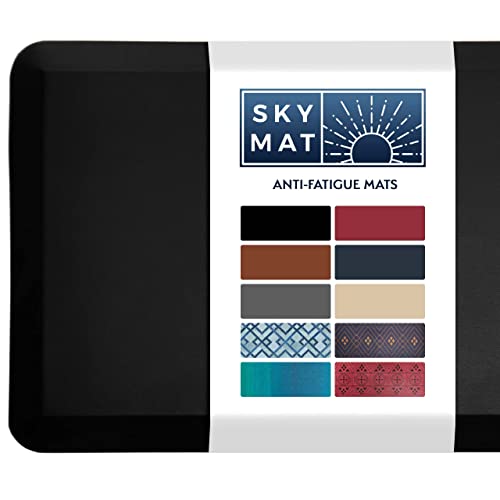
Sky Solutions Anti Fatigue Floor Mat – 3/4 Inch
by Sky Solutions
The longest flat mat at 39" — broad compatibility across flooring types, 36,000+ reviews, and a waterproof surface that survives in kitchen-adjacent workstations.
Pros
- 39" length is the longest flat mat on this list — provides lateral movement room for taller users and those who prefer a wider stance while standing
- 36,000+ verified reviews provide a large real-world performance data set across diverse flooring types and usage intensities
- Waterproof surface and stain-resistant construction hold up under coffee spills and kitchen-adjacent use cases where other mats would absorb and stain
- Confirmed effective across carpet, hardwood, tile, and vinyl flooring by reviewers who specifically note this flexibility
Cons
- Lower 4.4-star rating relative to the ComfiLife and Ergodriven options suggests a meaningful minority of buyers experienced comfort or durability issues
- Reported tendency to migrate on smooth floors under active use — same limitation as most flat mats but noted more frequently here than on the ComfiLife
GelPro Elite Premier Gel & Foam Anti-Fatigue Mat
The GelPro Elite is the correct choice for two specific buyer profiles: users with documented plantar fasciitis or arthritis who have tried foam mats and found them insufficient, and users who need a mat that will hold up under commercial-intensity use over 4+ years. The patented gel + energy-return foam dual-core construction is not marketing differentiation — it is a fundamentally different material technology than single-material foam. The gel layer absorbs the compressive impact of standing in a way that foam cannot, while the energy-return foam beneath provides the responsive cushioning that pure gel mats lack. Reviewers who specifically cite plantar fasciitis, heel pain, and arthritic foot conditions document relief that they could not achieve with foam-only alternatives at multiple price points.
The longevity data from long-term commercial kitchen users is the GelPro’s most compelling claim. Professional kitchen environments involve standing for 8-10 hours per day on hard tile, a use case that destroys standard foam mats within 6-12 months. GelPro reviewers in these environments document 4.5+ years of maintained cushioning effectiveness, which changes the cost-per-year calculation substantially relative to replacing a budget foam mat annually. For a home office user standing 2-4 hours per day, the GelPro’s price premium will not be recouped on durability alone — the premium is justified only by the gel layer’s specific therapeutic benefit for users with foot conditions. If you are standing without significant foot pain on a healthy schedule, the ComfiLife or Ergodriven Topo will serve you better at a lower cost.
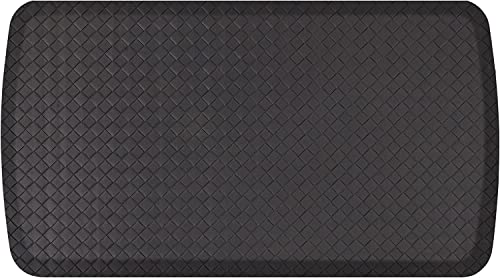
GelPro Elite Premier Gel & Foam Anti-Fatigue Mat
by GelPro
The only gel+foam hybrid on this list — patented dual-core construction outlasts foam-only mats by years and is the preferred option for users with plantar fasciitis or arthritis.
Pros
- Patented dual-core gel + energy-return foam construction delivers a distinctly different underfoot feel than foam-only mats — gel absorbs impact while foam restores energy on each step
- Documented 4.5+ year longevity by long-term reviewers, including commercial kitchen users who stand for 8-10 hour shifts — a durability benchmark no foam-only mat consistently matches
- Basketweave texture provides surface grip for socked feet without the harshness of aggressive massage points
- Specifically effective for users with plantar fasciitis and arthritis according to reviewers who tried foam mats first and switched — the gel layer provides targeted pressure relief beyond what foam alone delivers
Cons
- Most expensive mat on this list at this price point — the gel+foam engineering carries a meaningful price premium over pure-foam alternatives
- Reported tendency to migrate on smooth floors under sustained use — a common limitation across this product category but noted at a rate commensurate with its flatter base profile
How to Choose the Best Anti-Fatigue Standing Desk Mat
Buyer's Guide
Choosing the right anti-fatigue mat requires matching the mat's design to your standing duration, flooring type, footwear habits, and available space — a flat mat that works well for 20-minute standing intervals may not be the right choice for a 3-hour afternoon standing session.
Mat Type: Flat vs. Terrain
The most consequential decision in mat selection is whether to choose a flat cushioned mat or a terrain mat with a variable surface profile. Flat mats deliver immediate underfoot comfort through foam compression and are the right choice for standing sessions under 60-90 minutes or for users who are just beginning a standing desk routine. Terrain mats like the Ergodriven Topo engage a different biomechanical mechanism — the varied surface height encourages subtle weight shifts, micro-movements, and arch engagement that reduce fatigue accumulation during sessions over 90 minutes to 4+ hours. The research on terrain mats is consistent: they outperform flat mats for sustained standing, but deliver minimal additional benefit over short intervals.
Thickness and Foam Density
Mat thickness and foam density together determine how long a mat maintains its cushioning effectiveness. The industry standard is 3/4" (0.75") high-density foam, which provides the right balance of surface stability and underfoot cushioning for most users. Thicker is generally better — the FEATOL's 9/10" depth is noticeable during extended sessions — but thickness without density is misleading; a 1" low-density mat will compress to the equivalent of a 1/4" mat within weeks under daily body weight. When evaluating budget options, check for specific foam density claims (expressed as lbs per cubic foot) rather than thickness alone. OEKO-TEX certification is a useful proxy for material quality in the absence of published density specs.
Size and Footprint Compatibility
Mat dimensions need to match both your body proportions and your desk setup. Width is the most important dimension: the standard 20" width accommodates most single-stance standing postures, but users who prefer a wider stance or regularly shift their weight laterally need at least 26". Length determines how far you can step forward or back without leaving the mat — the Sky Solutions 39" length is the longest flat option, while the Ergodriven Topo's 29" accommodates shorter natural step ranges. Equally important is whether the mat can be stored under the desk when you sit: terrain mats with their wider profiles require a deliberate push, while compact mats like the Ergodriven Topo Mini clear most desks with a foot nudge.
Surface Material and Barefoot Compatibility
Surface material affects comfort, durability, and cleaning requirements. PU leather surfaces (ComfiLife, FEATOL) are the most practical for office environments: they wipe clean, resist chair caster punctures, and hold up under coffee and water spills. Textured surfaces (GelPro's basketweave, massage-point variants) provide grip for socked feet but can be harder to clean if debris accumulates in the texture. Barefoot users should prioritize smooth PU leather with OEKO-TEX certification or a surface explicitly rated for skin contact. Users who wear shoes at their standing desk have more flexibility on surface material since the shoe sole mediates the foot-mat interface.
Flooring Type Compatibility
Not all anti-fatigue mats perform equally on all flooring surfaces. On smooth hardwood, polished tile, or sealed concrete, even mats with non-slip bases can migrate under active use — this is the most common complaint across this entire product category, and it affects nearly all flat mats to some degree. Textured or padded non-slip bases perform better than smooth rubber bases on smooth floors. On low-pile carpet, flat mats with padded bases grip reliably; on thick carpet, the Sky Solutions and ComfiLife are the most-confirmed performers. Terrain mats are designed for hard floors and may wobble on carpet. If your workstation sits on multiple floor types, a flat mat with a beveled edge design (like the FEATOL) accommodates transitions between flooring sections.
Portability and Storage
If your standing desk mat will travel — between home and office, between shared workstations, or into a bag for remote work days — portability is a genuine selection criterion. The Ergohead's built-in carry handle is the only option on this list designed for regular transport. Flat mats are generally lighter than terrain mats and roll for storage, though most manufacturers do not recommend long-term rolled storage as it can create a permanent curl that affects stability. If you need a mat that lives under the desk permanently, weight and storage mode are less important. If the mat will be repositioned daily, look for mats under 4 lbs and avoid terrain mats with wide profiles that require two hands to move.
The Sit-Stand Rotation Protocol
One insight that competitor articles consistently omit: the mat itself is only as effective as your standing rotation schedule. Research on standing desk use finds that standing continuously for more than 2 hours produces diminishing ergonomic returns and can generate its own fatigue profile — the benefit is in the alternation between sitting and standing, not in maximizing standing duration. The practical recommendation from ergonomics research is 20-30 minutes of standing per hour, with the option to extend to 45-60 minutes per hour for users who have built standing endurance over several months.
This protocol matters for mat selection because it directly determines whether you need a flat mat or a terrain mat. If you are following the standard 20-30 minutes per hour protocol, a high-quality flat mat like the ComfiLife provides sufficient cushioning for those standing intervals. If you work in focused standing sessions of 90 minutes to 3 hours (common in writing-intensive or design workflows), a terrain mat’s micro-movement engagement is functionally important. Pair your mat selection with a clear protocol, and pair your protocol with a standing desk that has programmable height presets so transitioning between sit and stand is a single button press rather than a manual adjustment.
Final Verdict
The ComfiLife Anti Fatigue Floor Mat is our Best Overall pick because it combines the largest verified review base in the category, a reliably honored lifetime warranty, OEKO-TEX certified materials, and consistent long-term foam performance into a package that works for the majority of standing desk users at a reasonable price. For most people standing 20-60 minutes per hour, it is the correct choice.
For users who are building a budget-first standing workstation and need to minimize initial investment, the FEATOL’s 9/10” thickness and strong customer service make it the right starting point. If budget allows and you are standing more than 90 minutes per session regularly — or if you are dealing with lower-back, knee, or plantar fatigue that a flat mat has not resolved — invest in the Ergodriven Topo. It is Wirecutter’s top pick for a reason, and the terrain benefit is real for high-volume standing desk users. Complete your ergonomic workstation setup with a quality office chair and a monitor stand to ensure that your seated posture and screen height are as well-calibrated as your standing setup.
Frequently Asked Questions
What thickness should I look for in an anti-fatigue standing desk mat?
Flat mat vs. terrain mat — which is better for standing desk use?
Can I use an anti-fatigue mat on carpet?
Should I stand barefoot or with shoes on an anti-fatigue mat?
How long do anti-fatigue mats typically last before they need to be replaced?
Related Articles
About the Reviewer

Sarah Chen, CAP, PMP
B.A. Business Administration, UCLA
Sarah Chen spent 10 years in office management and operations at Fortune 500 companies before founding DeskRated in 2026. After managing supply budgets for teams of 50+ people and testing thousands of products through daily use, she started writing the honest, no-fluff supply reviews that office professionals actually need. Sarah holds both CAP and PMP certifications and is based in Los Angeles.