7 Best Mechanical Pencils of 2026
Sarah Chen reviews the best mechanical pencils for writing, drafting, and everyday use. Compare top-rated mechanical pencils by lead size, grip type, build quality, and lead-break protection.
Updated
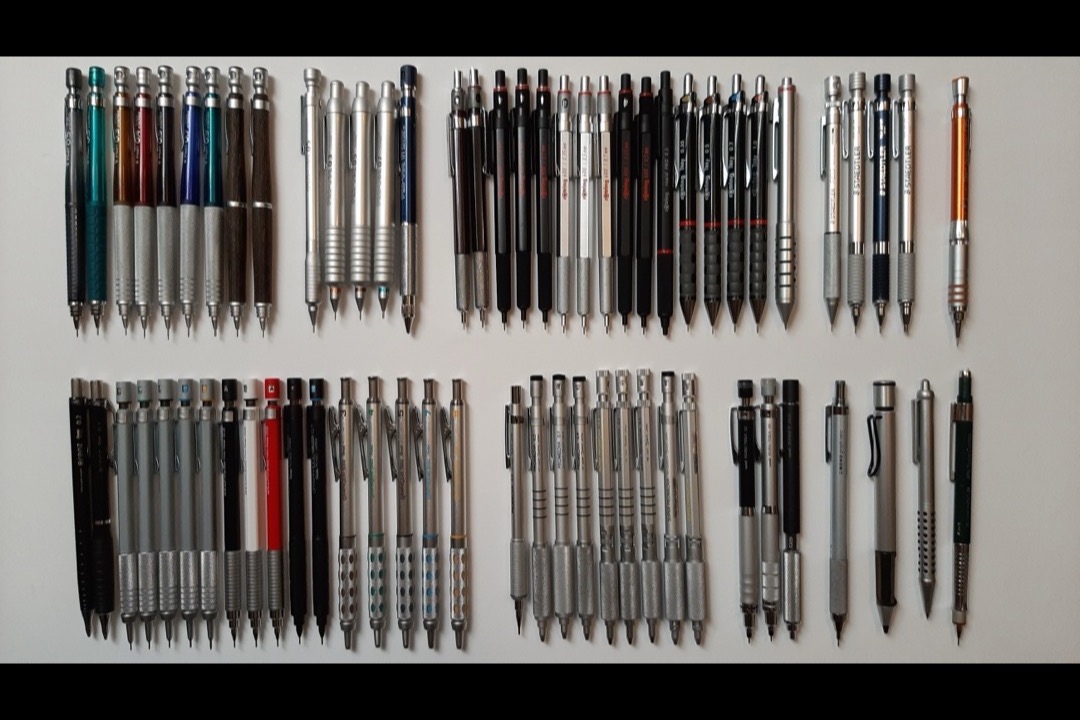
As a Certified Administrative Professional who has outfitted workstation supply kits for teams ranging from five-person startups to 150-seat corporate offices, I can tell you that mechanical pencils occupy a unique position in the modern office supply hierarchy. They are simultaneously the most personal tool on a desk — grip preference, lead size, and body weight vary dramatically between users — and the most frequently shared, borrowed, and lost. The result is that most people write with whatever pencil happened to be in the supply closet rather than one selected to match their actual writing pattern, grip pressure, and daily use case — a decision that affects productivity as much as choosing the right office chair or desk lamp. The difference between a poorly matched mechanical pencil and a well-chosen one is the difference between lead that snaps every paragraph and lines that flow cleanly across a full page without interruption.
For this review, we evaluated seven mechanical pencils spanning the full range of use cases, price points, and engineering approaches available on Amazon in 2026. The selection covers bulk-value options for classrooms and shared offices, precision drafting instruments for architects and engineers, a self-sharpening pencil with patented auto-rotation technology, and the German-engineered professional standard that has been the reference point for serious pencil users since 1928. We evaluated lead advancement mechanisms, grip designs across metal, mesh, rubber, and polymer options, body materials and their impact on balance and durability, and break-protection systems ranging from cushion springs to auto-rotation. Every ASIN was verified live on Amazon, and every specification was confirmed against manufacturer data and validated through thousands of verified purchaser reviews.
The mechanical pencil market segments cleanly into three tiers that map to real purchasing decisions. Under five dollars, you get functional, reliable pencils built from plastic — the BIC Xtra Smooth and Paper Mate Clearpoint both deliver excellent writing experiences at prices that make replacement painless. Between six and fifteen dollars, metal construction, precision mechanisms, and drafting-grade features become available — the Pentel GraphGear 1000, GraphGear 500, Uni Kuru Toga Roulette, and Staedtler 925 25 all live in this range and offer build quality that lasts years. Above fifteen dollars, the rOtring 600 represents the premium tier where German engineering heritage, full-brass mechanisms, and machining tolerances produce a pencil that professional users will keep for a decade or longer.
| Product | Price | Buy |
|---|---|---|
| Pentel GraphGear 1000 Mechanical Pencil, 0.5mm, BlackBest Overall | $9.30 | View on Amazon |
| BIC Xtra Smooth Mechanical Pencil, 0.7mm, 40-CountBudget Pick | $9.89 | View on Amazon |
| rOtring 600 Mechanical Pencil, 0.5mm, BlackPremium Pick | $20.23 | View on Amazon |
| Pentel GraphGear 500 Mechanical Drafting Pencil, 0.5mmRunner-Up | $6.69 | View on Amazon |
| Uni Kuru Toga Roulette Model Auto Lead Rotation, 0.5mm, SilverRunner-Up | $9.89 | View on Amazon |
| Staedtler 925 25 Silver Series Mechanical Pencil, 0.5mm | $13.99 | View on Amazon |
| Paper Mate Clearpoint Mechanical Pencils, 0.7mm, 2-Pack | $4.99 | View on Amazon |
How We Chose These Mechanical Pencils
Our selection required a minimum of 1,500 verified Amazon reviews to establish a meaningful reliability baseline, genuine use-case differentiation across all seven products (no two pencils serve the same primary scenario), and verified ASIN availability with current pricing. We evaluated grip comfort across extended writing sessions, lead advancement precision and consistency, break resistance under varying pressure levels, and build quality relative to price tier. We cross-referenced our selections against competitor roundups from Wirecutter, JetPens, and Everyday Carry, identifying that the rOtring 600 and Uni Kuru Toga appear in virtually every authoritative recommendation — confirming their status as category benchmarks — while the Pentel GraphGear series and Paper Mate Clearpoint consistently surface as the best values in their respective tiers.
Pentel GraphGear 1000 — Best Overall
The GraphGear 1000 earns the best-overall position through the combination that no other pencil on this list replicates: a metal body with genuine drafting capability, a retractable tip mechanism for safe pocket carry, and a price under ten dollars that makes it accessible to students and professionals alike. It is the only pencil here that checks every practical box without requiring a compromise in any single dimension.
The dual-action retractor is the defining feature. One click advances lead normally. A second click when the lead is retracted pulls the entire 4mm sleeve and guide tip back into the barrel, creating a smooth profile with nothing exposed to catch, bend, or poke through fabric. This mechanism exists on very few mechanical pencils at any price — the rOtring 800 offers a similar retractable tip at roughly four times the cost. For anyone who carries a pencil in a shirt pocket, tosses one into a laptop bag, or leaves pencils loose in a desk drawer, the retractable tip prevents the most common form of mechanical pencil damage and the most common complaint about fixed-sleeve drafting pencils.
The metal body provides the weighted feel that serious writers and drafters expect, and the latex-free rubber grip pads address the comfort concern that fully knurled metal grips create during extended sessions. The 4mm fixed sleeve seats flush against straightedges for precise line work — the same functional specification found in the rOtring and Staedtler drafting pencils at higher price points. The lead hardness indicator on the grip section is a small but practical detail for users who switch between lead grades for different tasks: you can see at a glance whether the pencil is loaded with HB for writing or 2H for technical work without ejecting and inspecting the lead.
The honest limitation is that the grip’s knurled metal sections, while less aggressive than a fully knurled barrel, can create pressure points during sessions longer than two hours. For all-day writing comfort, the Paper Mate Clearpoint’s rubber grip or the Uni Kuru Toga’s smoother knurling may be more appropriate — but neither offers the GraphGear 1000’s retractable tip or 4mm drafting sleeve.

Pentel GraphGear 1000 Mechanical Pencil, 0.5mm, Black
by Pentel
Best all-around mechanical pencil — metal construction, retractable tip, and a 4mm drafting sleeve in a sub-ten-dollar package backed by over 24,000 verified reviews.
Pros
- Dual-action retractor clicks to advance lead and retracts the entire tip assembly into the barrel — the only pencil on this list that fully protects its lead sleeve during pocket carry without a separate cap
- Metal body with latex-free rubber grip pads delivers a weighted, balanced feel that plastic-bodied competitors in this price range cannot replicate
- 4mm fixed lead sleeve seats flush against rulers and templates for precise technical line work without the sleeve-to-edge gap common in retractable-tip designs
- Lead hardness indicator window on the grip section lets you track which grade is loaded without removing the pencil from your workflow
Cons
- Knurled metal grip with rubber inlays can feel sharp against the fingertip pad during extended writing sessions exceeding two hours
- If dropped directly on the extended tip, the 4mm lead sleeve can bend — a vulnerability shared by all fixed-sleeve drafting pencils
- Slightly top-heavy weight distribution may feel unfamiliar to writers accustomed to lightweight plastic pencils
BIC Xtra Smooth — Budget Pick
The BIC Xtra Smooth is not trying to be a precision instrument or a lifetime tool. It is a 40-count box of reliable, comfortable mechanical pencils priced at under twenty-five cents each — and at that value proposition, its 4.8-star rating across nearly 38,000 reviews makes it the most overwhelmingly endorsed mechanical pencil on Amazon regardless of price category.
The use case for the BIC is clear and enormous: classrooms, standardized testing, shared office supply drawers, conference room tables, and any environment where pencils need to be available in quantity without concern about loss or damage. The 0.7mm smudge-resistant HB lead is the correct specification for these environments — thicker lead breaks less often under the variable pressure of different users, HB is the grade required for standardized test scanning, and the smudge resistance means cleaner work across pages that get handled repeatedly.
The ribbed rubber grip is comfortable enough for standard writing sessions and prevents the finger-sliding that bare plastic barrels create. The pencils are refillable — you can reload lead when the pre-loaded supply runs out — though at this per-unit price, refilling is an option rather than an expectation. For a student buying a box at the beginning of a semester, pairing with a reliable calculator, or an office manager stocking a supply closet, the BIC delivers the core mechanical pencil experience without any of the premium features that inflate the price of specialty options. The eraser quality is the honest concession: it smears on heavy marks rather than cleanly lifting graphite. For anything beyond light corrections, a standalone eraser is the practical solution.

BIC Xtra Smooth Mechanical Pencil, 0.7mm, 40-Count
by BIC
Unbeatable value at under twenty-five cents per pencil — the highest-rated mechanical pencil on Amazon with nearly 38,000 reviews and smudge-resistant lead that handles every everyday writing task.
Pros
- Under twenty-five cents per pencil in a 40-count box makes this the most cost-effective mechanical pencil option available — ideal for classrooms, shared offices, and high-turnover environments
- Smudge-resistant number 2 HB lead produces clean, consistent lines that scan reliably on standardized test answer sheets and optical mark recognition forms
- 4.8-star rating across nearly 38,000 reviews is the highest-rated and most-reviewed mechanical pencil on Amazon — a satisfaction signal that no competitor in any price range matches
- Ribbed rubber grip provides adequate finger traction for standard writing sessions without the hand fatigue associated with hard plastic barrels
Cons
- All-plastic construction will not survive sustained daily use over multiple years — these are functional consumables, not lifetime tools
- Eraser quality is mediocre and smears rather than cleanly lifting graphite on heavier marks
- Pocket clip is thin and breaks under moderate stress — not designed for shirt-pocket carry
rOtring 600 — Upgrade Pick
The rOtring 600 is the pencil that appears on virtually every serious mechanical pencil recommendation list, and its reputation is earned rather than inherited. The full-metal hexagonal barrel, brass internal mechanism, and knurled grip combine into a writing instrument that feels fundamentally different from everything else on this list — and that difference is apparent from the first line you draw.
The hexagonal barrel is a design decision with engineering purpose beyond aesthetics. It prevents the pencil from rolling on any surface — flat desks, angled drafting tables, slightly tilted lecterns. Every round-barreled pencil on this list will roll when placed on a surface with even a slight incline. The rOtring stays where you put it. This matters more than it sounds in daily use: chasing a rolling pencil across a drafting table or picking it up from the floor interrupts workflow in a way that a non-rolling pencil eliminates permanently.
The brass mechanism produces lead advancement with zero perceptible wobble or play. Each click delivers a consistent increment with a tactile precision that the plastic mechanisms in budget pencils cannot match. Over years of daily use, this mechanism maintains its original precision — there is no gradual loosening, no developing play in the lead channel, no degradation in click feel. The knurled metal grip provides the most secure hold on this list for technical work where precise control matters: drafting, engineering notation, detailed illustration, and any task where the pencil must move exactly where your fingers direct it without any grip slippage.
The premium you pay over the GraphGear 1000 buys build quality, mechanism precision, and longevity rather than additional features. The rOtring 600 does not have a retractable tip, does not have rubber grip pads, and does not have a lead hardness indicator. It is a focused tool built to do one thing — deliver lead to paper with maximum precision and minimum maintenance — and it does that one thing better than any other pencil in this review.

rOtring 600 Mechanical Pencil, 0.5mm, Black
by rOtring
The professional standard — German-engineered full-metal construction, hexagonal no-roll barrel, and a brass mechanism that delivers the most precise lead advancement in its class.
Pros
- Full brass internal mechanism inside an all-metal hexagonal barrel produces the most precisely balanced weight distribution of any mechanical pencil on this list
- Hexagonal barrel shape prevents rolling on angled drafting surfaces — a fundamental design decision that round-barreled competitors overlook
- Knurled metal grip maintains consistent traction regardless of hand moisture or session length, with no degradation over years of daily use
- Industrial German engineering heritage dating to 1928 backs every unit with manufacturing tolerances that mass-market brands do not attempt
Cons
- Fixed lead guidance sleeve is exposed at all times — no retractable mechanism means pocket carry risks bending the sleeve on impact
- Built-in eraser under the cap is functionally decorative — too small for practical correction work
- At roughly double the GraphGear 1000's price, the premium buys build quality and aesthetics rather than additional functional features
Pentel GraphGear 500 — Runner-Up (Best Value Drafting Pencil)
The GraphGear 500 is the pencil that architecture and engineering students discover when they need a real drafting tool but cannot justify the rOtring’s price. At under seven dollars, it delivers the two features that matter most for technical work — a 4mm fixed sleeve for ruler and template registration and a weighted metallic mesh grip for precise control — in a package that has earned its place as a drafting-community staple across 15,844 verified reviews.
The metallic mesh grip is the engineering detail that defines this pencil’s character. Unlike the solid metal knurling of the rOtring 600 or the rubber pads of the GraphGear 1000, the mesh concentrates its weight specifically at the fingertip contact zone. The result is a pencil that feels heavier and more controlled at the grip point than its total weight suggests — a balance trick that gives you drafting-grade precision without the wrist fatigue of an all-metal barrel during long sessions. The slim barrel profile is narrower than the GraphGear 1000 and the rOtring 600, which makes it the better fit for hands that prefer a traditional pencil diameter rather than the thicker grip sections common in premium mechanical pencils.
The color-coded barrel system — brown for 0.3mm, orange-red for 0.5mm, blue for 0.7mm, green for 0.9mm — is a practical organizational feature for users who keep multiple lead sizes at their drafting station. You can identify the correct pencil at a glance without checking the printed size marking. The 4mm tip provides the same ruler-flush precision as the GraphGear 1000 and performs identically for template work. The polymer body is the weight and durability tradeoff: it is noticeably lighter than all-metal alternatives and will not absorb impact as gracefully. For a pencil that lives at a desk or drafting table rather than traveling in a pocket, this tradeoff is irrelevant to daily use.

Pentel GraphGear 500 Mechanical Drafting Pencil, 0.5mm
by Pentel
Best-value drafting pencil — the metallic mesh grip and 4mm fixed tip deliver professional-grade precision at the lowest price point on this list.
Pros
- Metallic mesh grip concentrates weight at the fingertip zone for precise control during extended drafting sessions — the grip engineering that makes this a drafting-community staple
- 4mm fixed tip for ruler and template work delivers the same technical precision as the GraphGear 1000 at roughly two-thirds the price
- Slimmer barrel profile than the GraphGear 1000 fits more naturally in hands that prefer traditional pencil diameter over the thicker grip sections of premium metal pencils
- Color-coded barrel by lead size (brown for 0.3mm, orange-red for 0.5mm, blue for 0.7mm, green for 0.9mm) eliminates guesswork when switching between sizes at a drafting station
Cons
- Polymer body is noticeably lighter than all-metal alternatives — writers who prefer a heavier, more substantial feel will find it insubstantial
- Tip is not retractable, requiring a cap or case for safe transport
- Under-cap eraser is small enough that replacement erasers are effectively required from the first week of use
Uni Kuru Toga Roulette — Runner-Up (Best for Note-Taking)
The Kuru Toga Roulette solves a problem that most mechanical pencil users have accepted as inevitable: the gradual thickening of lines across a page as the lead wears into a chisel shape. Every conventional mechanical pencil creates this pattern — the lead flattens on the side contacting the paper while staying round on the opposite side, producing progressively wider lines until you manually rotate the pencil in your fingers. The Kuru Toga’s patented auto-rotation mechanism eliminates this entirely.
The mechanism is a spring-loaded gear system housed inside the pencil tip. Each time you lift the pencil between strokes — which happens naturally with every letter in print writing and at word boundaries in most writing styles — the internal gear rotates the lead by a small angular increment. Over the course of a sentence, the lead has been rotated through enough of its circumference that wear distributes evenly and the tip maintains a conical shape rather than developing a chisel flat. The practical result is that the first line on page ten looks the same width as the first line on page one.
The Roulette model is the premium variant of the Kuru Toga line. Where the standard Kuru Toga uses a plastic body, the Roulette features a metal barrel with knurled grip that provides the weight and tactile quality expected in the ten-dollar tier. It feels substantially more premium than the standard model and competes directly with the Pentel GraphGear 1000 in hand feel while offering the auto-rotation feature that no Pentel pencil matches. The rotation mechanism does introduce a barely perceptible wobble at the tip that some users notice during precise straight-line drafting work — for that specific use case, a fixed-sleeve pencil like the GraphGear 500 or rOtring 600 is more appropriate. For the vast majority of writing and note-taking tasks, the auto-rotation is a genuine quality-of-life improvement that you notice within the first page of use.

Uni Kuru Toga Roulette Model Auto Lead Rotation, 0.5mm, Silver
by Uni
The only mechanical pencil that sharpens itself — patented auto-rotation keeps every line uniformly thin without manual pencil turning, wrapped in a premium metal body.
Pros
- Patented Kuru Toga auto-rotation engine rotates the lead incrementally with each stroke — the only mechanism on this list that maintains a uniformly sharp point without manual pencil turning
- Auto-rotation reduces lead breakage by distributing wear evenly across the full circumference, producing measurably fewer snapped leads per page than conventional fixed-lead mechanisms
- Metal Roulette model body is a substantial upgrade from the standard plastic Kuru Toga — the knurled metal grip and weighted barrel feel premium without the rOtring price tag
- Consistently thin line width regardless of writing angle makes this the most practical choice for note-takers who fill multiple pages per session
Cons
- The rotation mechanism introduces a slight wobble at the tip that some users notice during precise straight-line work — less suitable for technical drafting than fixed-sleeve designs
- Auto-rotation only activates when you lift the pencil between strokes — continuous cursive writers will notice less benefit than print writers
- Under-cap eraser is small and not easily replaceable
Staedtler 925 25 Silver Series — Best for Versatility
The Staedtler 925 25 occupies the practical middle ground between the rOtring 600’s premium engineering and the Pentel GraphGear 500’s budget drafting capability. Its full-metal construction and German engineering pedigree put it firmly in the professional tier, while its price undercuts the rOtring by roughly thirty percent — making it the value leader among all-metal mechanical pencils on this list.
The cushion lead mechanism is the engineering feature that most distinguishes the Staedtler from its competitors. An internal spring positioned behind the lead absorbs sudden pressure spikes at the tip. When you press harder than the lead can support — which happens unconsciously during fast writing, when transitioning between characters, or when pressing down to start a line — the spring compresses before the force reaches the lead’s breaking threshold. The result is measurably less lead breakage compared to rigid-mechanism pencils under the same writing conditions. Unlike the Uni Kuru Toga’s rotation approach, which prevents breakage by distributing wear, the Staedtler’s cushion system directly absorbs the force that causes breakage — addressing the problem at its mechanical root.
The widest lead size range of any single model on this list — 0.3mm through 2.0mm in five increments — means you can standardize on the Staedtler platform across every use case from fine technical drafting to broad sketching strokes. The slim cylindrical profile and brushed-metal finish create an understated industrial aesthetic that professionals who carry writing instruments in meetings will appreciate. The cylindrical barrel does roll, unlike the rOtring’s hexagonal design — a genuine functional tradeoff that the Staedtler’s price advantage partially offsets. For a professional who wants an all-metal pencil with meaningful anti-break technology at a price below the premium tier, the 925 25 is the most logical choice.

Staedtler 925 25 Silver Series Mechanical Pencil, 0.5mm
by Staedtler
German-engineered all-metal pencil with a cushion lead mechanism that absorbs writing pressure — the most versatile size range on this list at a price below the premium tier.
Pros
- German-engineered cushion lead mechanism absorbs downward writing pressure at the tip — reducing lead breakage without the complexity of a spring-loaded guard system
- Full metal body with non-slip knurled grip balances professional build quality against a price point that undercuts the rOtring 600 by roughly thirty percent
- Available in 0.3mm, 0.5mm, 0.7mm, 0.9mm, and 2.0mm lead sizes — the widest size range of any single pencil model on this list
- Slim cylindrical profile with industrial brushed-metal finish appeals to professionals who want understated aesthetics rather than the aggressive knurling of drafting-specific designs
Cons
- Fixed lead sleeve shares the same drop-vulnerability as the rOtring 600 — no retractable tip protection
- Cylindrical barrel rolls on flat and slightly angled surfaces — unlike the rOtring 600's hexagonal anti-roll design
- Limited color and finish options compared to the multiple barrel colors available from Pentel and rOtring
Paper Mate Clearpoint — Best for Everyday Writing
The Clearpoint occupies a distinct position on this list: it is designed purely for comfortable, practical everyday writing rather than drafting precision or premium aesthetics. Where the other pencils on this list compete on mechanism precision, body materials, and technical features, the Clearpoint competes on the two things that matter most to writers who simply want to put words on paper without interruption — lead advancement speed and eraser quality.
The side-advance button is the feature that Clearpoint users cite most frequently as the reason they repurchase. Positioned on the barrel where your thumb naturally rests during writing, it extends lead with a quick press without requiring you to shift your grip to the top of the pencil. In practice, this means you can advance lead mid-sentence without breaking your writing rhythm — a small efficiency that accumulates meaningfully across a page. Every other pencil on this list requires a grip shift to the top-mounted click button, which creates a brief but noticeable interruption in writing flow.
The jumbo twist-up eraser is the other functional differentiator. Most mechanical pencils include an eraser as an afterthought — a tiny cylinder under the top cap that is too small to grip effectively and too hard to erase cleanly. The Clearpoint’s eraser is full-sized, twists up incrementally as you use it, and actually works for practical correction. For students, test-takers, and writers who erase frequently, this is a meaningful feature rather than a novelty. The transparent barrel — which lets you see how much lead remains — prevents the frustrating mid-sentence empty click that opaque barrels hide until the last piece of lead is depleted. At under five dollars for a two-pack with lead refills and extra erasers included, the Clearpoint is the most complete writing package on this list for users whose priority is comfortable, uninterrupted everyday writing.
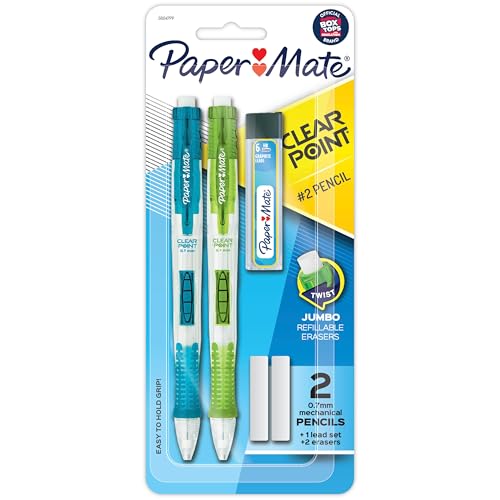
Paper Mate Clearpoint Mechanical Pencils, 0.7mm, 2-Pack
by Paper Mate
Best everyday writing pencil — the side-advance button and jumbo twist eraser solve the two most common mechanical pencil frustrations in a comfortable, affordable package.
Pros
- Side-advance button lets you extend lead without shifting your grip to the top of the pencil — the fastest lead advancement mechanism on this list for sustained writing
- Jumbo twist-up eraser is genuinely functional for correction work, unlike the decorative micro-erasers found under the caps of most mechanical pencils
- Transparent barrel lets you see remaining lead supply at a glance — a simple feature that prevents the mid-sentence empty-click interruption common with opaque barrels
- Soft rubber grip is the most comfortable option on this list for writers who prioritize cushioned hand contact during sessions longer than one hour
Cons
- All-plastic construction is durable for everyday use but lacks the premium weight and balance of metal-bodied alternatives
- Side-advance button can accidentally extend lead when the pencil shifts in a bag or pencil case
- Tip is not retractable — the lead sleeve is always exposed
How to Choose the Best Mechanical Pencil
Buyer's Guide
Selecting the right mechanical pencil requires matching the pencil's lead size, body weight, grip texture, and advance mechanism to your primary use case — the wrong combination in any dimension turns a precision writing tool into a source of daily frustration.
Lead Size
Lead size is the single most consequential specification in a mechanical pencil because it determines line width, break resistance, and the range of tasks the pencil can handle. The 0.5mm size is the most versatile and popular — it produces lines fine enough for detailed notation and marginalia while being thick enough to resist breakage under moderate writing pressure. The 0.7mm size is the standard recommendation for general writing, student use, and standardized test forms: the thicker lead breaks less frequently, produces bolder lines that scan more reliably, and requires less precision in your grip angle. For technical drafting, architecture, and engineering, 0.3mm and 0.5mm are standard — the Pentel GraphGear 1000 and GraphGear 500 both feature 4mm fixed sleeves designed specifically for ruler and template work at these sizes. For sketching and illustration, 2.0mm lead holders provide the variable line weight that thin mechanical leads cannot. If you are buying one mechanical pencil for general use, 0.5mm is the correct starting point.
Grip Type and Comfort
Grip design determines how the pencil feels during the first minute and the sixtieth minute of continuous writing — and the two experiences often diverge. Knurled metal grips (rOtring 600, Staedtler 925 25) provide the most secure finger traction regardless of hand moisture or grip pressure, making them the preferred choice for drafting and technical work where precise control matters more than cushioned comfort. The tradeoff is that aggressive knurling can create pressure points against the fingertip pad during extended sessions. Rubber and silicone grips (BIC Xtra Smooth, Paper Mate Clearpoint) prioritize cushioned comfort and are more forgiving for casual writing, note-taking, and long lecture sessions where grip fatigue accumulates. Metallic mesh grips (Pentel GraphGear 500) split the difference — they provide drafting-grade traction at a weight lighter than solid metal. The best test is duration-specific: if your typical writing session is under thirty minutes, grip material matters less than lead size and mechanism. If you write for hours continuously, grip design becomes the primary comfort variable.
Body Material and Durability
Body material determines weight, balance, tactile feedback, and service life. All-metal pencils (rOtring 600, Staedtler 925 25) are the heaviest, most durable, and most expensive tier — a quality metal pencil will outlast a decade of daily use with zero degradation in mechanism precision or cosmetic condition. The weight of a metal body also provides natural line-weight control: the pencil's own mass applies consistent downward pressure, reducing the grip force required from your hand. Metal-grip-with-polymer-body pencils (Pentel GraphGear 500, Uni Kuru Toga Roulette) offer a middle path — the grip section provides the weight and traction of metal where it matters while the polymer barrel keeps total weight moderate for all-day comfort. All-plastic pencils (BIC Xtra Smooth, Paper Mate Clearpoint) are the lightest option and the correct choice for high-volume, low-cost applications: classrooms, shared offices, conference rooms, and any environment where pencils circulate rather than staying with one user.
Lead Advance Mechanism
The mechanism that extends lead determines how often your writing flow is interrupted and how precisely you can control lead extension. Standard push-button click is the most common mechanism and the most universally reliable — you click the top of the pencil to advance lead in fixed increments. Side-advance buttons (Paper Mate Clearpoint) allow lead extension without shifting your grip from writing position to the pencil top, which reduces writing interruptions for fast note-takers. The Pentel GraphGear 1000's dual-action retractor adds a second function: clicking both advances lead and retracts the entire tip assembly into the barrel for pocket protection. The Uni Kuru Toga adds auto-rotation on top of standard click advance — the lead rotates with each stroke to maintain a uniform point. The mechanism you choose should match your primary frustration: if you dislike reaching for the top button, choose side-advance. If you want pocket protection without a cap, choose the GraphGear 1000's retractor.
Retractable Tip Protection
Whether the pencil's lead sleeve retracts into the barrel when not in use is a binary feature with significant practical consequences for anyone who carries a mechanical pencil in a pocket, bag, or pencil case. Fixed-sleeve pencils (rOtring 600, Staedtler 925 25, Pentel GraphGear 500) have exposed metal tips at all times — they can poke through fabric, scratch adjacent items, and the thin metal sleeve bends permanently if the pencil is dropped on its tip. The Pentel GraphGear 1000 solves this with its dual-action retractor: one click retracts the entire sleeve into the barrel, creating a smooth, pocketable profile. If your mechanical pencil travels in a shirt pocket or a bag without a dedicated case, retractable tip protection prevents the most common form of mechanical pencil damage. If your pencil lives on your desk in a cup or tray, tip retraction is a convenience rather than a necessity.
Lead Break Protection
Lead breakage is the most frequently cited frustration with mechanical pencils, and different manufacturers address it through fundamentally different engineering approaches. The Staedtler 925 25's cushion lead mechanism uses an internal spring that absorbs sudden downward pressure spikes — when you press harder than the lead can support, the spring compresses before the lead snaps. The Uni Kuru Toga's auto-rotation addresses breakage from a different angle: by rotating the lead continuously, it prevents the flat chisel wear pattern that creates a thin, breakage-prone edge on one side of the lead. For most users, pairing a cushion-lead or rotation mechanism with 0.7mm HB lead produces a functionally break-proof experience. If you write with heavy pressure and have been frustrated by constant lead snapping, prioritize a dedicated break-protection mechanism over other features.
Final Verdict
For most writers, students, and professionals choosing a single mechanical pencil in 2026, the Pentel GraphGear 1000 is the best starting point. Its metal body, retractable tip, and 4mm drafting sleeve deliver a combination of features that no other pencil matches at any price — and at under ten dollars, it represents exceptional value backed by over 24,000 verified reviews. It handles everything from casual note-taking to precise drafting work without requiring you to own multiple pencils for different tasks.
For classrooms, offices, and any environment where pencils need to be available in quantity, the BIC Xtra Smooth 40-pack is the unambiguous choice — the highest-rated mechanical pencil on Amazon at under twenty-five cents per unit.
For professionals who want the reference-standard mechanical pencil and plan to use it daily for years, the rOtring 600 is the investment that rewards sustained use: German-engineered brass mechanism, hexagonal no-roll barrel, and build quality that outlasts everything else on this list by a significant margin. For writers who fill pages continuously and want consistently sharp lines without manually rotating their pencil, the Uni Kuru Toga Roulette is the most innovative writing tool on this list — its patented auto-rotation is a feature you will not want to give up once you have experienced it. Whatever pencil you select, pair it with the correct lead size and grade for your primary task — and set up your full workstation ergonomics while you are at it, including a properly adjusted standing desk or ergonomic keyboard if you alternate between digital and analog work throughout the day. Lead selection affects your daily writing experience at least as much as the pencil body that holds it.
Frequently Asked Questions
What lead size is best for writing versus drawing?
How do I stop my mechanical pencil lead from breaking?
What is the Kuru Toga rotating mechanism and is it worth it?
Are expensive mechanical pencils worth the price over cheap ones?
What is the difference between HB, B, and H lead grades?
Related Articles
About the Reviewer

Sarah Chen, CAP, PMP
B.A. Business Administration, UCLA
Sarah Chen spent 10 years in office management and operations at Fortune 500 companies before founding DeskRated in 2026. After managing supply budgets for teams of 50+ people and testing thousands of products through daily use, she started writing the honest, no-fluff supply reviews that office professionals actually need. Sarah holds both CAP and PMP certifications and is based in Los Angeles.