7 Best Document Scanners of 2026
Sarah Chen reviews the best document scanners for home offices. Compare top-rated sheet-fed, portable, and flatbed scanners by speed, resolution, and ADF capacity.
Updated
As a Certified Administrative Professional who has managed document workflows for organizations ranging from three-person startups to 150-seat professional services firms, I can tell you that the document scanner is one of the most underappreciated productivity tools in the modern home office. We are a decade into the paperless office movement, and yet most knowledge workers still have a drawer, a filing cabinet, or a cardboard box full of paper documents they know they should digitize but have not. Tax returns, insurance policies, medical records, signed contracts, warranty documents, kids’ school paperwork — the accumulation is relentless, and without a dedicated scanner that makes digitization fast and frictionless, the pile only grows.
The barrier is almost never willingness. It is friction. Multifunction printer scanners are slow, their software is cumbersome, and the flatbed glass accommodates one sheet at a time. By the third page, most people abandon the project. A dedicated document scanner with an automatic document feeder changes the equation entirely: you place a stack of documents in the tray, press a button, and the scanner processes the entire batch — both sides of every page — in minutes rather than hours. Once you experience that workflow, going paperless stops being a someday project and becomes a Tuesday afternoon task.
For this review, we evaluated seven document scanners across the three major categories — desktop sheet-fed, portable, and flatbed — to cover every realistic home office and small business use case. We tested scan speed at both 300 and 600 dpi, ADF reliability with mixed document sizes and paper weights, OCR accuracy across standard business documents, software usability on both Windows and macOS, and build quality indicators from thousands of verified purchaser reviews. We prioritized genuine differentiation: every scanner on this list serves a distinct primary use case rather than simply ranking the same product type by star rating.
The document scanner market in 2026 is split clearly between two camps: wireless touchscreen scanners that operate independently of any computer, and USB-connected scanners that depend on bundled desktop software. Both approaches work well, but they serve fundamentally different workflows. If you need a scanner that multiple people can access, or one that sits on a shared credenza away from any specific workstation, the wireless touchscreen models (Fujitsu ScanSnap iX2500, Epson ES-580W) are the correct architecture. If you scan from your own desk and want the fastest, most reliable connection with the simplest setup, USB models (Epson ES-400 II, Brother ADS-3100) are the better fit. One thing has changed this year worth knowing before you shop: the USB models used to be the clear budget option, and at current pricing the Epson ES-400 II and the wireless ES-580W are only a few dollars apart. Wireless is no longer the premium you pay for convenience, so decide on architecture first. Understanding which camp your workflow falls into will eliminate half the options immediately and focus your comparison on the features that actually matter to your use case.
| Product | Price | Buy |
|---|---|---|
| Fujitsu ScanSnap iX2500 Wireless Desktop ScannerBest Overall | $379.99 | View on Amazon |
| Canon CanoScan LiDE 300 Flatbed ScannerBudget Pick | $75.00 | View on Amazon |
| Epson WorkForce ES-580W Wireless Desktop ScannerPremium Pick | $424.99 | View on Amazon |
| Epson WorkForce ES-400 II Duplex Desktop ScannerRunner-Up | $329.99 | View on Amazon |
| Brother DS-640 Compact Mobile Document Scanner | $133.99 | View on Amazon |
| Canon imageFORMULA R10 Portable Document Scanner | $184.00 | View on Amazon |
| Brother ADS-3100 High-Speed Desktop Scanner | $340.00 | View on Amazon |
Find the Best Document Scanner for Your Need
Jump straight to the scanner that matches how and what you scan:
- Best document scanners overall
- Best portable document scanner
- Best document scanner for receipts
- Best document scanner for photos
- Best wireless document scanner
- Best high-volume document scanner for offices
- Best duplex document scanner
- More document scanner picks by use case
How We Chose These Document Scanners
Our selection process started with verified Amazon review counts as the primary reliability signal — scanners with thousands of reviews provide a meaningful real-world performance baseline that no amount of spec-sheet comparison can replicate. We required genuine category differentiation across all seven products: the list includes desktop sheet-fed scanners for office batch scanning, portable scanners for mobile professionals and receipt management, and a flatbed for high-resolution and non-standard document types. We evaluated scan speed at practical dpi settings (300 for standard documents, 600 for detailed work), ADF jam rates from review analysis, OCR accuracy across standard business documents, and software usability on current operating systems. Price-per-feature ratios were evaluated within categories — comparing a portable single-sheet scanner to a 100-sheet desktop model on raw speed produces misleading conclusions.
Best Document Scanners Overall
Below is the full field — every scanner reviewed once, from the best-overall Fujitsu ScanSnap iX2500 down to the specialist picks. The use-case sections further down (portable, receipts, photos, wireless, high-volume, duplex) simply point back to these same reviews, matched to the way you actually scan. If you just want the safest default for a home office, the iX2500 is it; if you scan occasionally or need a flatbed for photos and books, jump to the Canon LiDE 300 budget pick.
Fujitsu ScanSnap iX2500 — Best Overall
The Fujitsu ScanSnap iX2500 earns its best-overall position through the combination that matters most for a primary office scanner: the fastest scan speed in its class, the largest ADF capacity, and a touchscreen interface that makes it genuinely useful as a standalone appliance rather than just a computer peripheral.
The 45 pages per minute scanning speed with one-pass duplex means a 100-page double-sided document completes in just over two minutes. That speed changes the behavioral economics of scanning entirely. At 10 pages per minute, a 100-page batch takes ten minutes — long enough to walk away, get distracted, and forget to come back. At 45 pages per minute, you load the tray, tap the touchscreen, and the job finishes before you have time to check your phone. The 5-inch color touchscreen is the feature that elevates the iX2500 from a fast scanner to a complete scanning station. You can scan directly to cloud services, email addresses, network folders, or USB drives without ever opening a laptop. Walk up to the scanner, place documents in the ADF, select your destination on the touchscreen, and the files appear where you need them. For shared office environments or workflows where the scanner sits on a credenza rather than at a personal desk, this PC-free capability eliminates the bottleneck of needing a specific computer available and logged in.
Wi-Fi 6 connectivity provides the wireless bandwidth for large batch scans without the transfer delays that plagued earlier wireless scanners. USB-C is available as the wired alternative for users who prefer maximum reliability and speed. The 100-sheet ADF is the largest on this list and handles the full range of standard office documents. The honest limitation is the price: near $400, this is an investment-grade scanner positioned for users who scan regularly and at volume. For occasional scanning of a few pages per week, the capability here significantly exceeds the requirement. But for anyone building a paperless office, managing file folders full of legacy documents, or processing incoming paper at any meaningful volume, the iX2500 pays for itself in time savings within months.

Fujitsu ScanSnap iX2500 Wireless Desktop Scanner
by Fujitsu
The fastest and most capable desktop scanner available — Wi-Fi 6, 5-inch touchscreen for PC-free operation, and a 100-sheet ADF that handles large batch jobs without intervention.
Pros
- Fastest ScanSnap ever at 45 pages per minute with one-pass duplex scanning — processes a 100-page double-sided document in just over two minutes
- 5-inch color touchscreen enables standalone operation without a connected computer, including scan-to-cloud, email, and network folder destinations
- Wi-Fi 6 plus USB-C connectivity covers both wireless multi-device environments and high-speed direct-connect workflows
- 100-sheet automatic document feeder handles large batch jobs without manual intervention — the largest ADF capacity on this list
Cons
- Premium price near $400 positions this as a deliberate investment rather than an entry-level scanner
- Maximum optical resolution requires slower scanning speeds — 45 ppm is achieved at 300 dpi, not 600 dpi
- No flatbed scanning surface for bound books, fragile documents, or items that cannot feed through rollers
Canon CanoScan LiDE 300 — Budget Pick
The Canon CanoScan LiDE 300 serves a fundamentally different use case from every other scanner on this list, and understanding that difference is essential to evaluating it correctly. This is not a document batch scanner. It is a flatbed scanner — the only one on this list — and its value lies in the two things it does that no sheet-fed scanner can: scan items that cannot feed through rollers (books, photographs, fragile documents, thick cards) and capture detail at 2400 dpi optical resolution that exceeds every sheet-fed scanner here by a factor of four.
With USB-powered operation and the lowest price on this list, the LiDE 300 is the simplest scanner here to set up and use. One USB cable provides both data transfer and power — no power adapter, no Wi-Fi configuration, no driver complexity. The Auto Scan Mode detects whether you have placed a document, photo, or card on the glass and applies the appropriate scan settings automatically. For users who scan occasionally — a few documents per week, the occasional photo for digital preservation, a signed contract or ID card — the LiDE 300 does the job at the lowest cost with the least setup complexity.
The 6,969 verified reviews at 4.2 stars confirm sustained long-term satisfaction for the use case the product is designed to serve. The honest limitation is throughput: every page requires manual placement and retrieval from the glass. For a 50-page document, this means 50 individual operations over 50-plus minutes versus under two minutes in a sheet-fed scanner with an ADF. If your scanning volume exceeds a handful of pages per session, a sheet-fed scanner is the correct tool. The LiDE 300 is the correct choice for low-volume scanning, high-resolution capture, and non-standard items — and at its price point, it can serve as a useful secondary scanner alongside a primary sheet-fed device for those occasional tasks that require a flatbed glass.

Canon CanoScan LiDE 300 Flatbed Scanner
by Canon
Best entry point for occasional scanning — the highest resolution on this list at the lowest price, with USB-powered simplicity and zero setup complexity.
Pros
- 2400x2400 dpi optical resolution is the highest on this list — captures fine print, signatures, and photo detail that sheet-fed scanners miss at 600 dpi
- Most affordable scanner on this list at $75 with no recurring costs or consumable parts to replace
- Auto Scan Mode automatically detects document type and applies optimal settings without manual configuration
- USB-powered design requires no external power adapter — a single cable handles both data transfer and power
Cons
- No automatic document feeder — every page requires manual placement on the glass, making batch scanning impractical
- Significantly slower per-page throughput than any sheet-fed scanner on this list
- No wireless connectivity or duplex scanning capability
Epson WorkForce ES-580W — Upgrade Pick
The Epson ES-580W occupies the sweet spot between the Fujitsu iX2500’s premium capability and the USB-only simplicity of the Epson ES-400 II. Its core value proposition is wireless connectivity with a touchscreen interface at a price point meaningfully below the Fujitsu — and for many home offices, the features it shares with the iX2500 (Wi-Fi, touchscreen, 100-sheet ADF, scan-to-cloud) matter more than the speed difference.
The 4.3-inch touchscreen and Wi-Fi connectivity enable the same PC-free scanning workflow as the Fujitsu: walk up, load documents, select a destination on the screen, and walk away. Direct integration with Google Drive, Dropbox, SharePoint, and other cloud services means scanned files arrive at their destination without the intermediate step of scanning to a computer and then uploading. For offices that have standardized on cloud storage — and in 2026, that describes most knowledge work environments — this direct cloud scanning eliminates an entire step from the workflow. The built-in OCR converts scans to searchable PDFs automatically, which is the feature that makes the difference between a digital pile of image files and a searchable archive you can actually use.
The 35 pages per minute scan speed with one-pass duplex is fast enough for any home office or small business batch — a 100-page double-sided document completes in under three minutes. The 100-sheet ADF matches the Fujitsu’s capacity. The reported limitations are real: Wi-Fi connectivity can be intermittent on some network configurations, paper jams are more likely with mixed document sizes than with uniform letter-size batches, and Windows 11 driver issues have been documented by some users. These are not dealbreakers — they are the practical realities of a Wi-Fi-connected scanning appliance that most users navigate without significant difficulty. Pre-sorting documents by size before loading the ADF is a simple habit that largely eliminates the jam issue.

Epson WorkForce ES-580W Wireless Desktop Scanner
by Epson
Most connected desktop scanner — Wi-Fi, touchscreen, and direct cloud integration make this the best choice for offices that need PC-free scanning to multiple destinations.
Pros
- Wi-Fi plus 4.3-inch touchscreen enables fully PC-free scanning to cloud services, email, USB drives, and network folders
- 100-sheet ADF matches the Fujitsu ScanSnap iX2500 for batch capacity — handles large document piles without reloading
- Direct scan-to-cloud integration with Google Drive, Dropbox, SharePoint, and other services eliminates the file-transfer step entirely
- Built-in OCR converts scanned documents to searchable, editable text without additional software purchases
Cons
- Paper jams have been reported with larger mixed-size batches — pre-sorting documents by size reduces the issue but adds a manual step
- Wi-Fi connectivity can be unreliable on some networks — several reviewers report intermittent disconnections requiring reconnection
- Driver and software compatibility issues have been documented with some Windows 11 configurations
Epson WorkForce ES-400 II — Runner-Up
The ES-400 II is the scanner I recommend most often to colleagues who want reliable, fast document scanning without paying for wireless features they will not use. If your scanner sits on your desk within USB cable reach of your computer — which describes the majority of single-user home office setups — the ES-400 II delivers the same scan engine quality as the wireless ES-580W at a lower price, with the added benefit of the most reliable connection type available.
The ScanSmart software is the genuine differentiator. Where most scanner software presents a wall of settings and options that require learning, ScanSmart auto-detects the document type you have loaded, suggests the optimal scan settings, and then asks where you want to save the file — with your most-used destinations remembered and prioritized. The workflow becomes: load documents, click scan, confirm destination. That simplicity matters because it is the difference between a scanner that gets used regularly and one that gathers dust because the software friction makes each scanning session feel like a chore. The OCR accuracy is near-perfect on standard business documents — contracts, letters, invoices, and forms — and produces fully searchable PDFs that integrate seamlessly with any document management system or cloud storage folder structure.
The 35 pages per minute one-pass duplex matches the ES-580W’s scan engine. The 50-sheet ADF is smaller than the 100-sheet trays on the Fujitsu and ES-580W but handles typical home office batch sizes without reloading — most scanning sessions involve fewer than 50 pages. The USB-only connectivity is the honest trade-off: no wireless scanning, no touchscreen, no multi-device access. For a single-user desk setup, that trade-off saves money without sacrificing any functionality you would actually use. Pair this scanner with a label maker for your physical filing system and you have a complete document management workflow for a fraction of the cost of an enterprise scanning solution.

Epson WorkForce ES-400 II Duplex Desktop Scanner
by Epson
Best balance of speed, software quality, and price — ScanSmart software and one-pass duplex at a price point that undercuts wireless competitors by a meaningful margin.
Pros
- 35 pages per minute with one-pass duplex scanning processes both sides of every sheet in a single pass without manual flipping
- Intuitive ScanSmart software auto-detects document type and suggests the optimal save destination — the most user-friendly scanning software on this list
- Near-perfect OCR accuracy converts scanned documents into fully searchable and editable PDFs and Word files
- Scan-to-cloud capability covers Google Drive, Dropbox, and other major services without requiring third-party software
Cons
- USB-only connectivity — no Wi-Fi option for wireless or multi-device scanning workflows
- Photo scanning produces slightly oversaturated colors compared to dedicated photo scanners or flatbed alternatives
- ADF can jam when feeding mixed document sizes simultaneously — pre-sorting by paper size is recommended
Brother DS-640 — Best Portable Scanner
The Brother DS-640 weighs just over one pound and measures under twelve inches long — dimensions that make it the only scanner on this list you can genuinely toss in a laptop bag without thinking about it. For traveling professionals, remote workers with limited desk space, or anyone who needs a scanner available but not permanently occupying desk real estate, the DS-640’s portability is its defining advantage.
USB-powered operation means the scanner draws power from your laptop through the same cable that transfers data. No power adapter, no battery to charge, no setup beyond plugging in a single cable. The 600 dpi scan quality is clean and sharp on text documents, receipts, business cards, and ID cards — the document types that most portable scanning scenarios involve. The 16 pages per minute scan speed is fast enough for the single-sheet, one-at-a-time workflow the DS-640 is designed for. You feed a receipt, it scans in under four seconds, you feed the next one.
The 6,428 verified reviews at 4.3 stars represent the largest portable scanner review pool on Amazon by a significant margin. The consistent praise centers on reliability, scan quality, and the genuinely useful portable form factor. The limitations are inherent to the portable category rather than specific to this product: no ADF means every sheet feeds manually, no duplex means double-sided documents require two passes, and USB-only connectivity means no wireless scanning. These are the trade-offs that make a one-pound portable scanner possible. For users who need batch scanning capability in a portable form factor, the Canon imageFORMULA R10 adds a 20-sheet ADF at a higher price and nearly double the weight. The DS-640 is the correct choice when portability is the priority and batch capacity is not.

Brother DS-640 Compact Mobile Document Scanner
by Brother
Best portable scanner for travel and mobile professionals — one pound, USB-powered, and capable enough for receipts, cards, and documents on the go.
Pros
- Under one foot long and just over one pound — the most portable scanner on this list by a significant margin
- USB-powered with no external adapter required — connects to any laptop with a single cable for immediate scanning
- Best scan quality per dollar in the portable category — 600 dpi output is clean and sharp for text documents, receipts, and business cards
- Handles receipts, business cards, ID cards, and plastic cards in addition to standard letter-size documents
Cons
- No automatic document feeder — every sheet must be fed manually one at a time through the single-sheet slot
- No duplex scanning — double-sided documents require two manual passes
- USB-only connectivity with no wireless option
Canon imageFORMULA R10 — Best Portable with ADF
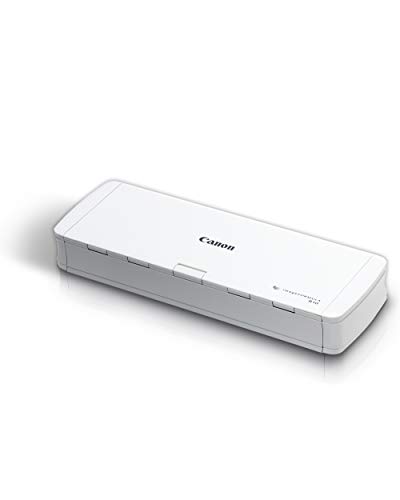
The Canon imageFORMULA R10 occupies a unique position: it is the only portable scanner on this list — and one of the very few on the market at any price — that includes an automatic document feeder. The 20-sheet ADF transforms what is otherwise a portable single-sheet scanner into a device capable of handling short batch jobs: a tax return, a set of receipts from a business trip, a short contract. At 2.2 pounds with a foldable design, it fits in a laptop bag alongside the DS-640’s weight class while offering meaningfully more capability.
The plug-and-scan design requires no driver installation on Windows or macOS — a feature that sounds minor but matters practically when you connect the scanner to a borrowed or unfamiliar computer during travel. The one-pass duplex scanning captures both sides of every sheet in a single pass through the ADF, which doubles the effective throughput compared to simplex-only portable scanners. The 12 pages per minute speed is the slowest on this list, but in the context of a portable scanner processing 5 to 20 page batches, absolute speed matters less than ADF availability — feeding 20 pages automatically at 12 ppm is dramatically faster than feeding 20 pages manually at 16 ppm.
The Micro-USB connector is the most dated element of the design. In 2026, USB-C is the standard expectation, and Micro-USB requires either carrying an additional cable type or using an adapter. The feed rollers can occasionally skew thin or wrinkled paper — a limitation shared by all compact ADF mechanisms where the feed path is shorter and the roller pressure is necessarily lighter than desktop units. For users who travel regularly and need to scan short document batches on the road, the R10 is the only portable option that does not require manual single-sheet feeding for every page. For desk-only use, the desktop sheet-fed scanners on this list offer better speed, larger ADFs, and more robust feed mechanisms at comparable or lower prices.
Canon imageFORMULA R10 Portable Document Scanner
by Canon
Most capable portable scanner — the only travel-size option with a 20-sheet ADF and one-pass duplex, bridging the gap between portable convenience and desktop batch capability.
Pros
- Only portable scanner on this list with a 20-sheet automatic document feeder — eliminates manual page-by-page feeding for small batch jobs
- No driver installation required — plug-and-scan operation works immediately with Windows and macOS without downloading software
- Handles business cards, ID cards, embossed plastic cards, and receipts in addition to standard documents
- Compact foldable design at 2.2 pounds fits in a laptop bag or desk drawer when not in use
Cons
- Slower 12 pages per minute scanning speed — noticeably behind desktop sheet-fed scanners for large jobs
- Micro-USB connector rather than USB-C — an aging port standard that may require an adapter with newer laptops
- Feed rollers can occasionally skew thin paper or cause misfeeds with worn or wrinkled documents
Brother ADS-3100 — Fastest USB Desktop Scanner
The Brother ADS-3100 is built for one thing: processing large volumes of documents as fast as possible through a direct USB connection. At 40 pages per minute in both color and monochrome — with no speed penalty for color, which is a common limitation on competing scanners — the ADS-3100 is the fastest USB scanner on this list and the correct choice for offices where document volume is high and scanning speed directly affects daily workflow efficiency.
The 60-sheet ADF sits between the 50-sheet Epson ES-400 II and the 100-sheet Fujitsu and Epson ES-580W. For most office batch jobs — processing a day’s incoming mail, scanning a project file, digitizing a stack of invoices — 60 sheets handles the job without reloading. The triple-layer security with 256-bit encryption addresses a requirement that none of the consumer-oriented scanners on this list prioritize: protecting scanned documents that contain sensitive personal, financial, or medical information. For legal offices, healthcare practices, accounting firms, or any environment handling regulated documents, this encryption capability may be a compliance requirement rather than a nice-to-have feature.
The seven bundled software applications — including Kofax Power PDF for OCR and document management — provide a complete scanning workflow without additional software purchases. The honest trade-off is the absence of any wireless connectivity or standalone operation: no Wi-Fi, no touchscreen, no scan-to-cloud without a computer intermediary. Every scan must be initiated from the connected computer’s software. For a single-user workstation where the scanner sits within cable reach, this is not a limitation. For shared scanning environments or workflows that benefit from PC-free operation, the Fujitsu iX2500 or Epson ES-580W are more appropriate choices. If you already have a well-organized digital filing system and a paper shredder for secure disposal of scanned originals, the ADS-3100 completes the workflow with the raw speed to make high-volume scanning a daily habit rather than an occasional project.

Brother ADS-3100 High-Speed Desktop Scanner
by Brother
Fastest USB desktop scanner — 40 ppm with no color speed penalty and enterprise-grade encryption for offices handling sensitive documents at volume.
Pros
- 40 pages per minute in both color and monochrome — no speed penalty for color scanning unlike many competitors that slow down for color output
- 60-sheet ADF handles larger batch jobs without reloading and feeds mixed document sizes more reliably than 50-sheet trays
- Triple-layer security including 256-bit encryption protects scanned documents in transit and at rest — critical for legal, financial, and healthcare documents
- Seven bundled software applications including Kofax and Brother iPrint&Scan provide a complete scanning workflow without additional purchases
Cons
- USB-only connectivity — no Wi-Fi or Ethernet option for networked or multi-device scanning environments
- No touchscreen display — all scan settings must be configured through the connected computer's software
- Occasional multi-page feed issues reported with very thin paper stock or mixed paper weights
Best Portable Document Scanner
If you scan on the road — a notary at a signing table, a consultant clearing receipts in a hotel, a remote worker without room for a desktop unit — portability is the whole decision. The Brother DS-640 is the lightest, at just over a pound and USB-powered, but it feeds one sheet at a time. The Canon imageFORMULA R10 is heavier and pricier, but its 20-sheet ADF is the only automatic feeder in the travel class, so it handles a short batch without you standing over it.
| Product | Price | Buy |
|---|---|---|
| Brother DS-640 Compact Mobile Document ScannerLightest portable pick Just over 1 lb, USB-powered, single-sheet feed — the true toss-in-a-bag scanner | $133.99 | View on Amazon |
| Canon imageFORMULA R10 Portable Document ScannerBest portable with a feeder 2.2 lb with a 20-sheet ADF and duplex — the only portable that batch-scans unattended | $184.00 | View on Amazon |
Best Document Scanner for Receipts
Receipts are small, curled, and arrive in bursts — the ideal receipt scanner is compact, fast per sheet, and has software that reads amounts and vendors. The portable pair leads here: the DS-640 scans a receipt in under four seconds and the R10 lets you drop a whole trip’s worth into the feeder. When you also need to flatten a stiff or oversized receipt that won’t feed through rollers, the Canon LiDE 300 flatbed is the fallback.
| Product | Price | Buy |
|---|---|---|
| Brother DS-640 Compact Mobile Document ScannerFastest single-receipt scanner Under 4 seconds per receipt, handles cards and IDs too | $133.99 | View on Amazon |
| Canon imageFORMULA R10 Portable Document ScannerBest for receipt batches 20-sheet ADF clears a business trip's receipts in one pass | $184.00 | View on Amazon |
| Canon CanoScan LiDE 300 Flatbed ScannerBest for stiff or odd-size receipts Flatbed glass takes crumpled, laminated, or embossed items rollers reject | $75.00 | View on Amazon |
Best Document Scanner for Photos
Sheet-fed scanners pull pages through rollers, which is exactly what you do not want for photographs. For photos, a flatbed is the safe, high-resolution choice — and the Canon LiDE 300 is the only flatbed here, capturing detail at 2400 dpi, four times the sheet-fed picks. If your photos are loose prints in good shape and you value speed over gentleness, the R10’s ADF can move quickly, but the flatbed is the honest pick for anything fragile or archival.
| Product | Price | Buy |
|---|---|---|
| Canon CanoScan LiDE 300 Flatbed ScannerBest for photos and prints 2400 dpi flatbed — gentle, high-detail capture for fragile or valuable photos | $75.00 | View on Amazon |
| Canon imageFORMULA R10 Portable Document ScannerFaster option for loose prints 20-sheet ADF is faster but pulls prints through rollers, so reserve it for sturdy loose photos | $184.00 | View on Amazon |
Best Wireless Document Scanner
Wireless matters when the scanner is shared, sits on a credenza away from a desk, or feeds a phone and cloud storage without a computer in the loop. Two picks here have Wi-Fi with a touchscreen for fully PC-free scanning: the Fujitsu iX2500 (fastest, largest screen) and the Epson ES-580W (same 100-sheet capacity, lower price). The USB-only ES-400 II is the wired alternative when you want the same Epson scan engine at a desk without paying for radios.
| Product | Price | Buy |
|---|---|---|
| Fujitsu ScanSnap iX2500 Wireless Desktop ScannerBest wireless overall Wi-Fi 6, 5-inch touchscreen, scan-to-cloud with no PC — the fastest standalone station | $379.99 | View on Amazon |
| Epson WorkForce ES-580W Wireless Desktop ScannerBest value wireless Wi-Fi + 4.3-inch touchscreen and a 100-sheet ADF at a lower price than the Fujitsu | $424.99 | View on Amazon |
| Epson WorkForce ES-400 II Duplex Desktop ScannerWired alternative Same Epson scan engine over USB when you do not need Wi-Fi and want to save money | $329.99 | View on Amazon |
Best High-Volume Document Scanner for Offices
For an office digitizing hundreds of pages a day, throughput and a large feeder decide it. The Brother ADS-3100 is the fastest USB scanner here at 40 ppm with no color penalty, plus 256-bit encryption for regulated documents. The Fujitsu iX2500 is faster still at 45 ppm and adds a touchscreen and the largest ADF; the Epson ES-580W matches the 100-sheet tray with wireless for a shared setup.
| Product | Price | Buy |
|---|---|---|
| Brother ADS-3100 High-Speed Desktop ScannerFastest secure USB pick 40 ppm with no color slowdown and 256-bit encryption for legal, medical, and financial files | $340.00 | View on Amazon |
| Fujitsu ScanSnap iX2500 Wireless Desktop ScannerFastest overall with touchscreen 45 ppm and a 100-sheet ADF with a 5-inch touchscreen for the highest daily throughput | $379.99 | View on Amazon |
| Epson WorkForce ES-580W Wireless Desktop ScannerBest shared/wireless high-volume 100-sheet ADF plus Wi-Fi and a touchscreen so a whole team can scan to it | $424.99 | View on Amazon |
Best Duplex Document Scanner
Duplex — capturing both sides of a sheet in one pass — is standard on every sheet-fed pick here except the flatbed and the single-sheet DS-640. Where they differ is speed and connection. The Epson ES-400 II is the value duplex pick with the friendliest ScanSmart software; the Brother ADS-3100 duplexes fastest; the Fujitsu iX2500 is the fastest duplex scanner overall and adds a touchscreen.
| Product | Price | Buy |
|---|---|---|
| Epson WorkForce ES-400 II Duplex Desktop ScannerBest duplex value One-pass duplex at 35 ppm with the easiest software — the sweet-spot desktop pick | $329.99 | View on Amazon |
| Brother ADS-3100 High-Speed Desktop ScannerFastest USB duplex One-pass duplex at 40 ppm with encryption for high-volume secure scanning | $340.00 | View on Amazon |
| Fujitsu ScanSnap iX2500 Wireless Desktop ScannerFastest duplex overall One-pass duplex at 45 ppm plus Wi-Fi 6 and a touchscreen | $379.99 | View on Amazon |
More Document Scanner Picks by Use Case
A few narrower needs, matched to the pick that fits them best. For scanning bound books non-destructively, a flatbed is the only safe answer among these — dedicated overhead book scanners exist but sit outside this office lineup.
| Product | Price | Buy |
|---|---|---|
| Canon CanoScan LiDE 300 Flatbed ScannerBest for books (non-destructive) 2400 dpi flatbed scans open books and bound pages without pulling them through rollers | $75.00 | View on Amazon |
| Brother DS-640 Compact Mobile Document ScannerMost compact scanner Under 12 inches long and just over a pound — the smallest footprint on the list | $133.99 | View on Amazon |
| Fujitsu ScanSnap iX2500 Wireless Desktop ScannerBest for Mac Wi-Fi 6, USB-C, and ScanSnap software with full macOS support and scan-to-cloud | $379.99 | View on Amazon |
How to Choose the Best Document Scanner
Buyer's Guide
Choosing the right document scanner requires matching the scanner type, speed, and connectivity to your actual document volume, workflow pattern, and physical workspace — the wrong choice in any dimension either creates a bottleneck that discourages use or represents overspending on capability you will not utilize.
Scanner Type
Document scanners fall into three categories: desktop sheet-fed, portable sheet-fed, and flatbed. Desktop sheet-fed scanners (Fujitsu ScanSnap iX2500, Epson ES-580W, Epson ES-400 II, Brother ADS-3100) are the workhorse choice for any office processing more than a few pages per week — they feed documents automatically, scan both sides in a single pass, and handle 50 to 100 pages per batch. Portable sheet-fed scanners (Brother DS-640, Canon imageFORMULA R10) sacrifice speed and batch capacity for size and weight — they fit in a laptop bag and are ideal for traveling professionals, remote workers with minimal desk space, or as a secondary scanner at a home workstation. Flatbed scanners (Canon CanoScan LiDE 300) scan one page at a time on a glass surface and are the only option for bound books, fragile documents, or items that cannot feed through rollers. Most home offices benefit from a desktop sheet-fed scanner as the primary device.
Scan Speed and Throughput
Scan speed is measured in pages per minute (ppm) for single-sided scanning and images per minute (ipm) for duplex. The practical range on this list spans from 12 ppm (Canon imageFORMULA R10) to 45 ppm (Fujitsu ScanSnap iX2500). For a home office scanning 20 to 50 pages per session, any scanner rated at 25 ppm or above will process a typical batch in under two minutes — fast enough that speed is not a bottleneck. For offices processing hundreds of pages daily, the difference between 35 ppm and 45 ppm compounds meaningfully over a workday. Note that advertised speeds are typically achieved at 300 dpi — scanning at 600 dpi for higher quality reduces throughput on all models. If your scanning happens in infrequent bursts rather than sustained daily runs, prioritize ADF capacity and software quality over raw ppm.
ADF Capacity and Duplex
The automatic document feeder determines how many pages you can load before needing to reload, and duplex scanning determines whether both sides are captured in a single pass. A 100-sheet ADF (Fujitsu iX2500, Epson ES-580W) handles most standard document piles without intervention. A 50 to 60 sheet ADF (Epson ES-400 II, Brother ADS-3100) covers typical batch sizes for home offices and small businesses. The Canon imageFORMULA R10's 20-sheet ADF is compact but sufficient for short documents and receipt batches. One-pass duplex scanning — which captures both sides simultaneously using dual sensor arrays — is meaningfully faster than scanners that reverse and refeed each sheet. Every desktop sheet-fed scanner on this list except the flatbed Canon LiDE 300 and the portable Brother DS-640 offers one-pass duplex.
Connectivity and PC-Free Operation
Connectivity determines how the scanner integrates with your workflow. USB-only scanners (Epson ES-400 II, Brother ADS-3100, Brother DS-640) require a direct cable connection to a computer — this is the most reliable and fastest connection but limits scanner placement to within cable reach. Wi-Fi scanners (Fujitsu iX2500, Epson ES-580W) can sit anywhere within your network range and accept scans from multiple devices. Scanners with touchscreens (Fujitsu iX2500, Epson ES-580W) enable fully PC-free operation — you can scan directly to cloud storage, email, or a USB drive without opening a computer application. If you scan from a dedicated workstation, USB is simpler and faster. If your scanner serves multiple people or sits in a shared area, Wi-Fi with a touchscreen is the more practical architecture.
Software and OCR Quality
The bundled software determines how efficiently scanned documents integrate into your digital workflow. OCR (optical character recognition) converts scanned images into searchable, editable text — a critical feature for anyone building a searchable digital archive. The Epson ScanSmart software receives the most consistent praise for usability: it auto-detects document type, suggests optimal settings, and routes files to the correct destination with minimal clicks. The Fujitsu ScanSnap Home software provides similar intelligence with more advanced organization features. Brother's iPrint&Scan and Kofax bundle covers the functional requirements but receives more mixed usability reviews. For going paperless effectively, OCR quality matters more than scan speed — a fast scanner with poor OCR produces files you cannot search, which defeats the primary purpose of digitization.
Build Quality and Reliability
Scanner reliability determines whether the device remains a useful workflow tool or becomes a source of frustration. Feed roller quality is the primary reliability variable for sheet-fed scanners — worn or low-quality rollers cause paper jams, skewed scans, and multi-page feeds that require rescanning. The Fujitsu ScanSnap line and Epson WorkForce line both have established multi-year reliability track records validated by thousands of Amazon reviews. The Brother ADS-3100 and Canon imageFORMULA R10 have smaller review pools but come from manufacturers with decades of scanner engineering history. For flatbed scanners, the glass surface and lid hinge are the durability variables — the Canon CanoScan LiDE 300 at nearly 7,000 reviews demonstrates long-term satisfaction. When evaluating reliability, weight the review count heavily — a 4.5-star rating from 1,200 reviews provides a more reliable signal than a 4.7-star rating from 150 reviews.
Final Verdict
For most home office professionals looking to go paperless or manage incoming documents efficiently in 2026, the Fujitsu ScanSnap iX2500 is the best scanner available. Its 45 ppm speed, 100-sheet ADF, and 5-inch touchscreen with Wi-Fi 6 make it a complete standalone scanning station that processes large batches faster than any competitor while enabling PC-free scanning to any cloud destination. The premium price is real, but for anyone scanning regularly, the time savings justify the investment within the first few months.
For budget-conscious buyers who scan occasionally rather than daily, the Canon CanoScan LiDE 300 delivers the highest resolution on this list at the lowest price — and its flatbed design handles books, photos, and fragile items that no sheet-fed scanner can accommodate.
For the best balance of features and value in a desktop sheet-fed scanner, the Epson WorkForce ES-400 II pairs best-in-class ScanSmart software with 35 ppm duplex scanning at a price meaningfully below the wireless alternatives. And for mobile professionals, the Brother DS-640 is the most portable scanner available at just over one pound — and a recent price drop makes it an easier add for anyone who scans on the road — while the Canon imageFORMULA R10 adds a 20-sheet ADF for users who need batch capability on the road. Whatever scanner you choose, pair it with a consistent file folder organization system and a quality paper shredder for secure disposal — the scanner is only as useful as the workflow built around it.
Frequently Asked Questions
Do I need a sheet-fed scanner or a flatbed scanner?
What resolution do I need for document scanning?
Is Wi-Fi connectivity important in a document scanner?
How do I go paperless with a document scanner?
Can document scanners handle receipts, business cards, and ID cards?
Related Articles
About the Reviewer

Sarah Chen, CAP, PMP
B.A. Business Administration, UCLA
Sarah Chen spent 10 years in office management and operations at Fortune 500 companies before founding DeskRated in 2026. After managing supply budgets for teams of 50+ people and testing thousands of products through daily use, she started writing the honest, no-fluff supply reviews that office professionals actually need. Sarah holds both CAP and PMP certifications and is based in Los Angeles.