7 Best Keyboard Wrist Rests of 2026
Sarah Chen reviews the best keyboard wrist rests for office professionals. Compare gel, memory foam, cloth, PU leather, and wood by keyboard size, climate, and durability.
Updated
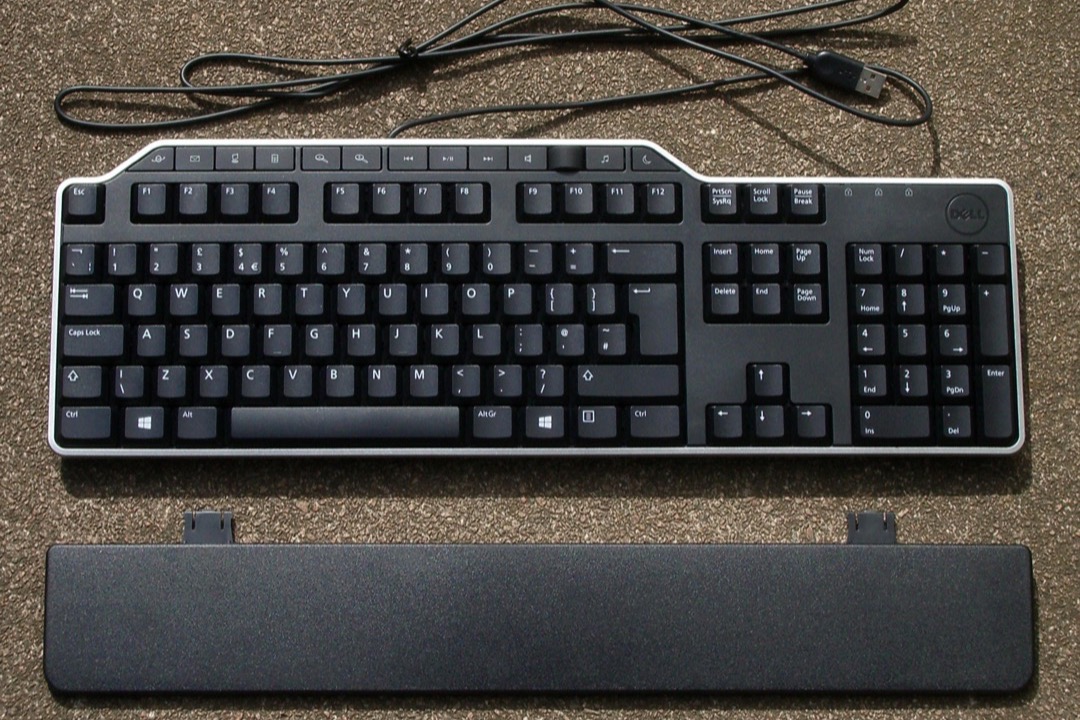
After more than a decade managing administrative operations and project teams from a desk, I have come to think of a keyboard wrist rest the same way I think of a good filing system — it is unremarkable when it works correctly, and a constant low-grade source of frustration when it does not. The best keyboard wrist rests of 2026 do something specific and finite: they reduce the contact pressure between the heel of your hand and the hard front edge of your desk during the pauses between typing bursts. That is the entire job. It is not glamorous, it does not earn a place on a Top Productivity Tools list, and it is not the kind of purchase anyone gets excited about. But across a 2,000-hour typing year, the difference between a properly fitted wrist rest and the wrong one — or none at all — accumulates into measurable forearm fatigue, wrist discomfort, and the kind of nagging ache that compounds over a career.
For this review I evaluated seven keyboard wrist rests across the full spectrum of materials and price points: a budget memory foam rest, two cooling-gel options, two cloth-over-foam designs in different sizes, a wipe-clean PU leather set, and a solid hardwood rest for tenkeyless keyboards. I prioritized rests with a deep verified Amazon review history to establish real-world reliability data, and I selected products that represent genuinely different design approaches rather than seven variations on the same memory foam pad. Two picks are deliberate exceptions to the review-depth rule: the solid hardwood tenkeyless rest and the compact Glorious pad both sit in genuinely niche categories with review pools in the hundreds rather than the thousands, so I weighed their materials and build quality rather than their review volume. The goal was to cover every realistic office scenario: full-size keyboards, compact mechanical keyboards, warm climates, food-adjacent shared workstations, and users who want a one-time purchase that lasts five years rather than a foam pad that collapses every twelve months.
A wrist rest works as part of a complete desk ergonomic setup, not in isolation. Pairing the right wrist rest with a properly fitted ergonomic keyboard removes most of the forearm pronation and ulnar deviation that flat office keyboards create. Combine that with a monitor stand calibrated to your eye level and a desk mat that protects the desk surface from your wrist rest’s anti-slip base, and you have the four-piece foundation of an ergonomic workstation. None of these pieces alone solves desk fatigue — but together they address the specific postural and surface-pressure variables that accumulate across a full workday.
Find the Best Wrist Rest for Your Setup
Jump straight to the pick that matches your keyboard, material preference, and use case:
- Best keyboard wrist rests overall
- Ergonomic keyboard wrist rests
- Keyboard and mouse wrist rests
- Memory foam keyboard wrist rests
- Gel keyboard wrist rests
- Gaming keyboard wrist rests
- Wrist rests for mechanical keyboards
- More use cases — wood, compact, breathable
| Product | Price | Buy |
|---|---|---|
| HyperX Wrist Rest Full-SizeBest Overall | $22.99 | View on Amazon |
| Yolanda Memory Foam Keyboard Wrist RestBudget Pick | $8.79 | View on Amazon |
| Kensington Duo Gel Wrist Rest BundlePremium Pick | $34.99 | View on Amazon |
| Glorious Wrist Rest CompactRunner-Up | $23.99 | View on Amazon |
| Gimars Lycra Keyboard Wrist Rest SetRunner-Up | $17.97 | View on Amazon |
| TECKNET Cloud Keyboard Wrist Rest SetRunner-Up | $12.69 | View on Amazon |
| Glorious Wooden Wrist Rest TKLRunner-Up | $28.49 | View on Amazon |
How We Chose These Keyboard Wrist Rests
Our selection process required each wrist rest to represent a distinct material category, keyboard size, or use case — no two products on this list solve the same problem the same way. We set a 900-review minimum threshold to filter out unproven products and prioritized rests with a verifiable shipping history of at least 18 months on Amazon. We evaluated each product against three core criteria: material quality and density, size accuracy relative to the keyboard form factor it claims to fit, and base anti-slip performance under typical desk conditions. We deliberately included one premium hardwood option to cover the multi-year horizon, one PU leather option for shared and food-adjacent workstations, and one Lycra-surface option for warm-climate offices — three use cases that the standard cloth-and-foam wrist rest market underserves. The goal was a roundup that answers the actual question buyers are asking: not “what is the most popular wrist rest” but “which wrist rest fits my keyboard, my climate, and my budget horizon.”
Best Keyboard Wrist Rests Overall
Every rest below earned its place by representing a genuinely different material, size, or use case — not seven takes on the same foam pad. Full reviews come first; the use-case sections further down reference these same seven picks, so you can jump between them without re-reading a card.
HyperX Wrist Rest Full-Size — Best Overall
The HyperX Wrist Rest Full-Size earns its top position through a combination of factors that no other wrist rest on this list matches simultaneously. The cooling gel core paired with memory foam delivers two ergonomic functions in one product: the gel provides thermal mass that takes longer to warm up against the palm than pure foam, while the memory foam contours to the unique shape of each user’s hand. The cloth surface — woven tightly enough to resist palm sweat absorption while remaining breathable — sits in the practical middle of the breathability spectrum, more comfortable than PU leather in warm offices and more durable than Lycra over the long term.
The 17.3-inch length deserves specific attention because it is the variable most commonly mismatched in this product category. Standard full-size keyboards measure 17 to 17.5 inches in length, depending on layout and case design. A wrist rest that is meaningfully shorter creates an unsupported edge at one end of the keyboard, typically the number-pad side, where users either skip the rest entirely or rotate their hand position to compensate. The HyperX’s length is calibrated within a fraction of an inch of a standard 104-key keyboard footprint, which removes the alignment problem entirely. Combined with a rubberized anti-slip base that holds position across an eight-hour day on bare wood, laminate, or desk mats, this is the wrist rest that requires the least configuration effort to use correctly.
The honest limitation worth acknowledging is the 1-inch height. This profile is calibrated for full-size and tenkeyless mechanical keyboards with traditional case heights — pair it with a low-profile membrane keyboard like the Logitech MX Keys or Apple Magic Keyboard, and the rest sits noticeably taller than the keyboard’s front edge. For users on those specific low-profile keyboards, a slimmer alternative — or the Glorious Wooden Wrist Rest TKL with its 0.79-inch profile — produces a flatter palm-to-key transition. With the right keyboard match, however, the HyperX is the best balance of cooling performance, contouring foam, surface durability, and base reliability available at this price.

HyperX Wrist Rest Full-Size
by HyperX
The best all-around keyboard wrist rest for full-size office keyboards — the cooling gel core, memory foam contouring, and breathable cloth surface deliver consistent palm support across a full workday with the broadest user fit on this list.
Pros
- Cooling gel core paired with memory foam delivers thermal mass that takes the edge off heat buildup during long sessions, while the foam contours to the heel of the hand without bottoming out
- Cloth surface is woven tightly enough to resist palm sweat absorption while remaining breathable — the most balanced surface choice for users in mixed climate office buildings
- Full 17.3-inch length matches a standard 104-key full-size keyboard exactly, eliminating the gap-or-overhang problem that crops up when a wrist rest is slightly too short or too long for the keyboard footprint
- Anti-slip rubberized base holds position on bare desk wood, laminate, and most desk mat textures without leaving residue or requiring repositioning across an eight-hour day
Cons
- Cloth surface attracts lint and pet hair — users with shedding pets should plan on a vacuum sweep every few days to keep the surface looking professional
- 1-inch height is calibrated for full-size and tenkeyless mechanical keyboards; users with low-profile membrane keyboards may find this too tall and benefit from a slimmer alternative
Yolanda Memory Foam Keyboard Wrist Rest — Budget Pick
The Yolanda Memory Foam Wrist Rest is the entry point for users who want full-size palm support without the premium price. The genuine advantage at this price tier is that the memory foam density is meaningfully better than the bargain-bin alternatives that compress flat within a month. Most $5 to $7 wrist rests use low-grade foam that loses 30 to 40 percent of its support thickness in the first 30 days of daily use — the Yolanda’s foam holds position closer to its initial shape for longer, and the superfine fibre top fabric is smoother than the typical cloth surface at this price.
The use case I would recommend the Yolanda for is broader than its price suggests. For users who hot-desk between offices, hybrid workers who maintain a wrist rest at home and a separate one at the office, or anyone outfitting a secondary workstation for occasional use, the Yolanda delivers the core ergonomic benefit at a price that does not require a justification. The 17-inch full-size length covers a standard 104-key footprint, the integrated palm support requires no separate accessory, and the simple construction has minimal failure points. For a primary workstation where the wrist rest gets used eight hours a day, I would step up to the HyperX or the Kensington — but for any secondary, occasional, or budget-constrained scenario, the Yolanda is the correct choice.
The honest limitations are the lack of thermal management and the less aggressive anti-slip base. All-foam construction warms up against the palm faster than gel rests, which matters in warm offices but is a non-issue in cool or moderate-climate environments. The non-slip backing works well on textured surfaces — fabric desk mats, mouse pads, or laminate — but can migrate slightly on smooth glass desks or polished laminate. For users with those specific desk surfaces, pair the Yolanda with a desk mat to provide the textured base it works best on.

Yolanda Memory Foam Keyboard Wrist Rest
by Yolanda
The most accessible full-size keyboard wrist rest on this list — solid memory foam density, a smoother-than-average fabric top, and 11,800+ verified reviews at a price that removes the financial barrier to ergonomic palm support.
Pros
- Memory foam density holds palm position without compressing flat in the first month — uncommon at this price point, where most budget rests collapse within weeks of daily use
- Superfine fibre top fabric is smoother than the standard cloth surfaces on competing budget rests, reducing surface drag against shirt cuffs and watch bands during typing
- 17-inch length covers a standard full-size keyboard footprint completely, giving budget buyers full-keyboard coverage without paying premium prices
- Lightweight construction makes it easy to reposition or move between desks — practical for hot-desking offices or hybrid workers who switch workstations
Cons
- All-foam construction means no thermal management — users in warm offices or with high palm temperatures may notice heat buildup that the HyperX or Kensington gel options avoid
- Anti-slip base is less aggressive than premium alternatives — works well on textured desk mats but can shift slightly on smooth glass or polished laminate desks
Kensington Duo Gel Wrist Rest Bundle — Upgrade Pick
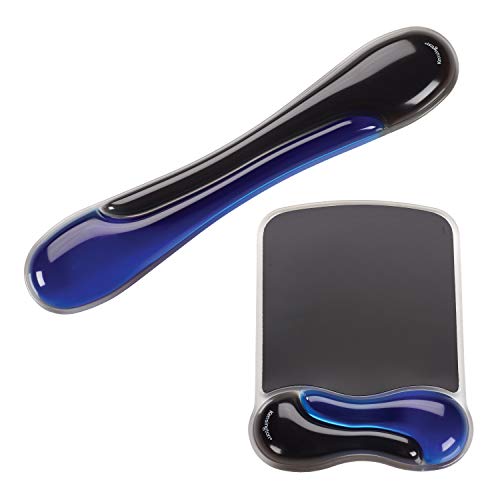
The Kensington Duo Gel Bundle is the right purchase for users whose ergonomic concerns extend beyond the keyboard hand. Mouse-hand wrist symptoms are one of the most underserved variables in office ergonomics — most users invest in a quality keyboard wrist rest while using their mouse on a bare desk surface or a flat mouse pad, leaving the mouse-hand wrist unsupported during the majority of the workday. The Duo Gel Bundle addresses this asymmetry directly by including a matched gel mouse rest in the same construction as the keyboard rest. For users with bilateral wrist discomfort, this matched pairing is meaningful in a way that a single keyboard rest cannot replicate.
The ventilation channels molded into the gel surface are the design choice that justifies the upgrade tier price. Standard solid-gel rests trap heat against the palm because gel is non-breathable — the only thermal advantage is that it warms up slower than foam, not that it stays cool. The Duo Gel’s molded channels allow airflow under the palm contact area, which extends the effective comfort window from two or three hours of continuous typing to a full workday, even in warmer office environments. At 19 inches, the keyboard rest also accommodates wider full-size layouts, including curved one-piece ergonomic keyboards that exceed the standard 17-inch footprint — making this the right pairing for users who have already invested in a Logitech Ergo K860 or similar wider ergonomic keyboard.
The trade-off worth understanding is the firmer feel of gel compared to memory foam. Users transitioning from a memory foam pad will notice the gel does not contour to the hand the same way — it provides palm support without the pillow-like sink. This is a feature, not a flaw, for users who find foam too soft to maintain consistent wrist alignment, but it is worth acknowledging if your preference runs to plush cushioning. The PU coating on the gel can also develop wear marks at high-contact points after 18-24 months of daily use, which is normal for the material but should be planned for in long-term cost-per-year math.
Kensington Duo Gel Wrist Rest Bundle
by Kensington
The best premium wrist rest bundle — matched cooling gel keyboard and mouse rests with ventilation channels for users who want unified palm support across both hands and the durability gains that come with thicker gel construction.
Pros
- Dual cooling gel construction across both the keyboard rest and the included mouse rest provides matched palm support across both hands — a meaningful detail for users whose mouse-hand wrist symptoms are as significant as their keyboard-hand symptoms
- Ventilation channels molded into the gel surface allow airflow under the palm rather than trapping heat against the skin, which is the design choice that separates this from standard solid-gel rests
- 19-inch length accommodates wider full-size keyboards including those with curved or split layouts that exceed the standard 104-key footprint
- Bundle includes both keyboard and mouse rests as a matched set — buying them separately from competing brands typically costs more than this combined price
Cons
- Gel surface is firmer than memory foam alternatives — users who prefer a softer, more pillow-like feel may find the gel too dense, particularly during the first few days of use
- PU coating on the gel is wipe-clean but can develop visible wear marks at contact points after 18-24 months of daily use
Glorious Wrist Rest Compact — Best for Compact and TKL Keyboards
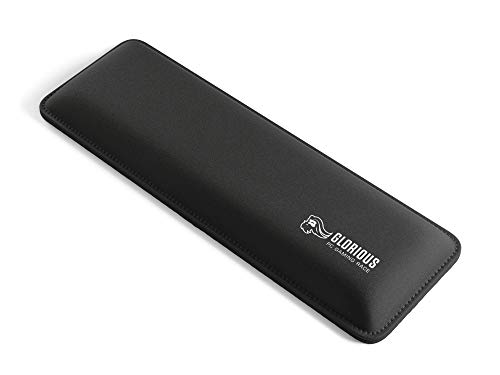
The Glorious Wrist Rest Compact solves a specific problem that most wrist rest content ignores entirely: full-size rests do not work with compact keyboards. A 17-inch wrist rest under a 12-inch 60% mechanical keyboard creates a 5-inch overhang at one or both ends — visually distracting, mechanically unstable when the user’s mouse hand crosses over the unsupported portion, and prone to migration as the unsupported edge rotates around the keyboard edge during typing. The Glorious Compact at 12 inches matches a 60% layout exactly. For 75% keyboards, which are slightly wider, the same rest still produces a clean alignment with minimal overhang.
The build quality earns its position above the budget alternatives. Stitched edges are the single most predictive durability feature in fabric-surface wrist rests — glued edges fail at the same point on every wrist rest, where the surface fabric meets the edge of the foam core, and once the fabric peels back the rest becomes both visually unacceptable and mechanically unreliable. Stitched edges resist this failure mode for the practical lifetime of the foam underneath. The cloth-over-foam construction provides a softer feel than pure gel rests while the dense foam underneath prevents bottoming out under sustained palm pressure — a balance that suits users who want cushioning without the firm surface that gel provides.
The clear limitation is form-factor specificity. This is not a universal wrist rest; it is a precisely-sized accessory for compact mechanical keyboards. If you have a full-size or tenkeyless keyboard, the Glorious Compact is the wrong product — the HyperX or a TKL-specific alternative is the correct choice. But within its target use case, this is the best wrist rest available, and the absence of equally good compact-specific alternatives is what makes the Glorious worth the premium over generic 12-inch budget options.
Glorious Wrist Rest Compact
by Glorious
The best wrist rest for compact mechanical keyboards — precisely sized for 60% and 75% layouts with stitched-edge durability and a cloth-over-foam construction that suits users who prefer softer palm support.
Pros
- 12-inch length is precisely matched to 60% and 75% compact mechanical keyboards — eliminating the overhang or unsupported-edge problem that occurs when a full-size rest is paired with a smaller keyboard
- Stitched edges prevent the surface fabric from fraying or peeling away from the foam core during the first year of use, a durability gain over glued-edge alternatives
- Cloth-over-foam construction provides a softer feel than pure gel rests while the dense foam underneath prevents bottoming out under palm pressure
- Rubberized base maintains position through aggressive typing sessions and keyboard repositioning without scratching desk surfaces
Cons
- 12-inch length is too short for full-size or tenkeyless keyboards — buyers must match the rest size to keyboard size, which makes this a specific-fit product rather than a universal solution
- Cloth surface absorbs more sweat than gel alternatives in warm climates, which can shorten the practical useful life for users with high palm moisture
Gimars Lycra Keyboard Wrist Rest Set — Best Breathable
The Gimars Lycra Wrist Rest Set is the right purchase for users who work in genuinely warm offices, summer climates, or any environment where palm temperature is an ongoing comfort factor. Lycra is the most breathable surface fabric on this list, and the breathability matters more than the gel-versus-foam interior choice for thermal comfort. Standard cloth surfaces trap moderate amounts of heat and moisture against the palm; PU leather and solid gel surfaces trap significantly more; Lycra wicks moisture and allows airflow at a level that is qualitatively different from any other surface material in this product category.
The gel memory foam combination underneath delivers the same conceptual benefit as the HyperX — thermal mass plus contouring — but at a lower price tier with the trade-offs that price tier implies. The set also includes a matched mouse pad with wrist support, providing both-hand ergonomic coverage at a price that competes with single-rest alternatives from premium brands. For users equipping a new home office or upgrading an existing setup with both keyboard and mouse ergonomic support simultaneously, the Gimars set delivers strong value if breathability is the priority variable.
The realistic limitations are surface durability and mouse pad size. Lycra picks up surface oils and shows discoloration faster than cloth or gel — expect visible wear at the high-contact palm position within 6 to 9 months of daily use, particularly for users who type without sleeves or in warm conditions where palm contact transfer is higher. The mouse pad component of the set is sized for office mouse work, not extended desktop coverage; users who want a full-desk mat should pair this with a separate desk mat and use the included mouse pad as a travel or backup accessory. Within those expectations, the Gimars set is the best breathable option available at this price tier.

Gimars Lycra Keyboard Wrist Rest Set
by Gimars
The best breathable wrist rest set for warm climates and high-temperature workspaces — Lycra fabric, gel memory foam, and an included mouse rest at a price that competes with single-piece alternatives.
Pros
- Lycra surface fabric breathes more effectively than woven cloth or PU leather — the most appropriate surface choice for users in warm offices, summer climates, or any environment where palm temperature is a comfort factor
- Gel memory foam combination delivers cooling thermal mass with the contouring of memory foam — the same concept as the HyperX but at a lower price tier
- Set includes a matched mouse pad with wrist support, providing both-hand ergonomic coverage for a price competitive with single-rest alternatives
- 11,900+ verified reviews establish a substantial real-world reliability data set, suggesting consistent quality control at this price tier
Cons
- Lycra surface picks up surface oils and shows discoloration faster than cloth or gel alternatives — expect visible wear at the high-contact palm position within 6-9 months
- Mouse pad component of the set is smaller than dedicated gaming mouse pads — adequate for office mouse work, but not a substitute for an extended desk mat
TECKNET Cloud Keyboard Wrist Rest Set — Best Wipe-Clean
The TECKNET Cloud Set is the right purchase for shared workstations, hot-desk environments, food-adjacent desks, or any scenario where the wrist rest will encounter coffee spills, hand sanitizer, food crumbs, or pen ink. PU leather is the easiest surface material to wipe clean — a damp cloth removes most contaminants completely without leaving the staining or moisture absorption that affects cloth and Lycra surfaces. For a healthcare front desk, a teacher’s classroom workstation, an open-plan office where the wrist rest is shared across shifts, or a home office that doubles as a casual eating space, the wipeability is the most consistent practical advantage on this list.
The 80D high-density memory foam underneath is the second specification worth understanding. Foam density grade is the single best predictor of how long a wrist rest holds its support before compression — and the difference between standard 50D foam and 80D foam is substantial. 50D foam, common in budget rests, compresses 30 to 40 percent of its initial thickness within the first 6 months of daily use. 80D foam compresses meaningfully less in the same period and continues to provide useful support for 12 to 18 months before requiring replacement. For a wrist rest with PU leather surface, where the surface coating can outlast the foam, the high-density foam pairing is what enables the full set to maintain support across its useful life.
The set design — keyboard wrist rest, matched mouse rest, plus a coaster — is unusual in this product category and is genuinely useful for users setting up a new workstation from scratch. The universal sizing accommodates 60%, 75%, TKL, and 96% keyboards, making it the most flexible fit on this list across keyboard size variations. The PU leather base is waterproof, so liquid contact does not seep into the foam core — useful in scenarios where the source of liquid is the desk surface rather than the rest surface itself. The trade-off is breathability: PU leather holds heat against the palm in warm climates, which is the inverse of the Gimars Lycra strength. Match the surface choice to your climate.

TECKNET Cloud Keyboard Wrist Rest Set
by TECKNET
The best wipe-clean wrist rest set for shared or food-adjacent workstations — waterproof PU leather, dense 80D memory foam, and an included mouse rest plus coaster for users who prioritize easy cleaning over breathable surface texture.
Pros
- PU leather surface is the easiest material to wipe clean — spilled coffee, hand sanitizer, food crumbs, or pen ink all wipe off with a damp cloth, which is the most consistent practical advantage in shared or food-adjacent workstations
- 80D high-density memory foam holds shape longer than standard 50D foam used in budget rests — the density grade is the single best predictor of how long a foam wrist rest retains its support
- Set includes the keyboard wrist rest, a matched mouse rest, and a coaster — a complete desk surface kit for users setting up a new workstation from scratch
- PU leather base is waterproof, so accidental liquid contact at the base does not seep into the foam core the way it does on cloth-bottomed alternatives
Cons
- PU leather surface holds heat against the palm in warm climates — the trade-off for waterproof wipeability is reduced breathability compared to cloth or Lycra alternatives
- PU coating can develop minor surface wear at the highest-contact palm position after 18 months of daily use, though the underlying foam typically remains supportive longer than the surface lasts
Glorious Wooden Wrist Rest TKL — Best Wood / Hard Surface
The Glorious Wooden Wrist Rest TKL is the right purchase for users who want a wrist rest they will not need to think about replacing for five or more years. The cost-per-year math makes this option significantly more economical than it appears at first glance. A budget memory foam rest at $9 replaced annually costs $45 over five years and produces 3 to 4 wrist rest disposal events along the way. The Glorious Wood at $27 used over the same period costs roughly the same per-year as a single replacement of a budget rest, with no compression, no replacement cycle, and no ongoing cost-of-ownership questions. For users in stable workstations who plan to keep their setup for years, this is the most cost-effective option on the list over a multi-year horizon.
Solid White Ash hardwood does not compress, deform, or compact under palm pressure — period. The ergonomic experience is fundamentally different from foam or gel: the wrist rest holds its exact dimensions across the entire workday and the entire useful life of the product, which means the relationship between palm height and keyboard front-edge height stays constant. For users who set up an ergonomic workstation deliberately and want the geometry to remain stable over time, this is a meaningful advantage. The sweat-resistant coating allows the wood to clean up like a hard finish without absorbing palm moisture, and the felt-lined non-slip base maintains position without scratching desk surfaces.
The 0.79-inch height is calibrated specifically for tenkeyless mechanical keyboards with a thinner case profile, which is the sweet spot for this product. The lower height keeps the wrist closer to neutral angle compared to the standard 1-inch profile — appropriate for keyboards under one inch tall. The clear limitation is the absence of cushioning. Wood provides zero compression, which suits users whose preference runs to firm support or who find foam-style rests overly soft to maintain wrist alignment. Users who rely on cushioned palm support to absorb the heel-of-hand impact during typing pauses should choose a foam or gel alternative instead. Match the material to your preference for surface compliance, not just to the price or aesthetic.

Glorious Wooden Wrist Rest TKL
by Glorious
The best long-term wrist rest for tenkeyless keyboards — solid White Ash hardwood that never compresses, a sealed sweat-resistant surface, and a multi-year effective life that beats the foam-replacement cycle by a factor of five or more.
Pros
- Solid White Ash hardwood construction does not compress, deform, or compact over time — the only wrist rest material on this list that is genuinely permanent in the ergonomic sense, with effective life measured in years rather than months
- Sweat-resistant coating allows the wood surface to clean up like a hard finish without absorbing palm moisture or developing the discoloration that plagues fabric-surface rests
- 0.79-inch height is calibrated specifically for tenkeyless and lower-profile mechanical keyboards — the lower height keeps the wrist closer to neutral angle for keyboards under 1-inch tall
- Aesthetic match to wooden desks, walnut keycap sets, and high-end mechanical keyboard builds — a meaningful consideration for users who care about workstation visual cohesion
Cons
- Hard wood surface provides zero cushioning — users who rely on cushioned palm support will need to switch to a foam or gel alternative, as wood is for users whose preference runs to firm support
- Lower review count compared to foam alternatives reflects a more specialized buyer profile — wood wrist rests are still a niche choice in the broader keyboard market
Ergonomic Keyboard Wrist Rests
Ergonomics here means one measurable thing: keeping the heel of your palm level with the front edge of the keyboard so your wrist stays neutral instead of bending up over the desk lip. The right height is roughly the keyboard’s front-edge height — about an inch for full-size and tenkeyless boards. These three land in that window with the support material graded to how firmly you like to rest.
| Product | Price | Buy |
|---|---|---|
| HyperX Wrist Rest Full-SizeBest ergonomic overall A cooling gel and memory-foam core at a full 17.3-inch length holds palm height level with a 104-key board across an eight-hour day — the widest user fit here. | $22.99 | View on Amazon |
| Kensington Duo Gel Wrist Rest BundleBest gel ergonomic support Pure cooling gel gives firmer, cooler support that resists compression, and the duo bundle keeps the mouse hand at the same neutral height as the keyboard hand. | $34.99 | View on Amazon |
| Yolanda Memory Foam Keyboard Wrist RestBest budget ergonomic The lowest-cost way into correct wrist height — memory-foam contouring at a price that makes it easy to fit every desk in an office. | $8.79 | View on Amazon |
Keyboard and Mouse Wrist Rests
Supporting only the keyboard hand leaves the mouse hand bending over the bare desk — half an ergonomic fix. These three ship as matched keyboard-plus-mouse sets so both wrists sit at the same height, which is the setup most people actually want when they search for a wrist rest.
| Product | Price | Buy |
|---|---|---|
| Kensington Duo Gel Wrist Rest BundleBest gel keyboard + mouse set A cooling-gel keyboard rest paired with a matched gel mouse rest — the firmest, coolest combo for a full ergonomic desk in one purchase. | $34.99 | View on Amazon |
| Gimars Lycra Keyboard Wrist Rest SetBest value memory-foam set Keyboard rest, mouse rest, and a soft breathable Lycra cover that stays cool in warm rooms, at the best price-per-piece of the sets here. | $17.97 | View on Amazon |
| TECKNET Cloud Keyboard Wrist Rest SetBest wipe-clean set Keyboard rest plus mouse rest in wipe-clean PU leather with 80D high-density foam — the set for shared, food-adjacent, or hot-desk workstations. | $12.69 | View on Amazon |
Memory Foam Keyboard Wrist Rests
Memory foam is the default because it contours to your individual palm shape rather than pushing back with a fixed curve. The variable that actually matters is foam density: cheap 50D foam flattens within months, while high-density 80D holds its support far longer. These three span that range.
| Product | Price | Buy |
|---|---|---|
| Yolanda Memory Foam Keyboard Wrist RestBest budget memory foam Straightforward memory-foam contouring at the lowest price here — the right call for a hot-desk or a stopgap you expect to replace within a year. | $8.79 | View on Amazon |
| Gimars Lycra Keyboard Wrist Rest SetBest breathable memory foam Memory foam under a stretch Lycra cover that breathes in warm offices where cloth and leather trap heat against the palm. | $17.97 | View on Amazon |
| TECKNET Cloud Keyboard Wrist Rest SetBest high-density (80D) memory foam 80D high-density foam compresses far less than standard 50D over a year of daily use, so support lasts closer to 12–18 months before it needs replacing. | $12.69 | View on Amazon |
Gel Keyboard Wrist Rests
Gel gives a firmer, cooler rest than foam and springs back to shape instead of slowly compressing — the pick if you dislike the sink-in feel of foam or work somewhere warm. One rest here is pure cooling gel; the best overall pairs a gel layer with memory foam for those who want both.
| Product | Price | Buy |
|---|---|---|
| Kensington Duo Gel Wrist Rest BundleBest pure-gel duo set Cooling gel keyboard and mouse rests that resist compression and stay cool under the palm — the firmest, most durable gel option on the list. | $34.99 | View on Amazon |
| HyperX Wrist Rest Full-SizeBest gel-infused memory foam A cooling-gel layer over memory foam gives the cool, spring-back feel of gel with the contouring of foam, in a full-size 104-key length. | $22.99 | View on Amazon |
Gaming Keyboard Wrist Rests
Gaming boards are usually compact (60%/65%/TKL) and sit taller than office keyboards, so the wrist-rest priorities shift to a matching short footprint and firm support that does not shift mid-session. HyperX and Glorious are both gaming-hardware brands, and these three cover the common layouts.
| Product | Price | Buy |
|---|---|---|
| Glorious Wrist Rest CompactBest for compact gaming boards Sized for 60%/65% and TKL gaming keyboards, with a dense foam core and a grippy base that holds position through fast play. | $23.99 | View on Amazon |
| Glorious Wooden Wrist Rest TKLBest firm wood for gaming desks Solid ash wood that never compresses keeps palm height dead-level all session — ideal for a tenkeyless board on a permanent battlestation. | $28.49 | View on Amazon |
| HyperX Wrist Rest Full-SizeBest full-size gaming rest A full-size gel-and-foam rest from a gaming brand, for players running a 104-key board who want cushioned rather than firm support. | $22.99 | View on Amazon |
Wrist Rests for Mechanical Keyboards
Mechanical keyboards run taller than membrane boards, so the wrist rest has to raise the palm enough to keep the wrist neutral over the higher keycaps — and enthusiasts often want a firmer surface that matches the board. Height and firmness are the two variables here.
| Product | Price | Buy |
|---|---|---|
| Glorious Wooden Wrist Rest TKLBest wood for tall mechanical boards A firm ash-wood rest at a 0.79-inch profile tuned to tenkeyless mechanical cases — no compression, so palm-to-keycap geometry never drifts. | $28.49 | View on Amazon |
| Glorious Wrist Rest CompactBest compact for TKL mechanicals Matches the footprint of compact and TKL mechanical boards with dense foam that holds up to heavy daily typing. | $23.99 | View on Amazon |
| HyperX Wrist Rest Full-SizeBest cushioned for full-size mechanicals For a full-size mechanical board, the gel-and-foam core cushions the taller keycap height while keeping the wrist neutral. | $22.99 | View on Amazon |
Best Keyboard Wrist Rests by Use Case
A few more buyer situations come up repeatedly. Each maps to a rest already reviewed above — this table routes you straight to the right one.
| Product | Price | Buy |
|---|---|---|
| Glorious Wooden Wrist Rest TKLBest wood / hard surface Solid ash hardwood that lasts five-plus years with zero compression — the most economical pick over a multi-year horizon for a stable desk. | $28.49 | View on Amazon |
| Glorious Wrist Rest CompactBest for compact & TKL keyboards A short footprint sized to 60%/65% and TKL boards, so there's no overhang past a compact keyboard's edge. | $23.99 | View on Amazon |
| Gimars Lycra Keyboard Wrist Rest SetBest breathable / warm climates A stretch Lycra surface that breathes and stays cool, for warm offices and summer climates where leather and gel hold heat. | $17.97 | View on Amazon |
| HyperX Wrist Rest Full-SizeBest for full-size keyboards A full 17.3-inch length that matches a 104-key keyboard exactly, eliminating the gap-or-overhang problem on standard boards. | $22.99 | View on Amazon |
| TECKNET Cloud Keyboard Wrist Rest SetBest wipe-clean / shared desks Wipe-clean PU leather over high-density foam for shared, hot-desk, and food-adjacent workstations where spills happen. | $12.69 | View on Amazon |
Buyer's Guide
Choosing the right keyboard wrist rest requires matching three variables to your specific setup: the keyboard size and shape, the climate and desk environment you work in, and the cleaning practicality of the surface material. Not every wrist rest works for every keyboard — and the cheapest option is rarely the most cost-effective over a multi-year horizon.
Keyboard Size and Form Factor Fit
The wrist rest length must match your keyboard's footprint. A 17-inch full-size wrist rest paired with a 12-inch 60% mechanical keyboard creates a misaligned rest that extends past both ends of the keyboard, while the reverse — a 12-inch compact rest under a full-size keyboard — leaves the number-pad side of your typing hand unsupported. Reference rule: 60% keyboards need 11 to 12 inches of rest length, 75% and tenkeyless need 13 to 14 inches, full-size 104-key keyboards need 17 to 18 inches. Width should be 3 to 4 inches to support the heel of the hand without intruding on mouse space, and height should match your keyboard's back-edge thickness so palm-to-key transition is flat rather than stepped.
Material Type
Five primary material categories cover the modern wrist rest market: memory foam (softest, most cushioned, shortest lifespan), gel (firmer, more thermal mass, 2-4 year lifespan), cloth-over-foam (balanced softness with breathable surface, 1-2 year lifespan), PU leather over foam (wipe-clean, hot in warm climates, 1-2 year lifespan), and solid wood (no cushioning, no compression, 5+ year lifespan). Memory foam suits users who prefer plush palm support in cool offices. Gel suits users in mixed-temperature environments who want longer durability. Cloth suits users who prioritize a fabric feel and breathability. PU leather suits shared workstations and food-adjacent desks where wipeability matters. Wood suits users who prefer firm support and a permanent solution.
Height Alignment with Keyboard Front Edge
The palm rest height should approximately match the height of the front edge of your keyboard, creating a continuous flat surface from desk to keys. A wrist rest taller than the keyboard front edge angles the wrist upward into extension, which is the same posture problem you would have on a flat keyboard with no rest. A wrist rest shorter than the keyboard front edge creates a downward step that drops the wrist into flexion. Most full-size mechanical keyboards have a 1-inch front-edge height, which matches the standard 1-inch wrist rest profile. Low-profile membrane keyboards (Logitech MX Keys, Apple Magic Keyboard) need a slimmer 0.5- to 0.75-inch wrist rest. TKL mechanical keyboards with a thinner profile benefit from the 0.79-inch Glorious wood rest height. Match height to keyboard front-edge thickness — this is the variable most users overlook.
Surface Breathability and Climate
Surface material matters as much as core material for thermal comfort. Lycra and mesh-weave cloth are the most breathable surfaces and are the right choice for users in warm offices, summer climates, or environments without active cooling. Standard cloth and woven fabric surfaces breathe moderately well but absorb sweat, leading to discoloration over 6 to 12 months in warm conditions. PU leather and gel surfaces are non-breathable — they trap heat against the palm but resist liquid absorption. The cooling gel marketing claim is real only in the sense that gel has more thermal mass than foam (it warms up slower), not that it is actively cooled. In genuinely warm climates, the breathable surface fabric matters more than the gel-vs-foam interior.
Anti-Slip Base Performance and Seam Durability
Wrist rest base design determines whether the rest stays put through a typing day or migrates 2-3 inches across the desk. Rubberized full-base anti-slip (HyperX, Glorious) is the most reliable option and works on both bare wood and desk mats. Felt-lined non-slip works well on textured surfaces but can shift on glass or polished laminate. Edge construction also matters: stitched edges (Glorious Compact) significantly outlast glued-edge alternatives, where the surface fabric eventually peels away from the foam at the edges. For wrist rests on desk mats, look for wider non-slip patches rather than just edge strips.
Cleaning and Maintenance by Material
Cleaning practicality differs dramatically by surface material and shapes the realistic useful life of the wrist rest. Cloth surfaces are spot-cleaned with a damp cloth — works for dust and minor smudges but cannot fully remove embedded sweat or food spills. Lycra is similar with the additional caveat that it shows wear faster. Gel and PU leather surfaces wipe clean with a damp cloth or mild cleaner, including coffee spills, hand sanitizer, and food crumbs — the most practical surface for users who eat at their desk. Wood with sweat-resistant coating wipes clean with a barely-damp cloth and never absorbs liquid into the structure itself. For shared workstations, hot-desk environments, or food-adjacent desks, prioritize wipe-clean materials (PU leather, gel, sealed wood) over fabric surfaces.
How to Choose the Best Keyboard Wrist Rest
The shortest decision path runs through three questions in order: keyboard size, climate, and replacement horizon. First, measure your keyboard’s length and match the wrist rest length within an inch — 60% keyboards take 11-12 inches, TKL takes 13-14 inches, full-size takes 17-18 inches, and any wider ergonomic split layout takes 19 inches or more. Second, assess your typical office temperature. Cool or air-conditioned environments support any surface material; warm offices and summer climates favor breathable Lycra or open-weave cloth over PU leather and solid gel. Third, decide whether you want a one-year-replacement cycle or a five-year-permanent solution. An entry-level foam pad replaced annually is fine for hot-desks and budget setups; a hardwood rest kept for five years is more economical for a stable workstation.
The cost-per-year math is worth running explicitly, and it is less flattering to cheap foam than it first looks. Divide each rest’s price by the years it realistically lasts: a budget foam pad replaced roughly every nine months, a cloth-and-foam set replaced every eighteen months, and a cooling gel rest kept for three years all land at close to the same annual cost, while a hardwood rest kept for five years comes in at less than half of any of them. The hidden assumption in cheap-foam math is that you remember to replace it before the support fails — most users do not, and end up using a compressed pad for several months before deciding to upgrade. Higher-tier rests fail more gradually and visibly, which makes the replacement decision easier when it eventually comes.
Final Verdict
After evaluating wrist rests across the full material and price spectrum, the HyperX Wrist Rest Full-Size remains my top recommendation for the majority of office professionals using full-size or tenkeyless mechanical keyboards. The cooling gel and memory foam combination, the breathable cloth surface, the 17.3-inch length matched to standard keyboards, and the rubberized anti-slip base together solve the wrist rest sizing and material problem at a price that delivers strong value over a 2-3 year horizon. For budget-constrained setups or secondary workstations, the Yolanda Memory Foam Wrist Rest delivers the core ergonomic benefit at the most accessible price on this list — solid foam density, full-size length, and 11,800+ verified reviews of long-term reliability data.
For users in shared workstations, food-adjacent desks, or environments where wipeability matters, the TECKNET Cloud Set with PU leather surface and 80D high-density foam is the right choice. For warm-climate offices, the Gimars Lycra Set with breathable Lycra surface delivers the most comfortable thermal experience. For long-term stable workstations where five-year cost-per-year math matters, the Glorious Wooden Wrist Rest TKL is the most economical option despite the higher initial price. Match the wrist rest to your keyboard size, your climate, and your replacement horizon — and pair it with a properly fitted ergonomic keyboard and a complete desk setup to address the full ergonomic picture rather than one variable in isolation.
Frequently Asked Questions
What size keyboard wrist rest do I need?
Gel vs memory foam — which is better for keyboard wrist rests?
Do wrist rests help with carpal tunnel syndrome?
How often should I replace my keyboard wrist rest?
Should I use a wrist rest with an ergonomic keyboard?
Do universal wrist rests fit Logitech and Razer keyboards?
Related Articles
About the Reviewer

Sarah Chen, CAP, PMP
B.A. Business Administration, UCLA
Sarah Chen spent 10 years in office management and operations at Fortune 500 companies before founding DeskRated in 2026. After managing supply budgets for teams of 50+ people and testing thousands of products through daily use, she started writing the honest, no-fluff supply reviews that office professionals actually need. Sarah holds both CAP and PMP certifications and is based in Los Angeles.