Pilot G2 vs Uni-Ball Signo: Which Gel Pen Should You Buy?
Sarah Chen compares Pilot G2 and Uni-Ball Signo 207 gel pens on ink chemistry, tip size variants, smoothness, drying time, archival quality, and which pen wins for office, journaling, and left-handed use in 2026.
Updated
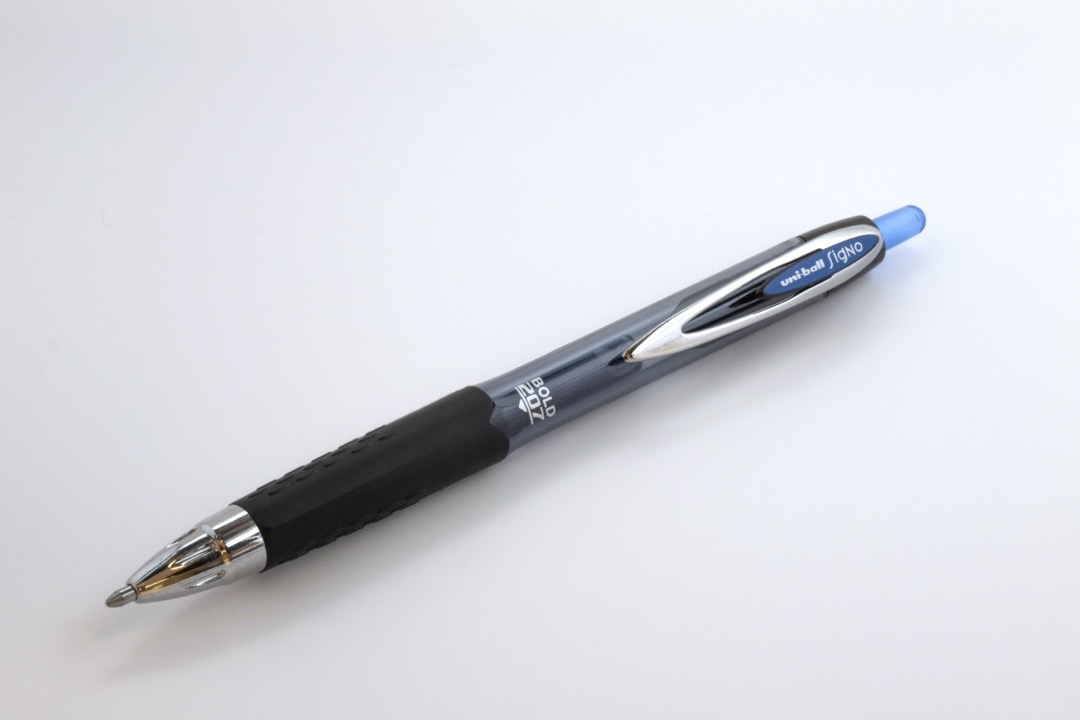
If you have spent any time in an office-supply aisle or clicking through the gel-pen section on Amazon, you have seen the Pilot G2 and the Uni-Ball Signo 207 sitting on the shelf next to each other. They look like near-twins — both retractable, both offered in similar tip sizes, both at roughly the same price point, both the default gel pens most professionals reach for without much thought. The assumption that they are interchangeable rivals is reasonable on the surface. It is also wrong, and the difference between them is the kind of thing that matters once you learn it and then changes what you reach for every day.
I have been using both of these pens at my desk for years, and I can tell you that I keep them for different purposes. The G2 lives in my pen cup for meeting notes, to-do lists, and the everyday paper-trail that gets recycled within a week. The Signo 207 lives in a separate tray with my signing pens, and it is the pen I reach for when I am signing a contract, endorsing a check, making a journal entry I want to last, or writing anything that might matter in five or ten years. The difference is not marketing — it is genuine chemistry. The G2 uses dye-based gel ink; the Signo 207 uses pigment-based gel ink. Almost every practical difference between these two pens flows from that single engineering choice.
This comparison is going to unpack what that chemistry difference actually means for your daily writing, which pen is better for which situations, and why the Signo 207’s pigment ink is the workplace secret most office professionals never learn about. If you are looking for a broader roundup rather than a head-to-head, our best gel pens guide covers the full category including Pentel EnerGel, Zebra Sarasa, and the Uni-Ball Signo UM-151.
Brand Overview: Pilot vs Uni-Ball (Mitsubishi Pencil Co.)
Both the G2 and the Signo come from long-established Japanese writing-instrument makers, and understanding their different corporate cultures helps explain why the pens feel different in practice.
Pilot Corporation was founded in 1918 in Tokyo and is one of the most recognized writing-instrument companies in the world. Pilot makes everything from disposable ballpoints to premium fountain pens, and their reputation rests on mass-market accessibility paired with reliable engineering. The G2 is Pilot’s flagship gel pen for the American office market — it launched in 1999, and it has become the default retractable gel pen in U.S. corporate stationery closets. Pilot’s positioning with the G2 is explicitly mainstream: smooth writing, vivid color, easy refills, broad availability. They are not positioning it as a security pen or an archival tool, and the product reflects that choice.
Uni-Ball is the international brand name for writing instruments from the Mitsubishi Pencil Company, founded in 1887 and unrelated to the more famous Mitsubishi Motors. Mitsubishi Pencil is a fixture of the Japanese stationery world, and Uni-Ball’s reputation in Japan is more serious and professional than Pilot’s — closer to a tool for accountants and document-signers than a general office pen. The Signo line in Japan includes the wildly popular capped UM-151 (often sold as the Signo DX), which is the pen many Japanese stationery enthusiasts consider the apex of modern gel technology. The Signo 207 is the retractable version built specifically for the American market, carrying the same pigment ink technology but in a click-action barrel better suited to U.S. office habits.
The shorthand is this: Pilot G2 is the American office default; Uni-Ball Signo 207 is the professional’s secret weapon that happens to be available at the same stores for roughly the same price.
Ink Chemistry: Pigment vs Dye (The Difference That Drives Everything)
This is the section that will make the rest of this comparison make sense, so I want to spend a moment here.
A gel pen’s ink is fundamentally a gel medium — a viscous, water-based slurry — loaded with some kind of colorant. The question of what that colorant is defines nearly everything else about the pen.
Dye-based gel ink — what the Pilot G2 uses — contains a colorant dissolved at the molecular level in the gel medium. Think of food coloring dissolved in water: the dye and the water are intimately mixed, and once the water evaporates, the dye stays behind on whatever surface it was on. Dye inks are vivid, saturated, smooth-flowing, and cheap to manufacture. They also stay water-soluble forever — if you add water back to dry dye ink, it partially dissolves and smears. Common solvents like acetone, nail-polish remover, or even some household cleaners can dissolve or alter dye ink on a page.
Pigment-based gel ink — what the Uni-Ball Signo 207 uses — contains a colorant that is not dissolved but suspended as microscopic particles. Think of fine sand suspended in water: the sand is in the water but not of it. When pigment ink is laid down on paper, the gel carrier evaporates and the pigment particles physically settle into and between the paper fibers, where they become mechanically locked into the material. Water cannot redissolve pigment ink once it has dried because the pigment was never dissolved to begin with. Most solvents cannot remove it either. The result is ink that is genuinely permanent, archival, and tamper-resistant.
This is not a marketing distinction. It is a fundamental materials-science difference, and it is the reason the Signo 207 is the pen accountants, notaries, and fraud-prevention experts recommend for check signing and contract execution, while the G2 is not. Everything that follows in this comparison — drying time, highlighter compatibility, archival quality, left-hand smudging — ties back to this single chemistry choice.
Tip Size Variants Side by Side
The G2 and the Signo 207 offer the same core lineup of tip sizes, which makes cross-shopping easy.
| Tip Size | Pilot G2 | Uni-Ball Signo 207 | Typical Use |
|---|---|---|---|
| 0.38mm | Yes | Yes | Small handwriting, grid planners, fine margins |
| 0.5mm | Yes | Yes | Standard fine point, everyday writing |
| 0.7mm | Yes | Yes | Medium point, signatures, bold notes |
| 1.0mm | Yes | Yes | Bold emphasis, labels, headline writing |
If you want ultra-fine tips — 0.28mm or 0.38mm with the widest color range — neither the G2 nor the Signo 207 is the pen you want. You need the Uni-Ball Signo UM-151 (Signo DX), the capped Japanese-market version of the Signo, which offers those finer tips with the same pigment ink technology. We will return to the Signo lineup confusion later because it trips up a lot of buyers.
For most people, the 0.5mm or 0.7mm tip is the right starting point. The 0.38mm is excellent for tight planners and detailed work, but it deposits less ink and at that size the G2’s dye ink looks slightly more saturated than the Signo 207’s pigment ink because pigment particles simply cannot flow through a narrow tip as densely as dissolved dye molecules can. From 0.5mm up, the visual difference narrows significantly.
Writing Feel and Smoothness
Let me be honest about this: writing feel is the one category where the G2 has a slight edge, and it is the reason the G2 became America’s default gel pen in the first place.
The G2 writes with the smooth, almost-slippery feel that dye-based gel ink is known for — the dye flows cleanly through the tip with minimal resistance, and the sensation on paper is a little like a ballpoint with extra ink flow. At 0.7mm on standard office paper, the G2 glides in a way that pigment inks cannot quite match.
The Signo 207 is still a smooth writer — it is a gel pen, not a ballpoint — but the pigment particles in the ink create a hair more tactile feedback against the paper fibers. Many writers describe it as slightly more controlled or grounded compared to the G2. Some people prefer this feel; others prefer the G2’s glide. It is a real difference, and whether it matters to you depends on your preference.
At the same tip size, the G2 also produces a slightly darker line on paper. Dye molecules pack more densely in the ink, so you get marginally more visual saturation per stroke. The Signo 207 is not pale by any means — it is plenty dark for everyday reading — but in side-by-side comparisons on the same paper, the G2 is a touch more vivid.
Drying Time, Smear Resistance, and Highlighter Compatibility
This is where the Signo 207 starts pulling ahead decisively.
The G2’s dye ink dries by evaporation. Water in the gel medium has to leave the paper before the ink sets, and that takes three to five seconds at 0.5mm, longer at wider tips. The Signo 207’s pigment ink dries both by evaporation and by the pigment particles binding into the paper fibers, which typically completes in two to four seconds.
Two to three seconds does not sound like a lot. In practice, it is the difference between a planner page you can close immediately and one you have to leave open for a moment. It is also the difference between running a highlighter over your notes for emphasis and creating a smeary, muddy mess.
I have specifically tested this at my desk. Write a line with a Pilot G2 at 0.7mm, wait five seconds, then drag a yellow highlighter across it. The highlighter’s wet felt tip partially redissolves the dye ink and pulls it into a smear. Do the same test with a Signo 207 at 0.7mm and wait the same five seconds, and the highlighter passes over cleanly — the pigment particles are locked into the fibers and the highlighter cannot dissolve them.
For anyone who writes notes and then annotates or highlights them afterward, this is a significant daily advantage. It is also why the Signo 207 works well alongside quality highlighters — you can lay down notes, come back later to mark them up, and not worry about destroying what you just wrote.
Archival Quality and Fraud-Proof Ink
This is the section where the Signo 207 wins without qualification, and it is the main reason I keep one in my signing-pen tray.
Three things degrade written documents over time: water, light, and solvents. Dye inks are vulnerable to all three. Pigment inks resist all three.
Water exposure — a spilled drink, a humid storage environment, a leaky box in the attic — will cause G2 writing to bleed, run, and eventually wash out entirely. Signo 207 writing survives water exposure because the pigment is mechanically locked into the paper.
UV light from ordinary office fluorescents will fade G2 ink noticeably over years of exposure. Pigment inks are lightfast for decades under typical indoor lighting.
Chemical solvents — and this is the critical one for fraud protection — can dissolve dye inks and allow a fraudster to wash the ink off a check and rewrite it with different payee and amount information. This is called check washing, and it is a real and common form of fraud. Pigment ink does not dissolve in common solvents, so a check signed with a Signo 207 is substantially more resistant to this attack. The Uni-Ball brand has been explicitly marketed to banks, accountants, and security-conscious consumers on this basis, and financial-crime prevention organizations routinely recommend it.
For any document that will be presented as authentic evidence of your signature — contracts, checks, notarized papers, legal filings — the Signo 207 is the right tool, and the G2 is not. This is not a close call.
Design and Ergonomics
Both pens use a click-retractable mechanism, rubber-composite grip, and translucent barrel design that lets you see the ink level. The feature set is deliberately similar because both are aimed at the same American office-supply market.
The G2 has a more playful, consumer-friendly aesthetic. The barrel has a clear ink window that shows the gel reservoir prominently, the grip is a soft rubberized material that is comfortable for extended writing sessions, and the clip is a plastic integral part of the cap. The G2 feels like what it is: a friendly, accessible office pen that your office-supply closet will replace in bulk without anyone noticing.
The Signo 207 has a more professional, business-oriented look. The barrel is sleeker, the grip is a firmer rubber that some writers prefer for signing applications, and the clip is a sturdier metal piece that looks more deliberate. The overall impression is of a slightly more serious tool. Neither is a luxury pen — both are made for daily volume use — but the Signo 207 reads as the kind of pen you would put into a leather portfolio for a client meeting, while the G2 reads as the kind you would leave on a shared desk.
Neither pen is going to match the experience of a proper fountain pen or a premium ballpoint — that is a different category with different priorities. But within the retractable gel-pen category at mass-market pricing, both are ergonomically competent for hours of use.
Price and Refillability
Both pens sit in roughly the same price tier — the sub-$2-per-pen range for single pens, often cheaper in multi-packs. Neither is expensive, and neither should be treated as a disposable pen given that both are refillable.
The G2 uses Pilot’s G2 refill, which is the single most widely available gel pen refill in the United States. Every Staples, every Office Depot, most drugstores, most grocery stores with a stationery section, and every online retailer stocks them. The refills themselves are inexpensive, typically costing less than half the price of a new pen, and they extend the life of a pen indefinitely.
The Signo 207 uses the Uni-Ball UMR-87 refill (plus a few closely related variants for different tip sizes). These are available on Amazon, through office-supply chains, and through specialty stationery retailers, but they are less prominently stocked in corner drugstores. If you like to buy refills on short notice at a walk-in store, the G2 has the advantage. If you are comfortable buying online and stocking a small supply, the Signo 207 refill ecosystem works fine.
Pigment ink is marginally more expensive to manufacture than dye ink, and that flows through to slightly higher refill pricing for the Signo 207 — but the difference is small enough that it is not a meaningful factor in total cost of ownership.
Who Should Buy Pilot G2
The Pilot G2 is the right pen for:
- Everyday office note-taking on cheap copy paper — meeting notes, to-do lists, scratch calculations — where smoothness and availability matter more than archival quality.
- Students taking lecture notes, annotating textbooks, or writing in notebooks that will be retired after the semester. The G2’s smooth feel is well-suited to fast note-taking, and its dye ink’s archival limitations do not matter for material you will recycle.
- Bulk office-supply purchases where a full stationery closet needs to be stocked with refillable pens that anyone can walk in and replace. The G2’s ubiquity is a real operational advantage.
- Casual journaling or planning where the content is personal, the planner will be replaced yearly, and long-term archival durability is not a goal.
- Anyone who values writing feel above all else and prefers the slightly glassier glide of dye-based ink. This is a real preference and a valid reason to choose the G2.
The G2 is not a bad pen. It is a genuinely excellent mass-market gel pen — the category leader for good reason. It is just not a fraud-resistant archival pen, and if you need those qualities, you need a different tool.
Who Should Buy Uni-Ball Signo 207
The Uni-Ball Signo 207 is the right pen for:
- Signing checks, contracts, legal documents, and any workplace writing meant to resist fraud or serve as durable evidence of your signature. This is the Signo 207’s flagship use case, and it outperforms the G2 decisively here.
- Journaling intended to last decades — bullet journals, travel journals, daily diaries, personal record-keeping. The pigment ink’s resistance to water, light, and chemical degradation pays off over time in ways that only become visible years after you have filled the book.
- Office professionals who highlight their own notes for study, review, or visual organization. The Signo 207’s smear-resistance makes highlighter-compatible note-taking reliably clean.
- Anyone writing in environments where humidity, accidental spills, or rough handling is a risk — travel, outdoor meetings, kitchens, workshops. Pigment ink’s durability is worth the trade-off in smoothness.
- Accountants, lawyers, notaries, and security-conscious professionals who sign documents as part of their job. This is literally the Signo 207’s industry-default audience in Japan and among informed U.S. professionals.
If I had to recommend one pen for a general audience knowing I could only pick one, I would pick the Signo 207 — the archival and fraud-resistance benefits matter more over a lifetime than the G2’s marginal smoothness advantage. But for someone whose writing never leaves the daily grind, the G2 is perfectly defensible.
The Signo Lineup Confusion (UM-151 vs 207 vs 307)
The Signo family has multiple product lines that all share pigment ink technology but differ in form factor, tip sizes, and market. Here is the disambiguation most buyers need.
Uni-Ball Signo 207 is the retractable, click-action pen sold widely in the U.S. market. Tip sizes: 0.38mm, 0.5mm, 0.7mm, 1.0mm. Limited color range dominated by black, blue, red, and a handful of secondary colors. This is the pen you will find at Staples, Amazon, and Office Depot. It is the workhorse — the pen for U.S. professionals who want pigment ink in a retractable format.
Uni-Ball Signo 307 is a refined version of the 207 with an upgraded grip, slightly improved ink formulation, and a more premium overall construction. Tip sizes: 0.5mm and 0.7mm. Somewhat less commonly stocked but available online. Think of it as the 207’s upscale sibling — if you love the Signo 207 and want a slightly nicer version, the 307 is the upgrade.
Uni-Ball Signo UM-151 / Signo DX is the capped (not retractable) Japanese-market pen that is beloved by stationery enthusiasts worldwide. Tip sizes include 0.28mm, 0.38mm, and 0.5mm. Enormously wide color range — dozens of colors in some markets. Typically stocked through specialty retailers like JetPens rather than big-box stores. This is the pen to seek out if you want ultra-fine tips or a broad color palette for bullet journaling or planner work; the trade-off is the cap, which is less convenient for quick-access daily writing.
If someone recommends “the Signo” without specifying, they probably mean the UM-151 if they are a stationery enthusiast, and the 207 if they are a U.S. office professional. Both use pigment ink, so the chemistry advantages apply equally to all three, but the form factors serve different daily workflows.
Verdict: The Decision Framework
The right pen between the Pilot G2 and the Uni-Ball Signo 207 depends on what you are actually writing and what you need the writing to survive.
Buy the Pilot G2 if you are stocking an office-supply closet, buying pens for general daily note-taking on disposable paper, prioritizing writing smoothness over archival durability, or equipping students with reliable all-purpose pens. The G2 is America’s default gel pen for good reason — it is smooth, colorful, widely refillable, and inexpensive. For the majority of casual office use, it is entirely sufficient, and it may be the better choice if you do not need the Signo’s pigment advantages.
Buy the Uni-Ball Signo 207 if you sign checks or contracts, if you are building long-term journals or records, if you highlight your own notes, if you want fraud-resistance built into your signing ritual, or if you work in a field (accounting, law, notarization, financial services) where document durability is part of the job. The Signo 207 is the professional’s secret — a pen that costs roughly the same as the G2 but offers meaningfully better document protection because of its pigment ink chemistry.
Keep both if you can — which is what I do. The G2 lives in my general pen cup for disposable writing. The Signo 207 lives in my signing-pen tray for anything that needs to last. That two-pen system costs almost nothing extra and gives you the right tool for each situation. Pair your pens with quality mechanical pencils for work where you need erasable precision, and keep a stack of sticky notes nearby for quick annotations that are meant to be temporary rather than archival — each tool has a specific job, and matching the tool to the task is the real productivity upgrade.
The myth that the G2 and the Signo 207 are equivalent gel-pen rivals is the kind of surface-level assumption that falls apart the moment you look at the ink chemistry underneath. Once you understand the difference, you will never confuse them again — and your documents, your journal, and your signed contracts will quietly benefit from the choice.
Buyer's Guide
Pilot G2 and Uni-Ball Signo 207 look similar on the office-supply shelf, but they are engineered for different priorities. These six factors cut through the visual similarity and tell you which pen is the right tool for your specific writing situation.
Ink Chemistry: Pigment vs Dye
This is the single most important difference between the Pilot G2 and the Uni-Ball Signo 207, and it drives almost every other practical distinction between them. The Pilot G2 uses a dye-based gel ink, which means the colorant is dissolved in a water-based gel medium. Dye-based inks produce vibrant, saturated color, flow smoothly out of the tip, and are inexpensive to manufacture — but they remain water-soluble after drying and can be altered or removed with solvents. The Uni-Ball Signo 207 uses pigment-based gel ink, where the colorant is an extremely fine particulate suspended in the gel medium. As the ink dries, those pigment particles physically lodge into the paper fibers rather than merely sitting on top of them. The result is writing that is water-resistant, solvent-resistant, and archival — suitable for documents intended to last or resist tampering. The trade-off is that pigment inks require slightly more careful manufacturing to prevent tip clogging, can feel a hair less slick on paper than dye inks, and cost marginally more to produce. For any writing that needs to survive coffee spills, highlighter overlays, or years of archival storage, pigment ink is the clear winner. For casual notes that will be recycled in a week, either chemistry works fine — and the G2's slightly smoother feel may tip the balance for everyday use.
Tip Size and Line Precision
Both the G2 and the Signo 207 are offered in the same core tip sizes — 0.38mm, 0.5mm, 0.7mm, and 1.0mm — which makes direct comparison easy and gives buyers meaningful options. The 0.38mm tip produces an extra-fine line ideal for small handwriting, tight grid planners, margin annotations, and precise form-filling. The 0.5mm is the all-around workhorse size, matching what most people think of as a standard fine-point pen. The 0.7mm is the medium size — slightly bolder, with more ink on the page, often preferred for signatures, bullet lists, and writing that needs to remain legible after photocopying or scanning. The 1.0mm is a bold tip, mostly used for emphasis, labels, and writing meant to read from across the room. If you want tips finer than 0.38mm, neither the G2 nor the Signo 207 provides them — you have to step up to the Uni-Ball Signo UM-151 (Signo DX) line, which offers 0.28mm and 0.38mm tips with the same pigment ink. One caveat: at the finest tip sizes, both pens deposit less ink, and the G2's dye ink remains slightly more vivid at 0.38mm than the Signo 207's pigment ink. At 0.5mm and above, both produce dark, legible lines, and the pigment ink's archival advantages tend to outweigh any minor difference in visual saturation.
Drying Time and Smudge Resistance
Drying time is where the pigment-vs-dye chemistry creates a practical daily difference. The Pilot G2's dye-based ink dries by evaporation — the water in the gel medium needs to leave the paper before the ink sets. On standard office paper this usually takes three to five seconds at 0.5mm, longer at 0.7mm and 1.0mm. The Uni-Ball Signo 207's pigment ink dries partly by evaporation and partly by the pigment particles physically binding into the paper fibers, which typically happens within two to four seconds at the same tip sizes. That is not a dramatic difference, but over an hour of writing it adds up — and more importantly, once the Signo 207's pigment ink has bound to the paper, it is genuinely set. You can run a highlighter over dried Signo 207 writing without the ink smearing; the same action on dried G2 writing often produces a smeary, muddied line because the dye is pulled back into solution by the highlighter's wet felt tip. For anyone who writes, then highlights their own notes, or writes in a planner they handle frequently, the Signo 207's smudge resistance is a meaningful everyday advantage. The G2 is not unusable in these scenarios, but it requires more patience and careful handling.
Archival Quality and Document Longevity
Archival quality is the category where the Signo 207 decisively outperforms the G2, and where the pigment-vs-dye chemistry becomes a professional-grade distinction rather than a casual preference. Pigment-based inks resist three things that degrade written documents over time: water exposure, UV light, and chemical solvents. Dye-based inks are vulnerable to all three. The Pilot G2's dye ink will fade noticeably under years of office fluorescent lighting, will bleed if a document is wetted even briefly, and can be chemically altered with common solvents — making it unsuitable for any writing meant to serve as legal evidence or long-term record. The Uni-Ball Signo 207's pigment ink is lightfast for decades under typical indoor light, survives water exposure once dry, and resists chemical alteration strongly enough that it is specifically recommended by financial-crime prevention experts as a fraud-resistant pen for signing checks and contracts. This is why the Signo 207 is the industry default for accountants, notaries, and security-conscious office professionals who sign high-stakes documents. For casual writing, neither pen's archival properties matter much because the paper will likely be discarded before degradation becomes visible. For documents meant to last, use the Signo 207 and do not second-guess the choice.
Refillability and Total Cost of Ownership
Both the Pilot G2 and the Uni-Ball Signo 207 are refillable, which changes the long-term economics compared to disposable pens — but the refill ecosystems differ in availability and convenience. The Pilot G2 uses the Pilot G2 refill, which is one of the most widely stocked gel pen refills in the United States. You can find it at any office-supply store, most drugstores, every major big-box retailer, and on Amazon typically at a price well below the cost of a new pen. Pilot produces G2 refills in all the major tip sizes and in multiple colors, and the refill compatibility extends to several other Pilot pen bodies, giving you flexibility in barrel choice while keeping the same ink. The Uni-Ball Signo 207 uses the UMR-87 refill (and closely related Signo-family refills), which is less prominently stocked in brick-and-mortar retail but is readily available online at similar per-refill pricing. If you are the kind of person who refills pens rather than discarding them, both pens make financial sense — but the G2's refill ecosystem is more convenient if you prefer to walk into a store and grab a replacement on short notice. Factor in the pigment ink's higher cost per refill (marginal, not dramatic), and the Signo 207's total cost of ownership runs slightly higher than the G2's, which is easy to accept for the archival and fraud-resistance benefits.
Intended Use Case (Office, Journaling, Student, Left-Hander)
The right pen depends heavily on what you are actually using it for, and the G2 and Signo 207 serve different daily roles well. For general office note-taking, meeting notes, and to-do lists on cheap copy paper, the Pilot G2 at 0.7mm is excellent — it is smooth, fast, colorful, inexpensive to refill, and readily available. For signing contracts, writing checks, endorsing legal documents, or any workplace task where the ink needs to be tamper-resistant, the Uni-Ball Signo 207 at 0.7mm is the clear choice, and I keep a black Signo 207 at my desk specifically for this purpose. For journaling and long-term personal records — a Bullet Journal, a leather-bound daily diary, a travel journal meant to last decades — the Signo 207 is again the right answer because pigment ink survives light, humidity, and the occasional coffee spill much better than dye ink. For students taking lecture notes, the G2 at 0.5mm is a fine all-purpose choice; the pigment ink's archival advantages are wasted on notes that will be discarded after finals. For left-handed writers, neither pen is ideal, but the Signo 207 smears marginally less — and either way, consider a dedicated quick-drying gel like the Pentel EnerGel or Zebra Sarasa Dry instead. Match the pen to the actual task, and you will use each one more effectively and enjoy both more.
Frequently Asked Questions
Is Pilot G2 ink waterproof?
Which is better for left-handers, Pilot G2 or Uni-Ball Signo 207?
What is the difference between the Uni-Ball Signo 207 and Signo UM-151 (Signo DX)?
Can I use Pilot G2 refills in a Uni-Ball Signo pen?
Is the Pilot G2 or Uni-Ball Signo better for writing checks and legal documents?
Related Articles
About the Reviewer

Sarah Chen, CAP, PMP
B.A. Business Administration, UCLA
Sarah Chen spent 10 years in office management and operations at Fortune 500 companies before founding DeskRated in 2026. After managing supply budgets for teams of 50+ people and testing thousands of products through daily use, she started writing the honest, no-fluff supply reviews that office professionals actually need. Sarah holds both CAP and PMP certifications and is based in Los Angeles.