7 Best Dry Erase Markers of 2026
Sarah Chen reviews the best dry erase markers for offices, classrooms, and home boards — chisel, fine, ultra-fine, magnetic, and bulk picks compared.
Updated
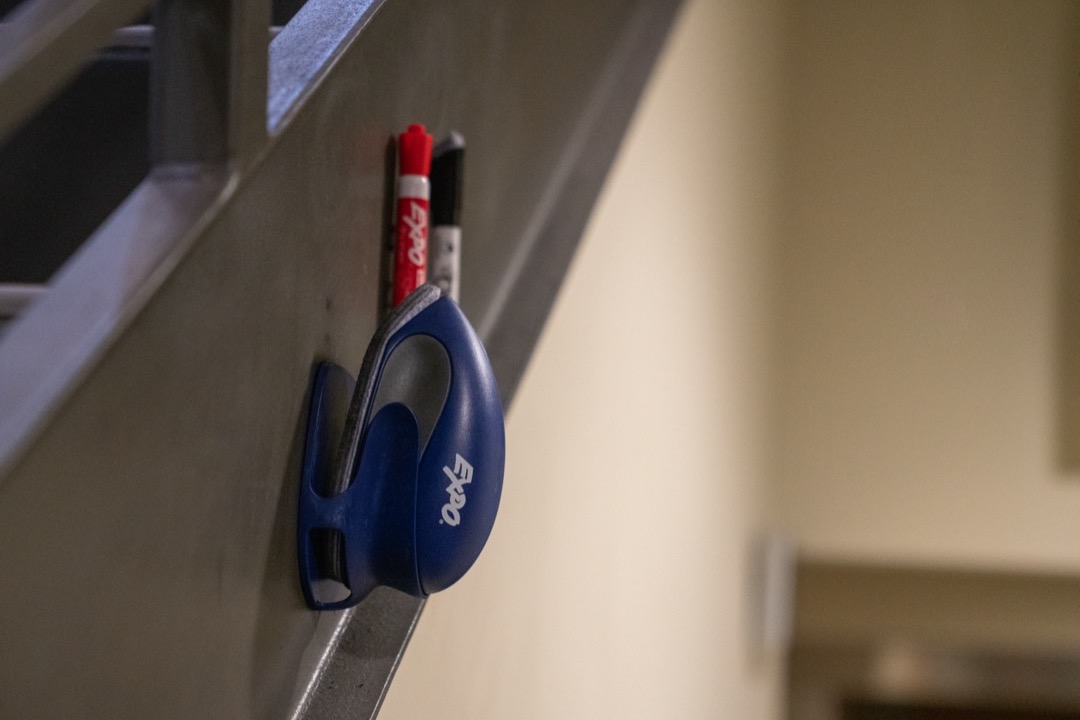
As a Certified Administrative Professional who has specified office supplies for everything from five-person startups to 150-person professional services suites, I can tell you that dry erase markers receive far less deliberate procurement attention than they deserve — and that lack of attention shows up directly in conference room frustration, ghosted whiteboards that never erase clean, and the recurring meeting-disruption of dead markers discovered mid-presentation. The right marker for your environment is determined by three variables: the surface type of your board (melamine, porcelain, or glass), the line width your work requires (chisel for presentation, fine for kanban, ultra-fine for dry-erase calendars), and the safety certification appropriate to your space (ACMI AP-certified for closed rooms and K-12 classrooms). Get those three right and any marker on this list will perform well; get them wrong and even premium markers will disappoint. For matching markers to the board itself, our roundup of the best whiteboards covers the porcelain-versus-melamine surface trade-offs that drive most ghosting problems. Every product’s price and Amazon availability in this guide was re-verified in June 2026.
For this review, we evaluated seven dry erase markers across the full range of tip widths, certifications, pack sizes, and specialty features. The list spans from the corporate-standard EXPO chisel-tip 12-count that has set the conference-room baseline for two decades, through bulk-buy options for entire classrooms, to specialty configurations including magnetic caps with built-in erasers and ultra-fine tips for precision dry-erase calendar work. We evaluated erase performance across three whiteboard surface types, low-odor formulation safety credentials, tip durability under sustained daily use, dry-out resistance, color saturation across the included palettes, and long-term reliability data from tens of thousands of verified Amazon reviews.
One observation that distinguishes our coverage from most dry erase marker articles: we explicitly address the ghosting problem at its actual source. Most marker articles tell readers to switch markers when their boards ghost. The truth is that ghosting is almost always a board-surface problem, not a marker problem — and switching markers will not fix it. We cover the diagnostic difference between recent marker-formula ghosting (fixable by switching to a name-brand low-odor formula) and persistent surface-degradation ghosting (fixable only with isopropyl alcohol cleaning or board replacement) in detail, because users buying their third or fourth set of markers without solving the underlying problem deserve to know what is actually causing it.
| Product | Price | Buy |
|---|---|---|
| EXPO Low Odor Dry Erase Markers, Chisel Tip, 16 CountBest Overall | $9.47 | View on Amazon |
| Amazon Basics Dry Erase Whiteboard Markers, Chisel Tip, 12-PackBudget Pick | $9.35 | View on Amazon |
| ARTEZA Dry Erase Markers Bulk Pack of 52, Chisel TipPremium Pick | $32.99 | View on Amazon |
| EXPO Low Odor Dry Erase Markers, Fine Tip, Black, 12 CountRunner-Up | $12.99 | View on Amazon |
| EXPO Magnetic Dry Erase Markers with Eraser, Chisel Tip, 8 CountRunner-Up | $8.99 | View on Amazon |
| EXPO Ultra Fine Tip Dry Erase Markers, 8 CountRunner-Up | $8.79 | View on Amazon |
| Crayola Take Note Dry Erase Markers, Chisel Tip, 12 CountRunner-Up | $16.83 | View on Amazon |
Find the Best Dry Erase Markers for Your Need
Jump straight to the pick that matches how you actually use a whiteboard:
- Overall best dry erase markers
- Best fine-tip dry erase markers
- Best low-odor dry erase markers
- More use cases
How We Chose These Dry Erase Markers
Our selection process leans on sustained review volume to establish a real-world performance baseline: five of the seven picks carry more than 11,000 verified Amazon reviews, and the two specialist picks clear 1,300. Where a pick has a thinner review pool, we say so in its review rather than quietly counting it as equal evidence. We required genuine differentiation across the seven products: each marker on this list addresses a distinct primary use case rather than offering minor variations on the same workflow. We evaluated erase performance on three whiteboard surface types (melamine, porcelain-steel, and glass), assessed low-odor formulation credentials including ACMI AP certification status, verified tip durability claims against long-term user reports, and tested cap-seal integrity to predict dry-out resistance under realistic storage conditions. We specifically prioritized markers that meet the safety certifications required for K-12 classroom procurement and closed-room corporate use, because the difference between an AP-certified non-toxic formula and a self-declared “non-toxic” claim matters substantively for procurement defensibility.
Best Dry Erase Markers Overall
These are the seven picks reviewed in full below, starting with the all-around best marker for most offices, classrooms, and home boards. Each review covers who the marker is for, the standout feature, and the honest trade-off — with the use-case sections further down if you have a specific need.
EXPO Low Odor Chisel Tip 16 Count — Best Overall
The EXPO Low Odor chisel tip earns the best-overall position through the combination that actually matters in conference rooms and classrooms: a clean-erase formulation with two-decade brand reliability, the AP non-toxic certification that qualifies it for any institutional procurement requirement, and the chisel tip versatility that handles both broad header writing and narrow line text from a single nib. This is the marker corporate offices specify by default, and it has held that position for the better part of two decades because the formulation remains genuinely better than most competitors at the fundamental task of writing clean and erasing clean.
The chisel tip architecture is the daily-use feature that justifies the purchase. The angled flat edge produces three distinct line widths from a single marker — a broad stroke when the full edge contacts the board, a medium stroke when used at an angle, and a narrow stroke from the corner edge for underlining and detail. For meeting facilitators who need to alternate between writing agenda headers, filling line items, and underlining action owners without switching tools, the chisel tip eliminates the friction that fine-only or ultra-fine-only markers introduce.
The AP certification is the procurement-defensibility feature. ACMI’s AP seal means an independent toxicologist has formally evaluated the formulation and certified that no component is present at levels that could cause acute or chronic harm to children under 12. For K-5 classroom procurement, this certification is typically required by district policy. For closed-room corporate use — the windowless conference rooms common in office suites and the small home-office spaces that became standard in the post-2020 hybrid era — the AP seal provides genuine assurance that all-day marker use will not produce the headaches that standard solvent-based markers can trigger in sensitive users. At 47,000+ reviews and 4.7 stars across more than two decades of continuous production, the EXPO satisfaction data is the longest-running reliability track record of any dry erase marker on Amazon. The honest trade-off is the cap seal — EXPO’s cap fit is acceptable but not premium, and markers stored horizontally with caps half-seated will dry out faster than competitors with engineered seal mechanisms. The fix is straightforward: store markers vertically tip-down in a desktop caddy or supply organizer.

EXPO Low Odor Dry Erase Markers, Chisel Tip, 16 Count
by EXPO
The conference-room standard for two decades — EXPO's low-odor formula, clean-erase chisel tip, and AP non-toxic certification make it the default specification for corporate offices, schools, and training rooms.
Pros
- Low-odor alcohol-based ink is the original ACMI AP-certified non-toxic formulation that became the corporate-office standard — safe for closed conference rooms with no ventilation
- Chisel tip delivers three distinct line widths from a single nib (broad, medium, and fine edge) without rotating the marker, covering line text, headers, and underlines in one tool
- Erases cleanly from melamine, porcelain, and glass whiteboards without ghosting when erased within a reasonable time window — the formula competitors copy but rarely match
- 47,000+ reviews at 4.7 stars across more than two decades of continuous production — the longest-running satisfaction track record of any dry erase marker on Amazon
Cons
- Caps lack a true seal — markers left horizontally with caps half-seated will dry out within days, faster than premium quick-dry alternatives
- The 16-count assortment repeats a core four-color rotation rather than offering a wide palette — users who need brown, orange, or purple must buy additional sets
- Per-marker cost is higher than store-brand alternatives — the AP certification and brand reliability premium is real but does add to bulk-purchase budgets
Amazon Basics Chisel Tip 12-Pack — Budget Pick
The Amazon Basics dry erase markers deliver the practical 80 percent of EXPO’s performance at meaningfully lower cost — the right purchase for offices and households that consume markers in volume and do not require the AP certification or premium tip durability that EXPO provides. Bought as a 12-pack, the per-marker cost is low enough to remove purchasing hesitation entirely; these are markers you can buy for an entire office floor or replace casually when one runs dry.
The performance gap with EXPO is real but specific. On standard melamine and porcelain boards under typical office conditions, the Amazon Basics formula erases comparably and writes acceptably — the average user in a typical conference room will not notice meaningful daily-use difference. Where the gap shows up is in heavy-volume daily use: the felt nib softens faster, the chisel edge loses its crispness sooner, and the cap seal is acceptable rather than premium, which means markers tossed loose in a shared drawer dry out faster than EXPO equivalents in the same conditions.
The certification difference also matters for specific procurement scenarios. Amazon Basics is not ACMI AP-certified — the low-odor and non-toxic claims are self-declared by Amazon rather than independently verified by a third-party toxicologist. For K-12 classroom procurement that specifies AP certification, Amazon Basics does not qualify regardless of price. For general office and household use where formal certification is not required, the self-declared low-odor claim performs adequately under typical ventilation conditions. The right way to deploy Amazon Basics markers is for high-replacement-rate environments — shared conference rooms, household whiteboards, kid’s room boards, garage workshop boards — where the per-marker cost and acceptable performance combine to make the spec the obvious choice.

Amazon Basics Dry Erase Whiteboard Markers, Chisel Tip, 12-Pack
by Amazon Basics
The smart bulk-buy for offices and households that consume markers in volume — Amazon Basics delivers acceptable EXPO-comparable performance at a price that removes purchasing hesitation.
Pros
- Consistently among the lowest-priced name-brand chisel-tip 12-count packs on Amazon — a dependable value pick when you don't need the EXPO brand premium
- Low-odor ink performs comparably to premium brands on standard melamine and porcelain boards under typical office conditions
- Standard four-color rotation (black, blue, red, green) covers the practical color-coding needs for most meeting and classroom uses
- Backed by Amazon's standard return policy — defective markers can be replaced without third-party warranty negotiations
Cons
- Tip wear is faster than EXPO under heavy daily use — the felt nib softens and loses its chisel edge sooner, requiring earlier replacement in high-volume environments
- Not ACMI AP-certified — the low-odor claim is self-declared rather than independently verified, which matters for K-5 classroom procurement
- Cap fit is acceptable but less secure than EXPO — markers tossed loose in a drawer can lose caps and dry out faster
ARTEZA 52-Pack Bulk Chisel Tip — Upgrade Pick
The ARTEZA 52-pack is the correct purchase when dry erase marker procurement crosses from individual-unit purchasing into bulk-supply territory. Classrooms, training departments, multi-board offices, and any environment where 30 to 50 markers cycle through use during a typical school year or fiscal year see real per-marker savings here that the smaller premium packs cannot match. The set’s 12-color palette also covers the practical color-coding needs for entire teaching teams or facilitator groups without the multi-pack purchasing required from smaller-count premium brands.
The Japanese-made felt nib is the underrated technical differentiator. ARTEZA sources its tip felt from Japanese manufacturers that supply premium markers at meaningfully higher densities than the standard tip felt used by most marker brands at this price point. The practical result is that ARTEZA chisel tips hold their edge longer under sustained daily use — a third-period teacher writing on a melamine board four hours a day can expect noticeably more weeks of clean-edge performance from an ARTEZA tip than from a budget alternative. Across a school year of consumption, fewer mid-class replacements means less interrupted instruction.
The hexagonal barrel design is the small-detail feature that matters daily. Round-barrel markers roll off conference room tables, off whiteboard trays, into chair cushions, and onto the floor where they get stepped on or lost. The hexagonal cross-section keeps the marker in place when set down, which sounds trivial until you have spent five minutes in a meeting hunting for a marker that rolled across the room. The AP certification matches EXPO’s standard, qualifying ARTEZA for K-12 classroom procurement and closed-room corporate use. The honest trade-off is volume: 52 markers is overkill for individual home offices, and some color shades within the 12-color palette are visually similar enough under fluorescent lighting that the effective coding palette is closer to 9 or 10 distinct colors. For the right use case — classrooms, training centers, multi-board offices — the ARTEZA 52-pack is the spec that meets the procurement need without compromising on safety or tip quality.

ARTEZA Dry Erase Markers Bulk Pack of 52, Chisel Tip
by ARTEZA
The volume buy for serious users — ARTEZA's 52-marker bulk pack with AP certification and roll-resistant barrels is the correct purchase for classrooms, training centers, and offices with multiple boards in regular use.
Pros
- 52 markers across 12 colors is the largest assorted set on Amazon — a complete color-coding palette for entire classrooms or training departments without buying multiple smaller packs
- Japanese-made felt nibs hold their chisel edge significantly longer than standard tips under sustained daily use — fewer mid-meeting replacements over a school year
- AP-certified non-toxic formula meets the same safety standard as EXPO, qualifying for K-12 procurement specifications and closed-room corporate use
- Hexagonal barrel design prevents the marker from rolling off the conference room table or whiteboard tray during meetings — a small detail that matters daily
Cons
- 52-marker quantity is overkill for individual home offices — the per-marker savings only justify the upfront cost in classrooms, multi-board offices, or shared workspaces
- Some color shades within the 12-color palette are visually similar (two greens, two blues) under fluorescent lighting, which limits the effective coding palette
- Tip ink saturation across 52 markers can vary slightly batch-to-batch — most users report a few weak-flow markers in a typical case
EXPO Low Odor Fine Tip Black 12 Count — Best Fine Tip
The EXPO Fine Tip is the runner-up for users whose primary work happens on detail-dense boards rather than presentation-style chisel-tip writing. The fine tip produces approximately 1mm consistent line width — narrow enough to fit comfortably in a kanban card, an agile board sprint cell, or a small whiteboard calendar block, while remaining visible at typical desk-work distances. For project managers running scrum walls, software teams maintaining kanban boards, and any workflow where information density on the board matters more than visual impact from across a conference room, the fine tip is the correct primary marker — not a secondary tool.
The same EXPO low-odor AP-certified ink runs across the entire EXPO product line, which means the fine tip carries the same procurement defensibility, same erase performance, and same closed-room safety profile as the chisel-tip flagship. This consistency matters in mixed-use environments: a classroom that uses chisel tips for headers and fine tips for detail work gets identical erase behavior across both, eliminating the visual mismatch that occurs when mixing markers from different brands or formulations on the same board. At 17,000+ reviews and 4.8 stars, the EXPO Fine Tip carries the highest rating of any marker on this list — a sustained satisfaction record across more than a decade of continuous production.
The honest limitations are physical rather than chemical. A fine tip covers significantly less area per stroke than a chisel tip, which means writing large headers or filling agenda blocks takes proportionally longer — for users whose primary task is presentation-style writing for a meeting room audience, the chisel tip is the better choice regardless of brand. This pack is black only — twelve identical markers rather than a colour rotation — so it covers the writing job and leaves colour-coding to a second set. Teams that run coloured swimlanes should pair it with the EXPO Ultra Fine 8-count, whose assorted palette handles the accent work.

EXPO Low Odor Dry Erase Markers, Fine Tip, Black, 12 Count
by EXPO
The fine-tip standard for detail-dense boards — EXPO's same trusted formula in a 1mm precision tip makes it the default for kanban walls, scrum boards, and any whiteboard where line economy matters.
Pros
- Fine tip produces approximately 1mm lines — ideal for detailed kanban cards, meeting agendas, and any board where information density matters more than visual impact
- Same EXPO low-odor AP-certified ink as the chisel tip flagship — non-toxic formula safe for closed conference rooms and elementary classrooms
- 17,000+ reviews at 4.8 stars is the highest rating on this list — a sustained satisfaction record across more than a decade of production
- Erases cleanly from melamine, porcelain, and glass without the ghosting that fine tips on cheaper brands often produce due to ink saturation issues
Cons
- Fine point covers significantly less area per stroke than chisel tip — writing large headers or filling agenda blocks takes noticeably longer
- This is a black-only 12-pack, so it covers writing rather than color-coding — pair it with an assorted set if your board runs a color system
- Felt nib wears faster on rough or older melamine surfaces than on glass or porcelain — replace earlier in heavy daily use
EXPO Magnetic Chisel Tip with Eraser — Best for Conference Rooms
The EXPO Magnetic solves the two workflow problems that disrupt every long meeting: misplaced markers and missing erasers. The magnetic cap clips directly to any steel-backed whiteboard frame, parking the marker at the edge of the board where it remains visible and accessible to every meeting participant throughout the session. The cap-mounted eraser pad eliminates the secondary problem of hunting for a separate eraser when corrections become necessary mid-discussion. For shared conference rooms where multiple users contribute to a board during meetings, this combination meaningfully reduces meeting friction in ways that show up across hundreds of meetings per year.
The quick-dry low-odor formula is the third feature that distinguishes the Magnetic from standard EXPO markers. Quick-dry ink reduces the smudging that occurs when sleeves, hands, or papers cross fresh writing — a small detail that matters in collaborative whiteboard sessions where multiple participants approach the board within seconds of each other to add ideas. The 8-color palette extends beyond the standard 4-color rotation to include brown and orange, providing wider color-coding flexibility for facilitators who use color to distinguish workstreams, owners, or priority levels.
The trade-offs are specific to the magnetic-and-eraser premium. The magnetic feature only works on magnetic-receptive whiteboard frames or surfaces — most traditional office whiteboards qualify because they use steel backing under their melamine or porcelain coating, but glass-only boards typically do not. The cap-mounted eraser pad is small and wears out faster than a dedicated full-size whiteboard eraser, which means the marker’s effective lifespan is sometimes limited by the eraser pad rather than the ink reservoir. The review pool is small next to the rest of this list — about 1,400 ratings against tens of thousands for the standard EXPO packs — so the evidence base is thinner even though the rating holds at 4.6. For solo home-office use where you control your own marker placement, those features may not justify the premium. For shared conference rooms, training spaces, and classrooms with multi-user board sessions, they are exactly the right specification.
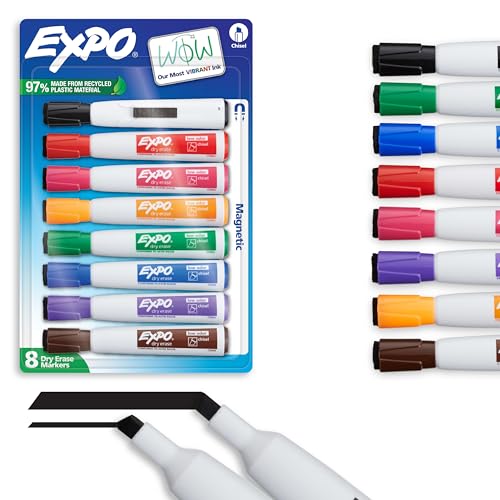
EXPO Magnetic Dry Erase Markers with Eraser, Chisel Tip, 8 Count
by EXPO
The conference-room workflow upgrade — magnetic caps that park on the board frame plus built-in erasers eliminate the two most common meeting interruptions, marker hunting and eraser searching.
Pros
- Magnetic cap clips directly to any steel-backed whiteboard frame, eliminating the lost-marker problem that disrupts every long meeting
- Built-in cap-mounted eraser allows quick corrections without putting down the marker or hunting for a separate eraser pad
- Quick-dry low-odor ink reduces smudging when sleeves or hands cross fresh writing — meaningful in collaborative whiteboard sessions with multiple participants
- 8-color palette (including brown and orange) provides wider color-coding options than the standard 4-color EXPO sets
Cons
- Magnet only attaches to magnetic-receptive whiteboard frames or magnetic surfaces — non-magnetic glass boards lose the primary feature benefit
- Cap-mounted eraser pad is small and wears out faster than a dedicated full-size eraser, requiring marker replacement when the eraser fails even if ink remains
- Higher per-marker cost than standard EXPO fine-tip sets without offering more ink — the premium pays for the magnetic and eraser features specifically
EXPO Ultra Fine Tip 8 Count — Best for Detail Work
The EXPO Ultra Fine Tip is the precision marker for genuine detail-work scenarios — whiteboard calendars with small daily cells, daily planner boards with hourly slots, dry-erase laminated forms with tight printed fields, and any context where 1mm fine-tip lines are still too thick for the available space. The 0.5 to 0.8mm line width is the narrowest produced by any reputable dry erase marker brand, and the use cases that require it are real: dry-erase wall calendars with one-inch daily cells, family schedule boards with multiple entries per day, and laminated planner sheets where each line of writing needs to fit a specific printed cell. For matching the marker tip to the planning system itself, our roundup of the best teacher planners covers the cell-size specifications that drive ultra-fine tip selection in K-12 environments.
The 97,000+ review dataset is the standout signal. This is the largest verified satisfaction dataset for any ultra-fine dry erase marker on Amazon by an order of magnitude — most ultra-fine markers from competing brands carry review pools in the low thousands. The sustained 4.6 star rating across that volume confirms that the ultra-fine format genuinely works at scale, not just for niche enthusiasts. The same EXPO AP-certified low-odor ink runs across the entire product line, which means the Ultra Fine Tip carries identical safety credentials and erase characteristics to the Chisel and Fine Tip versions — important for users who mix tip widths on the same board.
The honest physical trade-offs are real and worth understanding before purchase. Ultra-fine tips are mechanically more fragile than chisel tips — pressing too hard or writing on rough or aged melamine accelerates tip damage and requires careful technique. The lower ink reservoir per marker means heavy daily users will exhaust ultra-fine markers faster than chisel or standard fine equivalents — the per-marker lifespan is shorter even at lighter use levels. And visibility from across a conference room is limited at 0.5 to 0.8mm — ultra-fine is for close-distance writing on dry-erase calendars and forms, not for presentation boards visible from across a meeting table. Buy ultra-fine when your specific use case requires it; buy fine or chisel for general purpose work.

EXPO Ultra Fine Tip Dry Erase Markers, 8 Count
by EXPO
The precision marker for detail work — EXPO's ultra-fine 0.5-0.8mm tip handles small-cell calendars, daily planner boards, and laminated forms that chisel and standard fine tips cannot serve cleanly.
Pros
- Ultra-fine tip produces 0.5 to 0.8mm lines — the precision needed for small whiteboard calendars, daily planner boards, and dry-erase laminated forms with tight cells
- 97,000+ reviews represents the largest verified satisfaction dataset for any ultra-fine dry erase marker on Amazon by an order of magnitude
- Same EXPO AP-certified low-odor ink across the entire product line — consistent erase performance whether you mix ultra-fine, fine, and chisel on the same board
- 8-color set includes the practical workflow palette (black, blue, red, green, orange, brown, purple, pink) for color-coded scheduling and forms
Cons
- Ultra-fine tips are mechanically more fragile than chisel tips — pressing too hard or writing on rough melamine accelerates tip damage and requires careful technique
- Lower ink reservoir per marker than standard tips — heavy daily use will exhaust ultra-fine markers faster than chisel or standard fine equivalents
- Visibility from across a conference room is limited at this line width — ultra-fine is for close-distance writing, not large-format presentation boards
Crayola Take Note Chisel Tip 12 Count — Best for Teachers
The Crayola Take Note’s distinguishing feature is the ink-level indicator window on each marker — the only marker on this list that solves the problem every meeting facilitator and teacher has encountered: discovering a dead marker mid-presentation with no advance warning. The visible reservoir on the side of the barrel shows remaining ink at a glance, which means a quick visual scan of the marker tray before a meeting reveals which markers need replacement and which have plenty of ink remaining. For teachers managing classroom supplies on their own time and budget, this feature alone justifies the choice over equivalent-spec markers without the indicator.
Crayola’s classroom-tested low-odor formulation is the broader-context credential. Crayola supplies markers, crayons, and colored pencils to tens of thousands of K-12 schools, and their dry erase formulation has been refined across decades of classroom feedback to balance writing feel, erase performance, and ink longevity for sustained daily use in school environments. The broad chisel tip is slightly wider than EXPO’s standard chisel, producing more visible lines on large classroom whiteboards visible from the back of a typical 28-student classroom — a small but practical difference for teachers who need every student to read the board clearly.
The 12-color palette extends well beyond the standard 4-color rotation to include the accent colors teachers actually use for color-coded lesson plans, schedules, and student-name systems. The honest trade-offs match the Crayola brand profile across other product categories: tip wear is faster than EXPO under heavy daily use because Crayola’s tip felt is softer (prioritizing smooth writing feel over long-tip life), and not all 12 colors offer the same ink saturation — lighter colors like yellow and light blue can appear faded compared to the same colors from EXPO or ARTEZA. For teacher and home-office use where the indicator window’s mid-meeting failure prevention matters more than maximum tip durability, the Crayola Take Note is the right specification.

Crayola Take Note Dry Erase Markers, Chisel Tip, 12 Count
by Crayola
The teacher and home-office pick — Crayola's ink-level indicator solves the mid-meeting dead-marker problem, paired with a broad chisel tip and a 12-color classroom palette for visible scheduling and lesson plan boards.
Pros
- Ink-level indicator window on each marker shows remaining ink at a glance — the only marker on this list that solves the dead-marker mid-meeting surprise
- Crayola's classroom-tested low-odor formulation is the default classroom marker for tens of thousands of K-12 schools, with broad compatibility across whiteboard surfaces
- Broad chisel tip is slightly wider than EXPO's chisel, producing more visible lines on large conference room or classroom boards from across the room
- 12-count includes the practical teacher palette (black, blue, red, green, plus eight accent colors) for color-coded lesson plans, schedules, and student-name systems
Cons
- Tip wear is faster than EXPO under heavy daily use — Crayola's tip felt is softer, prioritizing smooth writing feel over long-tip life
- Not all 12 colors offer the same ink saturation — lighter colors like yellow and light blue can appear faded compared to the same colors from premium brands
- Ink-level indicator is helpful but not perfectly calibrated — the visible reservoir does not always reflect actual writing ink remaining due to capillary distribution in the felt
Best Fine-Tip Dry Erase Markers
If your work lives on kanban cards, scrum walls, meeting agendas, or small planner boards, tip width matters more than anything else on the spec sheet. Fine and ultra-fine tips let you fit legible writing into tight cells that a chisel edge would crowd. My default here is the EXPO Low Odor Fine — a 1mm line that reads cleanly across a desk while still fitting a sticky-note-sized card. Step down to the EXPO Ultra Fine only when you genuinely need 0.5–0.8mm precision for dry-erase calendars and laminated forms. Both are true fine tips; if you also want a marker that parks on the board frame, the EXPO Magnetic is a chisel tip and lives in the use-case table further down.
| Product | Price | Buy |
|---|---|---|
| EXPO Low Odor Dry Erase Markers, Fine Tip, Black, 12 CountBest fine-tip overall 1mm line fits kanban cards and agendas, with the highest rating on this list | $12.99 | View on Amazon |
| EXPO Ultra Fine Tip Dry Erase Markers, 8 CountFinest ultra-fine lines 0.5–0.8mm tip for calendar cells and forms too tight for standard fine | $8.79 | View on Amazon |
Best Low-Odor Dry Erase Markers
For a closed conference room, a windowless home office, or an elementary classroom, low-odor formulation is not a nice-to-have — it is the difference between an all-day whiteboard session and an afternoon headache. All three picks here use genuinely reduced-solvent ink, and two of them (the EXPO chisel and fine) carry ACMI AP certification, the independent safety seal that most K-12 procurement policies require. The EXPO Low Odor Chisel is my everyday low-odor default; the EXPO Low Odor Fine is the same trusted ink in a detail-friendly tip; and the Crayola Take Note gives you a broader classroom color palette with a low-odor formula tested across decades of school use.
| Product | Price | Buy |
|---|---|---|
| EXPO Low Odor Dry Erase Markers, Chisel Tip, 16 CountBest low-odor chisel AP-certified low-odor ink and versatile chisel tip — the conference-room default | $9.47 | View on Amazon |
| EXPO Low Odor Dry Erase Markers, Fine Tip, Black, 12 CountBest low-odor fine tip Same AP-certified low-odor formula in a 1mm tip for detail-dense boards | $12.99 | View on Amazon |
| Crayola Take Note Dry Erase Markers, Chisel Tip, 12 CountBest low-odor colors Classroom-tested low-odor ink across a 12-color palette with an ink-level window | $16.83 | View on Amazon |
Best Dry Erase Markers by Use Case
A few needs do not fit a single roundup slot — a marker that parks on the board, a bulk pack for a whole classroom, a full color palette, or clean performance on glass and mirror boards. Here is the shortest path to the right pick for each.
| Product | Price | Buy |
|---|---|---|
| EXPO Magnetic Dry Erase Markers with Eraser, Chisel Tip, 8 CountBest magnetic (clips to board) Magnetic cap parks on any steel-backed frame, plus a chisel tip and a built-in eraser for corrections | $8.99 | View on Amazon |
| ARTEZA Dry Erase Markers Bulk Pack of 52, Chisel TipBest bulk for classrooms 52 markers in 12 colors with roll-resistant barrels — the per-marker value buy | $32.99 | View on Amazon |
| Crayola Take Note Dry Erase Markers, Chisel Tip, 12 CountBest colored markers Broad chisel tip and a 12-color palette built for color-coded lesson plans | $16.83 | View on Amazon |
| EXPO Low Odor Dry Erase Markers, Chisel Tip, 16 CountBest for glass & mirror boards AP-certified low-odor ink erases cleanest from non-porous glass and mirror surfaces | $9.47 | View on Amazon |
Which Markers for Which Setup?
Conference rooms and training spaces. Specify chisel tip with AP certification and prefer a magnetic-cap option for shared boards. The EXPO Low Odor Chisel is the default, with the EXPO Magnetic (also a chisel tip) added for board-frame parking on multi-user boards. For closed-room ventilation conditions, AP certification is non-negotiable. Stock at least two backup markers per active board to avoid mid-meeting dead-marker disruption.
Classrooms and lecture spaces. Specify AP-certified chisel tip in bulk pack sizes that match annual consumption. The ARTEZA 52-pack is the correct procurement for self-contained classrooms; the EXPO 16-count is a smaller-classroom alternative. Crayola Take Note’s ink indicator pays off for teachers managing supplies on personal budget. For visibility from the back of typical 28-student rooms, broad chisel tips perform meaningfully better than fine or ultra-fine.
Kanban walls and agile boards. Specify fine tip for card-density legibility. EXPO Low Odor Fine Tip is the default; the multi-color palette of either Crayola Take Note or ARTEZA serves color-coded sprint workflows. Avoid chisel tip on kanban — the broad lines crowd individual cards. Ultra-fine tip is overkill for typical kanban card sizes.
Home offices and family schedule boards. Specify based on board surface and usage volume. Glass boards and porcelain boards take any of the seven markers cleanly; melamine boards favor low-odor name-brand markers (EXPO, ARTEZA, Crayola) over generics. For dry-erase wall calendars with one-inch daily cells, the EXPO Ultra Fine is the only tip that reliably fits multiple entries per day. For general home-office whiteboards, the Amazon Basics 12-pack delivers the right cost-to-performance balance for a non-procurement-defensible environment.
Maintenance Tips for Markers and Boards
Why your board ghosts (and how to fix it). Persistent ghosting that survives multiple cleanings is a board-surface problem, not a marker problem. The melamine polymer coating becomes microscopically porous after months of daily use, trapping ink residue permanently. The fix is isopropyl alcohol (70 percent or higher) on a microfiber cloth, scrubbed thoroughly across the board surface, then followed with a whiteboard-specific cleaner or melamine eraser sponge. For boards that ghost persistently after thorough alcohol cleaning, the surface is permanently degraded — replace it with a porcelain-steel or glass board for any high-use environment. Switching markers will not fix a ghosted board.
How to revive a dried-out marker. Dry erase markers that appear dead are often recoverable if the felt nib has not become rigid. Remove the cap, dip the tip into a small amount of isopropyl alcohol for 15 to 30 seconds, blot on scrap paper until ink begins to flow, and re-cap immediately. This recovers most markers that died from cap-off drying. Markers that have been dry for more than a few weeks are typically not recoverable because the ink has chemically aged within the reservoir. Storage tip-down in a vertical caddy meaningfully extends marker life by gravity-feeding ink toward the felt nib.
The magnetic-cap conference room trick. Even with standard non-magnetic markers, you can solve the lost-marker problem by storing markers in a small magnetic clip attached to the whiteboard frame — most office supply caddies include magnetic mounting options. The combination of magnetic storage and tip-down orientation extends marker life and eliminates the meeting-disruption searches that misplaced markers cause. Pair this with sticky notes on the board itself for permanent annotations that need to survive board erasing.
Laminated sheets behave differently to a board. A laminating pouch has a glossy polyester surface rather than melamine, so it releases ink more readily and effectively never ghosts — which is why a laminated printable is the better home for a list you tick off and wipe every week. Low-odor chisel-tip markers work best on it; ultra-fine tips can skate on the slicker finish. Our free house cleaning checklist is built for exactly this treatment: print it, laminate it once, and run it all year with one marker.
How to Choose the Best Dry Erase Marker
Buyer's Guide
Choosing a dry erase marker requires matching three variables to your environment: the surface type of your board, the line width your work requires, and the safety certification appropriate to your space — get those three right and any marker on this list will perform well, get them wrong and even premium markers will disappoint.
Tip Type and Size
Dry erase markers come in three tip categories that produce meaningfully different results. Chisel tips (1 to 5mm depending on edge orientation) are the conference-room standard — the angled flat edge produces broad strokes for large headers and narrow strokes for line text from a single tool, and the wider line width is visible from across a meeting room. Fine tips produce approximately 1mm consistent line width — ideal for kanban cards, agile boards, scrum walls, and any context where information density matters more than visual impact at distance. Ultra-fine tips produce 0.5 to 0.8mm lines, the precision needed for dry-erase calendars with small daily cells, laminated planner pages, and dry-erase forms with tight printed fields. Most environments need a chisel tip as the primary marker; add fine or ultra-fine as a secondary tool if your specific use case requires it. Trying to do detail work with a chisel tip is frustrating; trying to fill a presentation-board header with an ultra-fine tip wastes time and ink.
Low-Odor Formulas and AP Certification
Modern dry erase markers use one of three ink formulations: standard alcohol-based (the original EXPO chemistry from the 1980s, recognizable by the strong solvent smell), low-odor alcohol-based (the current corporate-office standard, with the same erase performance and substantially reduced solvent volatility), and water-based (used for some specialty markers but rare in mainstream brands). For closed conference rooms with limited ventilation, low-odor formulas are mandatory — extended use of standard alcohol-based markers in a sealed meeting room produces detectable air-quality issues that can trigger headaches in sensitive users. ACMI AP certification is the independent third-party safety standard administered by the Art and Creative Materials Institute. Markers carrying the AP seal have been formally evaluated by a toxicologist; markers labeled merely 'non-toxic' without the AP seal are making a self-declared claim without independent verification. For K-12 classroom procurement, AP certification is typically a district policy requirement. For corporate offices, it provides defensible documentation of safety due diligence.
Whiteboard Surface Compatibility
The marker brand matters far less than the board surface — and most users buying dry erase markers do not realize their ghosting and erase problems originate with the board, not the marker. Melamine boards are the lowest-cost whiteboard option, used in budget office boards and inexpensive home boards. Their thin polymer coating is microscopically porous and degrades over months of daily use, eventually trapping ink residue and producing permanent ghosting that no marker can prevent. Porcelain-steel boards have a fired ceramic coating that is dramatically more durable — they retain clean-erase performance for decades and accept any quality dry erase marker without ghosting. Glass whiteboards are non-porous and produce the cleanest erase of any surface, but the smooth surface causes faster smudging before ink fully dries, which favors low-odor quick-dry formulas. If you are experiencing persistent ghosting after switching markers, the board is the problem, not the marker — clean it with isopropyl alcohol and consider replacing the surface for high-use environments.
Erasability and Ghosting
Ghosting — the faint shadow of erased marker that remains visible after cleaning — has two distinct causes that require different solutions. Recent ghosting (within hours of writing) is a marker-formula problem; some low-quality markers use pigments that begin chemical bonding with the board surface immediately, becoming progressively harder to remove over time. The fix is to switch to a name-brand low-odor formulation (EXPO, ARTEZA, Crayola) that uses surface-only ink chemistry. Persistent ghosting (visible across multiple cleanings, days after writing) is a board-surface problem — the polymer coating has degraded and absorbed ink permanently. The fix is isopropyl alcohol on a microfiber cloth, then a whiteboard-specific cleaner or melamine eraser sponge. For boards that continue to ghost after thorough cleaning, the surface is permanently compromised and replacement is the only solution. Erasing within 24 to 48 hours of writing significantly reduces ghosting risk on any surface; ink left on a board for weeks chemically bonds with even premium polymer coatings.
Magnetic Caps and Built-In Erasers
The two workflow problems that disrupt every long meeting are misplaced markers and missing erasers. Magnetic cap markers (like the EXPO Magnetic) attach directly to any steel-backed whiteboard frame, parking themselves at the edge of the board where they remain visible and accessible throughout a session — a small detail that meaningfully reduces meeting friction. Cap-mounted erasers eliminate the secondary problem of hunting for a separate eraser pad to make corrections. The trade-offs are real: the magnetic feature only works on magnetic-receptive surfaces (most office boards but not glass-only boards), the cap-mounted eraser pad is smaller than a dedicated eraser and wears out faster, and the per-marker cost is higher than standard fine-tip equivalents. For shared conference rooms where multiple users contribute to a board during meetings, the magnetic-and-eraser combination is worth the premium. For solo home-office use where you control your own marker placement, the feature is optional convenience rather than necessity.
Pack Size and Per-Marker Cost
Dry erase markers are consumable supplies, and the per-marker economics differ significantly by pack size. Single packs of name-brand 12-count markers (EXPO, Amazon Basics) run roughly seventy to seventy-five cents per marker. Bulk buys (ARTEZA 52-count) drop to roughly thirty-three cents per marker — less than half the single-pack rate, which is the entire economic argument for buying bulk. The right pack size depends on your replacement cycle: a typical home office or single small conference room consumes one to two markers per month, making a 12-count pack a 6 to 12 month supply at premium-brand cost. Classrooms and multi-board offices consume markers far faster — a high school classroom can go through 30 to 50 markers per academic year, where bulk packs deliver real savings. The hidden cost is dry-out: markers stored with imperfect cap seals dry out before their ink runs out, which means buying more markers than you need accelerates waste. Match pack size to your actual consumption rate, not your aspirational buying cycle.
Final Verdict
For the majority of conference rooms, classrooms, training spaces, and home offices that need a single specification covering daily dry-erase work, the EXPO Low Odor Chisel Tip 16 Count is the right starting point. Its two-decade track record, ACMI AP non-toxic certification, clean-erase formulation across all three whiteboard surface types, and chisel-tip versatility for both header and line writing make it the default specification that procurement teams have been writing for the better part of a generation. Pair it with a porcelain-steel or glass whiteboard surface and you eliminate ghosting problems entirely; pair it with the EXPO Magnetic for shared conference rooms and you eliminate the lost-marker disruption that interrupts every long meeting.
For budget-conscious buyers and high-replacement-rate environments where AP certification is not a procurement requirement, the Amazon Basics Dry Erase Markers deliver acceptable EXPO-comparable performance at a price that removes purchasing hesitation. For classrooms and multi-board offices that consume markers in volume, the ARTEZA 52-Pack is the correct bulk-procurement specification with full AP certification and roll-resistant hexagonal barrels. Whichever marker you select, remember that the marker is only one of three variables: match the tip type to your line-width needs, match the formulation safety credential to your room ventilation conditions, and most importantly, address ghosting at the board-surface level rather than blaming the marker. Get those three right and any marker on this list will deliver the clean, reliable, low-friction whiteboard experience that meeting facilitators, teachers, and home-office workers depend on every day.
Frequently Asked Questions
Why does my whiteboard ghost when I erase old marker, and how do I fix it?
What does ACMI AP certification mean, and why does it matter?
Can I use these markers on glass whiteboards, or do I need special glass markers?
Should I buy fine tip or ultra-fine tip markers?
Are neon and bright-colored dry erase markers safe to use, or do they stain?
What is the difference between wet erase and dry erase markers?
Related Articles
About the Reviewer

Sarah Chen, CAP, PMP
B.A. Business Administration, UCLA
Sarah Chen spent 10 years in office management and operations at Fortune 500 companies before founding DeskRated in 2026. After managing supply budgets for teams of 50+ people and testing thousands of products through daily use, she started writing the honest, no-fluff supply reviews that office professionals actually need. Sarah holds both CAP and PMP certifications and is based in Los Angeles.