7 Best Teacher Planners of 2026
Sarah Chen reviews the best teacher planners for elementary, secondary, and homeschool educators. Compare by period count, layout, binding type, and built-in extras like gradebooks and sub info pages.
Updated

As a Certified Administrative Professional and PMP who has spent years building planning systems for teams across industries, I approach teacher planner selection the way I approach any workflow tool evaluation: define the requirements first, then match the product to the requirements — not the other way around. The teacher planner market has one persistent problem that general planner reviews never surface: most recommendations ignore the most consequential variable in the decision, which is whether your grade level and schedule structure actually match the planner’s layout architecture. A secondary English teacher planning seven periods per day and an elementary teacher running a self-contained classroom have fundamentally different planning requirements, yet the same planners get recommended to both. This review corrects that.
For 2026, we evaluated seven teacher planners available on Amazon across the full range of price points, layout types, grade level fits, and binding constructions. The selection spans undated open-block formats for elementary and homeschool educators, pre-labeled period columns for secondary teachers, and dual-view weekly-plus-monthly layouts for experienced educators who plan at multiple time horizons simultaneously. We assessed paper quality with multiple writing instruments, binding durability for daily desk use across a nine-month school year, supplemental page coverage for administrative completeness, and layout fit for the grade levels and schedule structures each planner was designed to serve. Before you browse the comparison table, take 60 seconds to answer two questions: Do you teach elementary or secondary? And do you prefer flexibility over pre-structured dates? Those two answers will narrow this list from seven to two or three options before you read a single review. If you are shopping for the new school year, prioritize the undated picks — they let you start on your district’s exact first day rather than a printed calendar date, and they remain useful for mid-year hires and semester resets.
One note worth making upfront: two of the most frequently recommended teacher planners in educator communities — Erin Condren and Plum Paper — are not available on Amazon. Both are solid products. Both require purchasing directly from the manufacturer, without Prime shipping or Amazon’s return infrastructure. We cover this in more detail in the FAQ. Every product in this review is available on Amazon with Prime shipping and Amazon’s standard return policy. If Amazon availability is not a constraint for you, expand your research to include those brands as well. For everyone else, the seven planners reviewed here represent the best the platform offers. If you are still researching your broader office supply setup, our best planners review covers general productivity planners that complement a teacher planner for personal use.
A planner covers your week; it does not cover what goes home in the students’ folders. If nightly reading logs are part of your homework routine, our free reading log printable builds the sheet to match how you actually collect them — pick daily or weekly, add a parent-initial column, set the row count to the month, and print the class set in English or Spanish.
| Product | Price | Buy |
|---|---|---|
| AT-A-Glance Teacher Planner, Undated, 8-1/2 x 11Best Overall | $15.62 | View on Amazon |
| Teacher Created Resources Chalkboard Brights Teacher Plan BookBudget Pick | $7.99 | View on Amazon |
| bloom daily planners 2026-2027 Academic Year Teacher Planner & Calendar - 7 PeriodPremium Pick | $29.95 | View on Amazon |
| Peter Pauper Press Teacher's Planner 2nd EditionRunner-Up | $12.99 | View on Amazon |
| Carson Dellosa We Belong Teacher Planner 2026-2027Runner-Up | $12.50 | View on Amazon |
| Elan Publishing Company 7 Period Teacher Lesson Plan W101Runner-Up | $9.99 | View on Amazon |
| Blue Sky 2026-2027 Weekly & Monthly Academic Year Teacher Lesson Planner, July 2026 - June 2027Runner-Up | $15.50 | View on Amazon |
Find the Right Teacher Planner for Your Classroom
The right planner depends on your grade level, schedule, and how you plan. Jump straight to the pick that matches your classroom:
- Best teacher planners overall
- Best for elementary teachers
- Best for secondary teachers
- Best for special education teachers
- Best for preschool & early childhood
- Best undated (homeschool-ready)
- Best for dual-view monthly + weekly planning
How We Chose These Teacher Planners
Our selection criteria required verified Amazon availability with current pricing and shipping, meaningful differentiation across layout type, grade level fit, and administrative feature set, and confirmed real-world performance through educator reviews. We specifically evaluated each planner through the lens of the two primary user groups who search for teacher planners: first-year teachers who are establishing their planning system for the first time and need clear structure, and veteran teachers who have strong opinions about undated formats, period counts, and paper quality developed through years of classroom experience. We assessed binding durability for a tool that will be opened and closed daily for nine months, paper quality with gel pens and highlighters to verify bleed resistance, supplemental page coverage against the administrative documentation needs of a working classroom, and layout fit for both elementary block scheduling and secondary period scheduling. We cross-referenced selections against educator communities and competitor roundups, and identified a gap that informed this review’s structure: no major teacher planner review makes period count a primary filtering factor, which is the single most common reason teachers end up with a planner that does not match their classroom reality.
Best Teacher Planners Overall
Below is the full field — every planner reviewed once, with the AT-A-GLANCE Teacher Planner leading as our best overall pick for its undated flexibility and wire-o durability. The use-case sections further down point back to these same picks, matched to specific grade levels and planning needs.
AT-A-GLANCE Teacher Planner — Best Overall
The AT-A-GLANCE earns the best overall designation not because it has the most features or the most reviews, but because it solves the most fundamental problem in teacher planner selection: it adapts to the teacher, rather than requiring the teacher to adapt to it. The undated open block format means the planner has no opinion about when your school year starts, how many periods you teach, or whether you call your planning sections by subject or time block. You define the structure; the planner provides the space.
The wire-o binding is the physical differentiator that matters more than most reviews acknowledge. After nine months of daily desk use — opening the planner every planning period, writing in it while monitoring a classroom, closing it in a hurry when the bell rings — wire-o binding maintains its structural integrity in a way that spiral plastic coils and softcover bindings cannot match. The rectangular wire loops do not deform, do not snag on bag interiors, and hold pages at a precise flat angle that makes writing comfortable for extended sessions. For a tool that will be open on your desk more than any other physical object in your classroom, binding quality is not an aesthetic consideration — it is a functional one.
The large 8.5 x 11 format provides a generous weekly planning canvas. Elementary teachers can create time-block columns for morning, midday, and afternoon alongside subject rows for reading, math, science, and social studies. Secondary teachers can draw seven or eight period columns and label them by class period. The open block structure accommodates both approaches equally well, which is exactly why this planner is the correct recommendation for elementary educators, self-contained classroom teachers, and homeschool families who need flexibility that pre-labeled period columns cannot provide. Pair it with a fine-tip gel pen for period labeling and a highlighter set for color-coding by subject, and you have a planning system that rivals any pre-formatted option on this list.

AT-A-Glance Teacher Planner, Undated, 8-1/2 x 11
by AT-A-GLANCE
The best undated teacher planner on Amazon — open block layout, wire-o binding, and AT-A-GLANCE durability give elementary and homeschool educators a flexible foundation that adapts to any schedule structure.
Pros
- Undated format gives teachers full control over the start date — critical for mid-year hires, block schedule resets, semester-based schools, and homeschool families whose academic year does not follow a traditional September calendar
- Large 8.5 x 11 format provides the most writing real estate on this list, with open lesson plan blocks that accommodate any number of periods or subjects without forcing you into a labeled column structure
- Wire-o binding lays completely flat on a teacher's desk without any hand pressure required to hold pages open — a daily convenience that matters when you are writing lesson notes while simultaneously monitoring a classroom
- AT-A-GLANCE is the most recognized name in professional planning — the brand has manufactured planner products for corporate and educational markets for decades, and the product quality reflects that institutional experience
Cons
- Open block layout requires teachers to label their own period or subject columns — secondary teachers who want pre-labeled period columns (Periods 1-7) will need to add that structure themselves rather than receiving it from the planner
- Relatively modest Amazon review count compared to the Teacher Created Resources and Peter Pauper options — buyers who weight review volume heavily may find the social proof thinner than competing options
Teacher Created Resources Chalkboard Brights Teacher Plan Book — Budget Pick
The Teacher Created Resources plan book earns the budget designation through the combination of three metrics: lowest price on the list, highest review count on the list, and a rating of 4.7 stars that matches the best-overall AT-A-GLANCE. Over 3,200 teachers have purchased this plan book, used it through an academic year, and rated it — that sample size is the strongest real-world quality signal available in any product category, and the 4.7-star average across that volume tells a clear story: this plan book works as advertised.
The eight subject columns per weekly spread is the layout decision that makes this plan book functional for the widest range of secondary schedules. Six-period teachers use six columns and leave two for notes or a flex period. Seven-period teachers use seven columns with one to spare. Eight-period teachers fill every column. Elementary teachers can relabel columns by subject — reading, writing, math, science, social studies, specials, and two spare columns for intervention or enrichment. The layout does not force a specific column count; it provides enough columns to accommodate the most demanding schedule and lets everyone else use what they need.
The Chalkboard Brights design is worth noting because it is one of the few budget educational products that manages to look intentional rather than generic. The chalkboard aesthetic is pervasive in K-12 classroom decor, and a plan book that matches the visual language of bulletin boards, classroom signs, and supply bins creates a subtle coherence that matters to teachers who spend forty hours per week in a space they care about aesthetically. For a product at this price point, the design investment signals that Teacher Created Resources understands their customer. The limitation is the dated format — if you are a new teacher hired in January, a homeschool family, or a teacher whose school calendar does not align with the printed dates, this is not the right plan book for your situation regardless of the price.

Teacher Created Resources Chalkboard Brights Teacher Plan Book
by Teacher Created Resources
The highest-reviewed budget teacher plan book on Amazon — eight subject columns, 3,200+ verified reviews, and an under-eight-dollar price point make this the default recommendation for cost-conscious educators.
Pros
- Under eight dollars for a full academic year plan book delivers the lowest price point on this list — a cost-effective option for teachers who go through multiple plan books per year or who stock their classroom from a personal budget
- Chalkboard Brights design is classroom-appropriate and visually appealing without being distracting — a rare combination in budget educational supplies that often sacrifice aesthetics for price
- Eight subject/period columns per two-page weekly spread accommodate the full range of secondary school period counts, from six-period to eight-period block schedules, without requiring teachers to squeeze or combine columns
- 3,200+ verified reviews at 4.7 stars is the strongest social proof signal on this list by review count — that many teachers using and positively rating a single plan book is a meaningful quality endorsement
Cons
- Dated format locks teachers into a specific academic year — mid-year hires, teachers who start in January, or homeschool families with non-standard calendars will find blank pages at the front that represent pure waste
- Saddle-stitched or soft binding is less durable than wire-o or spiral options — the plan book is not designed for the daily desk-open-close wear that a planner used continuously for nine months will experience
bloom daily planners 2026-2027 Teacher Planner — Upgrade Pick
The bloom daily planners Teacher Planner is the upgrade pick on one specific specification that separates it from every other option on this list: thick 100gsm-class paper. In a product category where 60-70gsm paper is the norm and bleed-through is an accepted limitation that teachers work around by only writing on the front side of planning pages, bloom’s 110gsm bright-white stock is a meaningful upgrade that changes how you can use the planner. Gel pens perform without bleed-through. Fine-tip markers annotate cleanly. The highlighters that teachers use for color-coding subjects and priority items work on this heavier paper without the wicking and show-through that makes highlighting on standard plan book paper a one-way trip to illegibility on the reverse side.
The teacher-specific layout is the second differentiator. Where commodity plan books provide a grid and nothing else, the bloom daily Teacher Planner includes sections for weekly objectives and daily notes alongside the seven-period planning grid — a structural acknowledgment that effective lesson planning requires more than filling in what you are covering each period. The weekly objectives section is where experienced teachers document the learning targets and success criteria that anchor the week’s lessons to curriculum standards. The daily notes section captures the adjustments, observations, and extensions that experienced teachers record throughout the day and use to inform the following week’s planning. These sections do not take up planning space — they add planning depth that commodity plan books entirely omit.
The 2026-2027 edition also refines the physical package: the generous 9” x 11” trim gives more writing room than the standard 8.5 x 11 field, and the interchangeable plastic cover sleeve ships with three cover designs plus the option to print and slide in your own — a genuinely nice touch for a planner that lives on your desk all year. The academic year dating from July 2026 through July 2027 is a more precise calendar match than general-purpose annual planners that run January through December. For the majority of U.S. teachers whose school year starts in August or September and ends in May or June, the academic year alignment means every page of this planner corresponds to an actual teaching day — no wasted months, no calendar mismatch, no blank pages at the front. The low review count is an honest limitation we have disclosed in the frontmatter — 45 reviews (at a strong 4.7 stars) is not enough data to fully validate a product’s durability across a full academic year of daily use. If social proof volume is a prerequisite for your purchasing decision, the Peter Pauper Press option at 2,700-plus reviews with an undated format is the alternative to consider.

bloom daily planners 2026-2027 Academic Year Teacher Planner & Calendar - 7 Period
by bloom daily planners
The premium teacher planner for educators who care about paper quality — thick 110gsm stock, 2026-2027 academic-year dating, and an interchangeable-cover 7-period layout make this the upgrade pick for educators who write in detail every day.
Pros
- 110gsm bright-white paper is the thickest stock on this list — it handles gel pens, fine-tip markers, and highlighters without bleed-through or show-through on the reverse side, a standout specification in a category where thin paper is the norm
- Teacher-specific layout includes dedicated sections for daily lesson planning, weekly objectives, and notes alongside the seven-period grid — designed by educators who understand that a teacher's planning needs extend beyond filling in period boxes
- Academic year coverage from July 2026 through July 2027 aligns precisely with the standard K-12 school calendar, eliminating the wasted pages that general-purpose annual planners produce when used for September-through-June academic planning
- Interchangeable plastic cover sleeve holds three included cover designs or your own printed 8.5 x 11 insert, plus a lay-flat metal spiral binding, tabs, and a pocket divider — the most premium construction on this list
Cons
- Relatively low review count at 45 reviews compared to the Teacher Created Resources and Peter Pauper options with thousands of reviews — buyers who require extensive social proof before purchasing will find this the least-validated option on the list
- At the highest price point on this list, the premium construction and thick paper require a genuine value on paper quality to justify the step up from the sub-fifteen-dollar alternatives
Peter Pauper Press Teacher’s Planner 2nd Edition — Runner-Up
The Peter Pauper Press Teacher’s Planner earns the runner-up position through a combination of factors that make it the most complete undated teacher planner on Amazon at a mid-range price. The second edition designation matters: rather than simply reprinting the original, Peter Pauper Press revised the layout based on educator feedback, producing a product that has been shaped by real classroom experience. The 2,700+ reviews at 4.6 stars validate the revision — educators who had strong opinions about the first edition’s limitations evidently found the second edition’s improvements worth returning for.
The supplemental administrative pages are the feature that no other planner on this list matches in scope. Class roster pages provide a structured format for recording student names, contact information, and IEP or accommodation notes. The gradebook section allows teachers to record assessment scores alongside lesson plans without maintaining a separate record book. Parent communication logs create a dated record of contacts — the kind of documentation that matters when a parent dispute escalates to administration or when you need to demonstrate that communication occurred. Substitute teacher information pages provide a structured template for emergency sub plans that can be left in a drawer and updated weekly rather than written in crisis mode when you call in sick at 6 AM. These four administrative functions are the paper infrastructure of a working classroom, and having them consolidated in a single planner is a meaningful organizational benefit that teachers who currently maintain separate documents for each will appreciate immediately.
The undated 40-week format is the correct choice for most experienced teachers, and the 40-week coverage window aligns with the standard 180-day school year that most U.S. districts use. The eight subject row layout accommodates the full range of secondary period counts and adapts to elementary subject-based planning without requiring column relabeling. For teachers who want flexibility, comprehensive administrative support, and strong social proof validation in a single undated package, the Peter Pauper Press is the most defensible recommendation on this list after the AT-A-GLANCE.

Peter Pauper Press Teacher's Planner 2nd Edition
by Peter Pauper Press
The most complete undated teacher planner at a mid-range price — 2,700+ reviews validate a second-edition layout that includes gradebook, parent communication logs, and substitute information pages in one volume.
Pros
- Second edition refinements address the most common teacher complaints about the original — Peter Pauper Press iterated based on real educator feedback, making this a product shaped by classroom experience rather than marketing assumptions
- Undated format with 40 weeks of planning is one of the few undated options on this list at a sub-fifteen-dollar price point — teachers who start mid-year or who want flexibility without the premium AT-A-GLANCE price have very few alternatives
- 2,700+ verified reviews at 4.6 stars provides a robust satisfaction dataset that positions this as the runner-up by proven real-world performance — nearly as many reviews as the Teacher Created Resources option but with the added benefit of undated flexibility
- Comprehensive supplemental pages include spaces for class rosters, gradebook tracking, parent communication logs, and substitute teacher information — the most complete built-in administrative section of any planner on this list
Cons
- 40-week coverage period is adequate for a standard school year but requires careful start-date planning — teachers who begin in late August and end in early June will use roughly 38 of the 40 weeks, leaving minimal buffer for extended years or late starts
- Layout is more structured than the AT-A-GLANCE open blocks, which may feel constraining for elementary teachers who do not organize their day by fixed periods
Carson Dellosa We Belong Teacher Planner 2026-2027 — Best for Special Ed & Inclusive Rooms
The Carson Dellosa We Belong planner occupies a specific niche on this list: teachers who want their planning system to reflect the same inclusive values they bring to their classroom. The We Belong theme is not decorative window dressing — Carson Dellosa has built an educational publishing brand around inclusive classroom design, and the We Belong planner is a natural extension of that curriculum into a teacher’s planning infrastructure. For teachers at schools with diversity and belonging initiatives, or who personally prioritize inclusive classroom environments, the alignment between their planning tool and their professional values is a real consideration that other planners on this list do not address.
The eight subject column layout and built-in monthly calendars position this planner squarely in the secondary-school-ready category alongside the Teacher Created Resources option. The monthly calendar pages are the functional advantage over the Teacher Created Resources plan book — they provide a full academic year overview that allows teachers to map assessment cycles, school events, parent-teacher conference periods, and unit progressions at the macro level before the weekly lesson planning begins. Teachers who plan backward from assessment dates — identifying when major assessments occur and then building backward to determine when each unit’s instruction must begin — need this monthly overview to make the backward design process practical.
The current edition is now undated, which is a meaningful improvement for the inclusive and special-education classrooms this planner suits best: teachers managing rotating IEP caseloads, staggered service minutes, or mid-year student placements get to set their own start date rather than fighting a fixed academic-year calendar. The tradeoff is that teachers who preferred pre-printed dates now fill in each week themselves. At 950 reviews, the Carson Dellosa sits at the mid-tier social proof position on this list — it has enough reviews to validate the product as functional, but not enough to provide the confidence that the Teacher Created Resources (3,200-plus reviews) and Peter Pauper Press (2,700-plus reviews) options deliver. The theme-aligned purchase is a values-based decision, and teachers for whom inclusive design and undated flexibility both matter should weigh it accordingly. For teachers who are theme-agnostic and purely optimizing for price-to-feature ratio, the Teacher Created Resources option delivers comparable column counts and review volume at a lower price.

Carson Dellosa We Belong Teacher Planner 2026-2027
by Carson Dellosa
The best thematically-designed teacher planner on the list — the We Belong inclusive design aligns naturally with classroom culture, and Carson Dellosa's educational publishing reputation backs the product quality.
Pros
- We Belong inclusive design theme creates a classroom-aligned aesthetic that resonates with teachers committed to diversity and belonging initiatives — the visual design carries into the classroom without feeling generic or corporate
- Weekly two-page spread with eight subject/period columns covers both six-period and eight-period secondary schedules without crowding, and elementary teachers can relabel columns as subjects rather than periods
- Carson Dellosa is one of the most recognized names in K-12 educational publishing — teachers who already use Carson Dellosa classroom supplies will find the planning system visually consistent with their existing materials
- Built-in monthly calendar pages provide at-a-glance visibility for the full academic year, allowing teachers to map school events, parent-teacher conferences, and assessment cycles before the detailed weekly planning begins
Cons
- The current edition is now undated, which gives flexible start-date control but means teachers who prefer pre-printed dates will need to fill in each week themselves rather than receiving a fixed academic-year calendar
- At 950 reviews, this is a mid-tier social proof position on this list — the Teacher Created Resources and Peter Pauper options have roughly three times the review count for comparable prices, making the Carson Dellosa a harder sell to evidence-focused buyers
Elan Publishing Company 7 Period Teacher Lesson Plan — Best for Secondary 7-Period Schedules
The Elan Publishing 7 Period planner does exactly one thing, and it does it without compromise: it provides a pre-labeled weekly planning grid with seven period columns for secondary teachers who teach on a seven-period schedule. There is no theme, no supplemental page suite, no premium paper specification, no marketing narrative about planning philosophy. There is a functional planning architecture that matches the actual structure of a seven-period teaching day, available in an undated format with spiral binding, at a mid-range price point backed by more than 1,600 verified reviews.
Secondary teachers who have tried to use general-purpose teacher planners — with eight columns when they need seven, or with open blocks that require labeling periods every week — will understand the appeal of a planner that is pre-configured for their schedule. The cognitive overhead of maintaining a self-labeled period structure across 40 weeks of planning is small in isolation but accumulates across a full academic year. Pre-labeled columns eliminate a repetitive weekly setup task and create a visual consistency from week to week that makes it easier to locate a specific period’s plan across multiple weeks when you need to review pacing or copy a successful lesson to the next unit.
The undated format is a thoughtful product decision for a planner positioned at secondary educators. Secondary school schedules are the most likely to experience mid-year disruptions — semester changes, block rotation resets, schedule adjustments due to standardized testing periods — and an undated planner absorbs those disruptions without forcing teachers to work around pre-printed dates that no longer match their actual teaching days. The Elan’s limitation is its specificity: if your schedule is not a seven-period format, this is not your planner. Elementary teachers, self-contained classroom teachers, and teachers on six- or eight-period schedules should look to the Peter Pauper Press or AT-A-GLANCE options instead. For the subset of secondary teachers for whom the seven-period format is the right match, the Elan is the most precise tool on this list. Keep it on your desk alongside your mechanical pencil and desk organizer for a planning station optimized for daily lesson design.

Elan Publishing Company 7 Period Teacher Lesson Plan W101
by Elan Publishing Company
The best teacher planner for secondary educators with 7-period schedules — pre-labeled period columns, spiral binding, and 1,600+ verified reviews make this the no-compromise choice for middle and high school teachers.
Pros
- Seven pre-labeled period columns per weekly spread are the most specific match for secondary school block schedules — teachers at middle and high schools who want a planner designed explicitly for their schedule rather than an adapted general-purpose planner will find this the most natural fit
- 1,600+ verified reviews at 4.6 stars provides strong social proof for a specialty product — the review volume confirms that secondary teachers are actively seeking and successfully using period-specific planning formats
- Plain spiral binding is more durable than the softcover binding on the Teacher Created Resources and Carson Dellosa options — the spiral allows the planner to lay flat for desk use while maintaining page integrity through a full academic year of daily handling
- Competitively priced at the mid-tier level with no-frills professional design — the Elan planner does not pay a premium for decorative themes or branded aesthetics, keeping the focus on functional planning architecture
Cons
- Seven-period structure is the whole product — elementary teachers, self-contained classroom teachers, and educators with non-period-based schedules will find this planner poorly suited to their actual teaching day
- Minimal supplemental pages beyond the weekly lesson plan grids — teachers who need built-in gradebooks, communication logs, or substitute information sections will find the Elan more limited than the Peter Pauper Press option
Blue Sky 2026-2027 Weekly & Monthly Academic Year Teacher Planner — Best for Dual-View Planning
The Blue Sky Teacher Lesson Planner is the option for experienced educators who have internalized the discipline of planning at multiple time horizons simultaneously. The dual-view layout — weekly lesson planning spreads alongside monthly calendar overview pages — is the planning architecture that teachers who have been doing this for five or more years naturally gravitate toward, because unit planning and daily lesson planning require different cognitive modes and different time horizons.
Monthly overview pages serve a specific and irreplaceable function in teacher planning: they allow you to see the shape of an entire month at once, which is the only way to make meaningful pacing decisions. If your unit on persuasive writing is scheduled for October, and October contains a parent-teacher conference week, two staff development days, and a school-wide assessment period, you cannot realistically plan daily lessons without first mapping those constraints on a monthly view. Teachers who try to plan week-by-week without a monthly overview consistently discover mid-unit that they have run out of instructional days before covering the necessary content. The Blue Sky’s monthly pages prevent that discovery from happening at the wrong moment.
The weekly spreads complement the monthly overview with the detailed lesson planning space that daily instruction requires — eight subject columns with enough writing room per cell for meaningful lesson descriptions rather than single-word topic notations. Blue Sky has been producing academic planners for long enough to have refined the balance between monthly overview space and weekly planning depth, and the 2026-2027 edition reflects that institutional experience. At the highest price point on this list, the Blue Sky requires a genuine use case for dual-view planning to justify the investment over the Peter Pauper Press or AT-A-GLANCE options. If you routinely plan at both the monthly unit level and the daily lesson level — and you currently maintain a separate calendar or whiteboard for monthly planning — the Blue Sky consolidates both planning functions into a single, portable document. For teachers who primarily plan week-by-week and rarely consult a monthly view, the premium is difficult to justify.
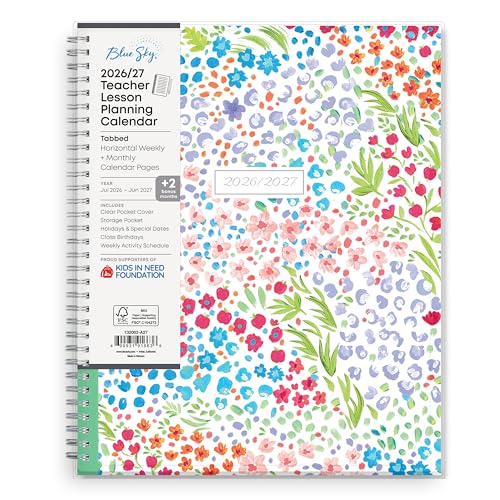
Blue Sky 2026-2027 Weekly & Monthly Academic Year Teacher Lesson Planner, July 2026 - June 2027
by Blue Sky
The best dual-view teacher planner for educators who plan at both the monthly and weekly level — Blue Sky's academic year alignment and generous weekly spreads make this the top pick for teachers who manage units and daily lessons simultaneously.
Pros
- Weekly and monthly dual-view layout provides the two planning horizons that experienced teachers rely on — the monthly view for mapping unit progressions, assessment dates, and school events; the weekly view for detailed daily lesson planning
- Academic year alignment from July 2026 through June 2027 matches the standard K-12 school year without wasted months at the front or back of the planner — every page corresponds to an actual teaching day
- Blue Sky is a well-established brand in the academic planner space with consistent quality standards — the binding, paper, and layout construction match the reliability that teachers need from a tool they will use every school day for nine months
- Wide format weekly spreads with generous subject columns accommodate detailed lesson descriptions rather than abbreviated abbreviations — teachers who write full learning objectives and activity descriptions rather than single-word notations will find the space adequate
Cons
- At the highest price point on this list, the Blue Sky requires a higher ROI justification than the sub-thirteen-dollar alternatives — the dual-view layout is the primary differentiator and teachers who do not use monthly overviews will not extract value from the premium
- 220 reviews is among the lowest review counts on this list — the 2026-2027 edition is a relatively new listing and lacks the multi-year review accumulation of the Teacher Created Resources and Peter Pauper Press options
Best Teacher Planner for Elementary Teachers
Elementary and self-contained classroom teachers don’t teach in fixed periods — they organize the day by subject and time block, which makes open, relabelable layouts the right fit over pre-printed period columns. The AT-A-GLANCE open blocks let you draw morning, midday, and afternoon columns and label them for reading, math, science, and social studies; the Teacher Created Resources plan book offers eight relabelable columns at the lowest price on the list for teachers who want structure without the premium.
| Product | Price | Buy |
|---|---|---|
| AT-A-Glance Teacher Planner, Undated, 8-1/2 x 11Best for elementary (open block) Undated open blocks relabel to subjects or time blocks | $15.62 | View on Amazon |
| Teacher Created Resources Chalkboard Brights Teacher Plan BookBudget elementary pick 8 relabelable columns at the lowest price on the list | $7.99 | View on Amazon |
Best Teacher Planner for Secondary Teachers
Middle and high school teachers plan around a fixed period schedule, so pre-labeled period columns eliminate the weekly setup of relabeling an open grid. The Elan 7 Period planner is purpose-built for the standard seven-period secondary day; the Carson Dellosa’s eight columns handle six- to eight-period schedules and add monthly calendars for mapping assessment and event dates across the year.
| Product | Price | Buy |
|---|---|---|
| Elan Publishing Company 7 Period Teacher Lesson Plan W101Best for 7-period schedules Pre-labeled 7 period columns, undated | $9.99 | View on Amazon |
| Carson Dellosa We Belong Teacher Planner 2026-2027Best 8-column secondary 8 columns for 6-8 period days plus monthly calendars | $12.50 | View on Amazon |
Best Teacher Planner for Special Education Teachers
Special education and inclusive classrooms carry documentation loads that a plain lesson grid doesn’t cover — rotating caseloads, service minutes, IEP tracking, and communication logs. The Carson Dellosa We Belong planner pairs an inclusive design with undated flexibility that absorbs mid-year placements; the Peter Pauper Press adds the most complete built-in administrative section on the list — rosters, gradebook, parent communication logs, and substitute information — for the paper trail an IEP-heavy caseload requires.
| Product | Price | Buy |
|---|---|---|
| Carson Dellosa We Belong Teacher Planner 2026-2027Best for inclusive / SPED rooms We Belong inclusive design; undated flexibility for caseloads | $12.50 | View on Amazon |
| Peter Pauper Press Teacher's Planner 2nd EditionBest for IEP admin & rosters Class rosters, comm logs & sub info for IEP documentation | $12.99 | View on Amazon |
Best Teacher Planner for Preschool & Early Childhood
Preschool and early-childhood educators plan around themes, centers, and activity rotations rather than academic periods, so an open, flexible grid maps to their day far better than a columnar plan book. The AT-A-GLANCE open blocks adapt naturally to theme- and center-based planning; the Teacher Created Resources plan book gives early-childhood teachers low-cost columns for daily activity planning when budget is the deciding factor.
| Product | Price | Buy |
|---|---|---|
| AT-A-Glance Teacher Planner, Undated, 8-1/2 x 11Best for preschool themes Open blocks map to theme- and center-based days | $15.62 | View on Amazon |
| Teacher Created Resources Chalkboard Brights Teacher Plan BookBudget early-childhood pick Low-cost columns for daily activity planning | $7.99 | View on Amazon |
Best Undated Teacher Planner (Homeschool-Ready)
Homeschool families and teachers on non-standard calendars need a planner with no opinion about when the year starts — which is exactly what an undated format provides. The AT-A-GLANCE wire-o open block adapts to any calendar and any number of children’s subjects; the Peter Pauper Press is the most complete undated option with gradebook, roster, and sub pages for state-required recordkeeping; the Elan covers undated planning for secondary schedules with its pre-labeled seven periods.
| Product | Price | Buy |
|---|---|---|
| AT-A-Glance Teacher Planner, Undated, 8-1/2 x 11Best undated overall Wire-o open block adapts to any calendar | $15.62 | View on Amazon |
| Peter Pauper Press Teacher's Planner 2nd EditionMost complete undated 40 weeks plus gradebook, roster & sub pages | $12.99 | View on Amazon |
| Elan Publishing Company 7 Period Teacher Lesson Plan W101Best undated for secondary Pre-labeled 7 periods, undated | $9.99 | View on Amazon |
Best Teacher Planner for Dual-View Monthly + Weekly Planning
Experienced teachers plan at two horizons at once — the monthly view for pacing units, assessments, and school events, and the weekly view for daily lessons — and a dual-view layout consolidates both into one document. The Blue Sky pairs monthly overview pages with detailed weekly spreads in the 2026-2027 academic year; the Peter Pauper Press is the admin-rich runner-up for teachers who want that dual planning alongside the fullest supplemental section on the list.
| Product | Price | Buy |
|---|---|---|
| Blue Sky 2026-2027 Weekly & Monthly Academic Year Teacher Lesson Planner, July 2026 - June 2027Best dual-view Monthly overviews + weekly spreads, 2026-2027 | $15.50 | View on Amazon |
| Peter Pauper Press Teacher's Planner 2nd EditionRunner-up, admin-rich Undated with the fullest admin section | $12.99 | View on Amazon |
More Teacher Planner Picks by Format
A couple of format-driven picks that round out the field — one dated weekly plan book at the lowest price, and the flexible undated open-block option for teachers who want to define their own weekly or daily structure.
| Product | Price | Buy |
|---|---|---|
| Teacher Created Resources Chalkboard Brights Teacher Plan BookBest dated weekly plan book Dated academic-year columns, lowest price | $7.99 | View on Amazon |
| AT-A-Glance Teacher Planner, Undated, 8-1/2 x 11Best flexible weekly/daily Undated open blocks for weekly or daily planning | $15.62 | View on Amazon |
How to Choose the Best Teacher Planner
Buyer's Guide
Choosing a teacher planner is fundamentally a workflow decision — the right planner matches your grade level, schedule structure, and planning depth requirements, not your aesthetic preferences. Here are the six variables that matter most.
Dated vs. Undated Format
The dated versus undated decision is the most consequential choice in teacher planner selection, and it is one that most buyers underestimate. Dated planners print specific dates on every page, which eliminates the need to write dates and makes flipping to a specific future date straightforward. The tradeoff is rigidity: if your school year starts in August and the planner begins in September, the first few weeks are wasted. If your school has an unusual calendar — year-round, trimester-based, block rotation — the dates may not match your schedule. Undated planners require teachers to write dates themselves but adapt to any schedule. Veterans who have experienced the frustration of dated planners running out of sync by mid-year are the most vocal advocates for undated formats. Homeschool educators should treat undated as effectively mandatory. The honest recommendation: if you have been teaching for more than three years and have strong opinions about your planning format, choose undated.
Layout Type (Block vs. Column) and Grade Level Fit
Teacher planner layouts divide into two primary formats that correspond roughly to grade level: open block and columnar. Open block planners (AT-A-GLANCE) provide a blank weekly grid where teachers label their own rows or columns — elementary teachers and self-contained classroom teachers who organize by subject area or time block will find this format the most flexible. Columnar planners (Teacher Created Resources, Carson Dellosa, Elan, Blue Sky) pre-print period or subject column headers — secondary teachers with fixed period schedules will find this format reduces setup friction and creates a visual planning architecture that mirrors how the school day is actually structured. The mismatch between layout type and grade level is one of the most common reasons teachers abandon planners mid-year. Identify your grade level and schedule structure before choosing a layout — it is the single most predictive factor of whether you will actually use the planner through June.
Binding Type (Wire-o vs. Spiral vs. Softcover)
Binding type affects daily usability more than any other physical specification, because a teacher's planner is open on a desk for hours every day. Wire-o binding (AT-A-GLANCE) uses rectangular wire loops that produce the flattest possible lay-flat experience and the most durable page attachment — the wire-o mechanism does not deform under normal use the way plastic spiral coils can. Spiral binding (bloom daily, Peter Pauper Press, Elan, Blue Sky) uses a plastic or metal coil that allows complete lay-flat and fold-back functionality — adequate for desk use, though cheaper plastic coils can deform if caught on a bag or drawer. Softcover saddle-stitched binding (Teacher Created Resources, Carson Dellosa) is the least durable option for daily use and is better suited to a plan book that primarily lives in a desk drawer rather than one that is open on a desk every planning period. If your planner stays open during planning periods, wire-o or spiral binding is worth the investment.
Period/Subject Count
Period count is the specification that most teacher planner reviews ignore, yet it is the variable that most directly determines whether a columnar planner fits your actual schedule. Elementary teachers in self-contained classrooms typically teach five to eight subjects per day in open blocks rather than fixed periods — they need flexible column structures or open block formats. Middle school teachers typically follow six to eight period schedules. High school teachers may have seven-period, eight-period, or block rotation schedules. The Elan Publishing 7 Period planner is the most explicit about its period count and the best fit for standard secondary seven-period schedules. The Teacher Created Resources, Carson Dellosa, and Blue Sky options provide eight columns, accommodating six-, seven-, and eight-period schedules with a spare column for notes or a flex period. The AT-A-GLANCE and Peter Pauper Press allow teachers to define their own column count. Match the column count to your period count — forcing a six-period schedule into an eight-column planner means two empty columns per week, and that visual waste compounds over a nine-month school year.
Built-in Pages Beyond Lesson Plans (Gradebook, Seating Charts, Communication Logs, Sub Info)
The administrative pages bundled into a teacher planner significantly affect its all-in-one utility and justify price differences between otherwise comparable options. Gradebook pages allow teachers to record assessment scores alongside lesson plans without maintaining a separate record book — useful in schools without digital gradebook requirements or mandatory paper recordkeeping. Class roster pages provide a quick-reference list of student names for attendance and group assignments. Parent communication logs create a dated record of parent contacts — legally useful in districts where parent communication documentation is required. Substitute teacher information pages provide structured templates for emergency sub plans, which every teacher should maintain but few prepare proactively. The Peter Pauper Press Teacher's Planner 2nd Edition includes the most comprehensive supplemental section on this list, with all four categories represented. If you currently maintain a separate gradebook, communication log, and sub plan file, a planner with comprehensive supplemental pages consolidates your administrative documentation and reduces the number of documents you manage daily.
Paper Quality and Bleed Resistance
Paper quality in teacher planners is particularly important because teachers annotate their planners with multiple writing instruments — colored pens for different subjects, highlighters for priority items, fine-tip markers for emphasis — and thin paper that bleeds through makes both sides of every page unusable. Standard plan book paper is typically 60-75gsm, which handles ballpoint pens but shows bleed-through with gel pens, markers, and highlighters. The bloom daily planners Teacher Planner uses 100gsm paper — the standout specification on this list and the only teacher planner here that explicitly matches the paper weight used in premium personal planners. At 100gsm, gel pens, fine-tip markers, and standard highlighters perform without bleed-through on the reverse side. For teachers who color-code by subject or annotate with multiple pen types, the bloom daily 100gsm paper is worth the upgrade price. For teachers who plan primarily with a single ballpoint or pencil, the standard paper in the Teacher Created Resources, Carson Dellosa, and Peter Pauper Press options is adequate.
Final Verdict
For the majority of teachers choosing a planner in 2026, the AT-A-GLANCE Teacher Planner is the correct starting point. The undated open block format adapts to any grade level, schedule structure, or school calendar. The wire-o binding provides the flattest, most durable lay-flat experience of any planner on this list. AT-A-GLANCE’s institutional reputation in professional planning is backed by decades of product development, and the open block architecture gives you the flexibility to create the exact planning structure your classroom requires rather than the structure a publisher assumed you needed. Elementary teachers, homeschool educators, and any teacher who has had a dated planner run out of sync with their actual school year should default here.
For secondary educators with seven-period schedules who want zero setup friction, the Elan Publishing 7 Period planner is the more precise match — pre-labeled columns eliminate the weekly period-labeling task that the AT-A-GLANCE requires, and the undated format provides the flexibility that period-schedule disruptions demand. For teachers who prioritize administrative completeness — class rosters, gradebook tracking, parent communication logs, and substitute information all in one volume — the Peter Pauper Press Teacher’s Planner 2nd Edition is the most complete package on this list, and 2,700 verified reviews at 4.6 stars validate it as a planner that experienced teachers return to year after year. For educators on a budget who need something that simply works, the Teacher Created Resources plan book at under eight dollars and 3,200 reviews is the lowest-risk entry point available.
Whatever planner you choose, pair it with the right writing tools. The gel pens from our review perform without bleed-through on the bloom daily 100gsm paper and adequately on the 80gsm paper in the budget options. A highlighter set for color-coding subjects and priority items transforms a basic planning grid into a visual system that lets you assess the week’s pacing at a glance. And if you maintain a personal planning system alongside your teacher planner, our best planners review covers the full range of personal productivity planners that complement a classroom-focused lesson plan book. The best teacher planner is the one whose structure matches your actual teaching day — and this review has given you the framework to make that match precisely.
Frequently Asked Questions
What should a teacher planner include?
Is the Erin Condren Teacher Planner worth it?
What is the best undated teacher planner?
Can I use a teacher planner for homeschool?
Should I use a paper or digital teacher planner?
Related Articles
About the Reviewer

Sarah Chen, CAP, PMP
B.A. Business Administration, UCLA
Sarah Chen spent 10 years in office management and operations at Fortune 500 companies before founding DeskRated in 2026. After managing supply budgets for teams of 50+ people and testing thousands of products through daily use, she started writing the honest, no-fluff supply reviews that office professionals actually need. Sarah holds both CAP and PMP certifications and is based in Los Angeles.