7 Best Footrests of 2026: Office-Tested for All-Day Desk Comfort
Sarah Chen, CAP, reviews the best ergonomic footrests for 7+ hour desk days. Compare foam, adjustable, rocking, heated, and tilt models for posture, durability, and floor type.
Updated

In more than a decade of managing supply procurement and desk setups for admin teams, I have seen footrests cycle through every cubicle, executive office, and hot-desk station I have ever bought office furniture for — and the single biggest predictor of whether a footrest gets used daily or kicked under the desk within a month is not brand, price, or foam density. It is whether the buyer made the right shoes-versus-barefoot decision before they hit purchase. The foam footrest with a removable washable cover that thrives in a shoes-on professional services office is the same footrest that gets unused in an open-plan tech environment where everyone kicks off their shoes by 10:00 AM, because the calculus on what the user actually wants under their feet is different. Get that one variable right and the rest of the decision tree shortens dramatically.
The other variable that footrest reviews undersell is the 90-90-90 posture rule that ergonomics professionals reference as the baseline for seated work. Knees at 90 degrees, hips at 90 degrees, elbows at 90 degrees — and feet flat on a stable surface, whether that is the floor or a properly sized footrest. A footrest is not an accessory layered onto a comfortable chair; it is a functional component of the seated posture system that determines whether your hamstrings, calves, and lumbar spine are loaded statically across a 7-plus-hour workday or supported in a way that distributes load and allows micro-movement. The wrong footrest — too tall, too soft, the wrong material for your shoe habits, or one that migrates across the floor every time you shift your weight — actively works against that posture rather than supporting it. Pair the right footrest with a properly fitted office chair and the seated half of an ergonomic workstation falls into place; pair it with the wrong chair and the footrest is doing the work that chair height adjustment should be doing.
For this review I evaluated seven footrests across the full spectrum of materials, designs, and use cases that I have actually procured for admin teams: a memory-foam best-overall pick that fits the broadest range of users, a high-volume budget option that has accumulated more verified reviews than anything else here, an adjustable-height upgrade pick suited to procurement contexts where one model needs to fit multiple users, a compact low-cost option for narrow under-desk spaces, an active rocking footrest with massage rollers for users who want micro-movement engagement, a wood-and-metal tilt platform for buyers who prioritize a permanent ergonomic geometry that does not compress, and a heated specialty mat for cold home offices in winter. Each of these solves a genuinely different problem, and the right purchase depends on which problem matches your actual desk reality.
| Product | Price | Buy |
|---|---|---|
| ComfiLife Foot Rest Under DeskBest Overall | $34.19 | View on Amazon |
| Everlasting Comfort Foot Rest Under DeskBudget Pick | $37.99 | View on Amazon |
| ErgoFoam Adjustable Foot Rest Under DeskPremium Pick | $41.95 | View on Amazon |
| BlissTrends Foot Rest for Under DeskRunner-Up | $24.99 | View on Amazon |
| Mount-It! Adjustable Tilt Footrest with Massage RollerRunner-Up | $37.99 | View on Amazon |
| EUREKA ERGONOMIC Adjustable Tilt FootrestRunner-Up | $45.99 | View on Amazon |
| OLYDON Electric Heated Foot Warmer MatRunner-Up | $34.99 | View on Amazon |
Find the Best Footrest for Your Need
Jump straight to the pick that matches your desk situation:
How We Chose These Footrests
Our selection required each footrest to be a currently active Amazon listing with meaningful verified review data — at minimum 400 reviews for specialty designs (Mount-It! rocking, OLYDON heated) and 4,000-plus reviews for the foam mainstream tier (ComfiLife, Everlasting Comfort, ErgoFoam, BlissTrends, EUREKA). We disqualified footrests with documented widespread foam-collapse failures within 12 months, footrests where the manufacturer’s stated dimensions were contradicted by a meaningful proportion of reviewers, and footrests with non-slip base claims that reviewers consistently reported failing on common office flooring types. We deliberately included one active rocking footrest, one wood-and-metal firm-surface platform, and one heated mat to cover use cases that the standard foam footrest market underserves — a roundup that represents only the volume bestsellers misses the buyers whose actual problem is plantar fasciitis, cold winter feet, or the static-posture fatigue that builds across a 4-plus-hour seated session. Pricing spans entry-level to premium so the list is useful regardless of budget.
Best Footrests Overall
Each footrest below is reviewed once in full, then referenced again in the use-case section further down. Start here for the across-the-board picks — the best all-day foam pick, the budget volume bestseller, and the adjustable upgrade — then jump to the adjustable section if height or angle adjustability is your specific requirement.
ComfiLife Foot Rest Under Desk — Best Overall
The ComfiLife earns its top position because it solves the median footrest problem better than any competitor at the same price tier. The high-density memory foam holds its profile through a year of 8-hour daily use without the bottoming-out collapse that affects budget-tier foam at the same price — I have specified ComfiLife footrests for new-hire desk packages and watched them last through full procurement cycles where lower-density alternatives required replacement at the 9-month mark. The two-position flip design — flat for standard support, flipped for a gentle 7-degree tilt — covers both the passive-cushion use case and the mild-active-engagement use case in a single product, which is meaningfully more flexible than a single-position competitor.
The removable, machine-washable cover is the feature I would single out as the practical differentiator. In shoed-office environments — professional services, healthcare administration, financial services, and most traditional corporate settings — the cover absorbs shoe contact, surface dust, and minor spills across daily use, and a non-removable fabric becomes visibly worn and faintly malodorous within 6-9 months. The ComfiLife’s washable cover extends useful life past 3 years in the same environment because the foam underneath stays clean while the surface fabric cycles through periodic washes. For a procurement budget calculation across a 40-person admin team, that durability differential is meaningful — three years of ComfiLife versus three replacement cycles of a non-washable competitor at a similar list price.
The honest limitation is that the fixed approximately 3.9-inch height is calibrated for users in the 5’2” to 5’10” range. Shorter users may want a taller footrest to keep knees at the 90-degree posture target, and taller users above 6’0” with chairs adjusted to keep their feet on the floor may not need a footrest at all unless they are using it for active engagement. For users outside that height window, the ErgoFoam’s adjustable 4/5/6-inch range is the better fit. For everyone else, the ComfiLife is the right choice.
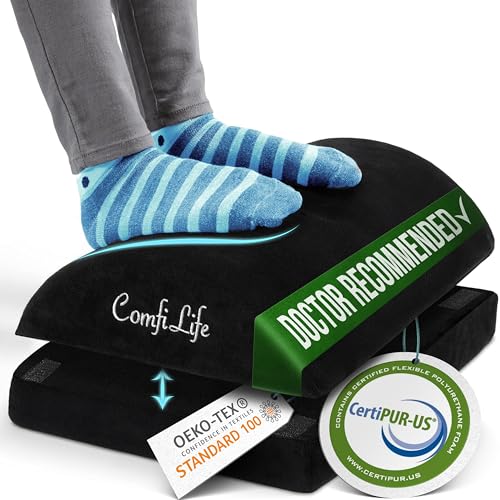
ComfiLife Foot Rest Under Desk
by ComfiLife
The most-validated office footrest on Amazon — high-density foam, a removable washable cover, and a flip-for-tilt design that covers the majority of desk-comfort use cases at a price that justifies replacing it once every 3-4 years.
Pros
- High-density memory foam holds its profile after a full year of 8-hour daily use without the bottoming-out collapse that plagues budget foam at the same price tier
- Removable, machine-washable cover is the single most underrated practical feature in this category — fabric footrests that cannot be washed develop visible wear and odor within 6-9 months in shoed use
- Two-position design works flat for standard support or flipped for a gentle 7-degree tilt that engages calf and ankle micro-movement during longer sessions
- OEKO-TEX-style anti-skid base grips both low-pile carpet and bare hardwood reliably without leaving residue or requiring a separate non-slip pad
Cons
- Single foam density means users above 200 lbs may notice deeper compression at the heel-contact zone over a full workday than lighter users will
- Fixed approximately 3.9-inch height is calibrated for users between roughly 5'2" and 5'10" — taller or shorter users may need an adjustable model instead
Everlasting Comfort Foot Rest Under Desk — Best Budget
The Everlasting Comfort is the volume bestseller, and what earns it the budget slot is not the lowest sticker on this page but the best price-to-evidence ratio. With more than 27,000 verified reviews — the largest data set on this list by a wide margin — this is a product where every meaningful failure mode has already been surfaced and documented, and the consensus pattern is that the pure memory foam construction holds up reliably for 12-18 months of daily use before the surface fabric shows visible wear. That is a lifespan you can plan around, which is worth more at this tier than shaving a few dollars off the purchase.
Be clear-eyed about where it sits on price, though: the compact BlissTrends below undercuts it by a wide margin, and the OLYDON heated mat is cheaper too. Neither carries anything close to the same review base. If your constraint is genuinely the lowest possible outlay, go to the BlissTrends; if it is the lowest outlay that still comes with 27,000 reviews’ worth of failure data, that is this one.
The teardrop profile — higher at the heel, lower at the toe — is the design choice I would highlight for buyers comparing budget options. A flat foam footrest provides cushioning but does nothing for ankle position; the teardrop encourages a slight forward foot tilt that reduces the dorsiflexion strain that builds during long seated sessions. This is the same biomechanical idea as the more expensive specialty designs, executed in a simpler form factor for meaningfully less. For a hybrid worker maintaining a footrest at home and a separate one at the office, for a parent equipping a kid’s homework desk, or for any secondary or hot-desk workstation where the budget does not justify a premium model, this is the correct purchase.
The realistic limitations are the non-removable cover and the fixed height. The cover spot-cleans but cannot be machine-washed, which limits useful life in shoed offices to roughly 12-18 months. The single fixed height — approximately 4 inches — works for most users but cannot be fine-tuned as desks and chairs change. For a primary workstation where you want a footrest that lasts 3-plus years, step up to the ComfiLife or ErgoFoam. For everywhere else, the Everlasting Comfort is the budget benchmark.

Everlasting Comfort Foot Rest Under Desk
by Everlasting Comfort
The deepest review base on this list by a wide margin — pure memory foam at a price that removes any reason not to add one to a workstation, with a teardrop profile that does what 90 percent of office workers actually need.
Pros
- 27,000-plus verified reviews is the largest data set on this list by a wide margin — the failure modes that exist with this footrest have been surfaced and documented across years of real-world use
- Pure memory foam construction (no shell or rigid base) makes this the lightest footrest on this list and the easiest to reposition between sit, stand, and lean-back postures during the day
- Teardrop profile with a higher heel and lower toe encourages a slight forward foot tilt that reduces ankle dorsiflexion strain during long seated sessions
- Non-slip bottom holds reliably on low-pile carpet, area rugs, and bare hardwood without the migration that affects flat-base foam alternatives
Cons
- Cover is not removable for machine washing — surface must be spot-cleaned, which limits its useful life in shoed offices to roughly 12-18 months before visible wear
- Single non-adjustable height of approximately 4 inches is fixed at the factory — users who need to fine-tune height as they switch between chairs will find this limiting
ErgoFoam Adjustable Foot Rest Under Desk — Best Upgrade
The ErgoFoam is the right purchase when adjustability is a genuine procurement requirement rather than a nice-to-have. The three-position height system — 4 inches, 5 inches, 6 inches — accommodates the full range of desk-and-chair geometries that I encountered in real procurement: the 5’2” administrative coordinator on a low-set ergonomic chair needs a different footrest height than the 6’0” project manager on a standard task chair, and a single ErgoFoam unit fits both with no swap. For shared workstations, hot-desk environments, or households where multiple people use the same desk on different days, this is the only footrest on this list that solves the multi-user fit problem cleanly.
The 4.7-star rating is the highest on this list across 7,900-plus reviews, and the consistency profile of those reviews matches my procurement experience — the ErgoFoam performs as advertised across body types, shoed and barefoot use, and a range of chair heights without the variable-quality complaints that affect lower-tier alternatives. The industrial-grade non-slip base is the second feature worth highlighting; on smooth office laminate and polished concrete (common in newer commercial buildings), this base outperforms the standard non-slip backings on competitor products. For workstations on smooth flooring where migration has been a recurring complaint, the ErgoFoam is the most-confirmed solution on this list.
The trade-off is that the height adjustment uses stacked foam wedges that require deliberate positioning rather than a hinge or quick-release mechanism. Users who want to change height multiple times per day will find this slower than they want; users who set the height once and leave it will not notice. The slightly larger footprint can also crowd narrower under-desk spaces where a CPU tower or cable tray competes for floor real estate — measure your under-desk volume before purchase. Within those constraints, the ErgoFoam is the most flexible long-horizon footrest available, and pairing it with a properly adjusted standing desk lets the same workstation accommodate users across the height spectrum.
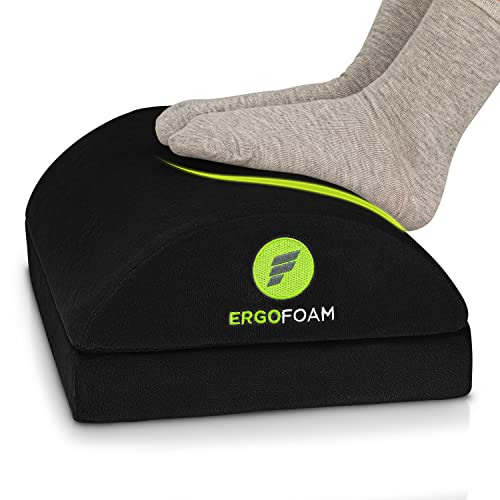
ErgoFoam Adjustable Foot Rest Under Desk
by ErgoFoam
The best footrest for procurement contexts where one model needs to fit a range of users — adjustable height, the highest verified rating on this list, and a washable cover combine into the most flexible long-horizon option on this list.
Pros
- Adjustable height across three positions (4, 5, and 6 inches) accommodates the full range of desk-and-chair height combinations — the single most useful feature in a procurement context where one model needs to fit multiple users
- Highest rating on this list at 4.7 stars across 7,900+ reviews, with the consistency profile of a product that performs as advertised across body types and use cases
- Industrial-grade non-slip base outperforms standard non-slip backings on smooth office laminate and polished concrete — meaningful for newer commercial buildings with sealed floors
- Cover is removable and machine-washable without losing fit or shape after multiple wash cycles, which extends its useful life past the 2-year mark in shoed use
Cons
- Adjustment mechanism uses stacked foam wedges that require deliberate positioning — height changes are not as instant as a hinged rocking design
- Slightly larger footprint than the ComfiLife or Everlasting Comfort, which can crowd narrower under-desk areas where a CPU tower or cable tray is also competing for floor space
BlissTrends Foot Rest — Lowest Price, Compact Footprint
The BlissTrends is the cheapest footrest on this list and the one with the smallest footprint, and it has 9,000-plus verified reviews behind it — a high-volume compact option rather than a thin-data budget gamble. That combination is genuinely uncommon at this tier, where most of the cheapest listings carry a few hundred reviews at best. The curved teardrop shape with a deliberately sloped heel-to-toe profile encourages the same gentle ankle position as the more expensive specialty designs, at close to half the cost of the ErgoFoam.
The use case I would recommend the BlissTrends for specifically is narrow under-desk geometry. A standard 17.5-inch foam footrest like the ComfiLife or ErgoFoam crowds narrow under-desk areas where a CPU tower, cable tray, or under-desk drawer is also competing for floor space — at approximately 16.5 inches by 11 inches, the BlissTrends fits under cubicle desks, dorm desks, and home-office hutches that the larger options cannot. Lightweight construction also makes it the easiest footrest on this list for users who relocate between conference rooms, hot-desks, or hybrid home-office setups multiple times per week. For a portable secondary footrest that lives in a backpack on commute days, this is the correct purchase.
The honest limitation is the 4.4-star rating, tied with the OLYDON mat for the lowest in this roundup. A meaningful minority of reviewers report foam that softens noticeably faster than the ComfiLife or Everlasting Comfort under heavier daily use, particularly users above 200 lbs and users in shoed offices where surface contact is more aggressive. Lateral foot range is also limited; taller users above 6’0” or those who shift their feet wide during calls will run off the edges of this compact footprint. For a primary workstation footrest where durability is a priority, choose the ComfiLife or Everlasting Comfort instead. For a compact secondary footrest where price and portability matter more than long-horizon foam density, the BlissTrends is exactly right.

BlissTrends Foot Rest for Under Desk
by BlissTrends
The lowest-priced pick here and the smallest footprint — a compact, contoured foam footrest with a deep review base, for tight under-desk spaces and budget-constrained setups where the ComfiLife will not fit.
Pros
- Lowest price on this list backed by 9,000-plus verified reviews — most listings this cheap carry a few hundred reviews, so the evidence base here is unusually deep for the tier
- Curved teardrop shape with a deliberately sloped heel-to-toe profile encourages the same gentle ankle position as more expensive specialty designs at roughly half the price
- Compact footprint suits narrow under-desk spaces, dorm desks, and cubicle setups where the larger ErgoFoam or EUREKA platforms will not physically fit
- Lightweight construction makes this the easiest footrest on this list for users who relocate between conference rooms, hot-desks, or hybrid home-office setups
Cons
- 4.4-star rating is tied with the OLYDON mat for the lowest on this list — a meaningful minority of reviewers report foam that softens noticeably faster than the ComfiLife or Everlasting Comfort under heavier daily use
- Compact size that makes it portable also means lateral foot range is limited — taller users above 6'0" or those who shift their feet wide during calls will run off the edges
Mount-It! Adjustable Tilt Footrest with Massage Roller — Best Active Sitting
The Mount-It! is the right purchase for users who sit for 4-plus-hour stretches and want the seated equivalent of an anti-fatigue mat’s micro-movement engagement. The active rocking design — a hinged platform that rocks gently under engaged feet — is not a gimmick. The biomechanics behind it parallel the biomechanics behind terrain-mat designs for standing desks: continuous low-amplitude movement at the ankles and calves reduces the static-posture fatigue that accumulates during long seated sessions, and it engages the lower-leg musculature that tends to deactivate during prolonged sitting. For users dealing with the afternoon-fatigue slump that compounds across a multi-hour focus block, this kind of footrest does something a stationary foam pad cannot.
The three integrated massage rollers on the foot-contact surface are a meaningful bonus that targets a specific user profile. Reviewers with mild plantar fasciitis specifically note that rolling the soles of the feet across the textured rollers during seated work delivers circulatory and pressure-relief benefits beyond what passive cushioning provides. The three-position tilt adjustment (15, 20, and 30 degrees) lets users dial in the ankle angle that matches their chair height and natural foot position, which is meaningful flexibility for a single-user workstation where the user wants to refine the geometry over time. Hard plastic shell construction holds up better than foam in heavy shoed use and does not show the gradual flattening that fabric-covered foam alternatives develop after 12-18 months.
The trade-off worth understanding is that the hard plastic surface is uncomfortable for barefoot or sock-only use. This footrest is calibrated for shoed feet — the textured rollers feel pleasantly grippy through a shoe sole and harshly grippy against bare skin. If you regularly kick off your shoes at your desk, the Mount-It! is the wrong choice; the ComfiLife or ErgoFoam handle that use case far better. The review base, just over 500, is also far smaller than the foam alternatives, so long-term reliability data on the rocking hinge is thinner — the mechanism has been validated in user reports, but not at the scale of the ComfiLife’s 14,000-plus reviews. Within the right-shoed-user use case, the Mount-It! is the most engaging seated footrest on this list.

Mount-It! Adjustable Tilt Footrest with Massage Roller
by Mount-It!
The best active-sitting footrest on this list — the rocking motion and adjustable tilt deliver micro-movement engagement that flat foam designs cannot match, with massage rollers as a meaningful bonus for users with foot fatigue.
Pros
- Active rocking design engages calf, ankle, and hip micro-movement during seated work — the closest seated equivalent to the standing-desk benefit of an anti-fatigue mat
- Three integrated massage rollers on the foot-contact surface promote circulation in the soles during long sessions; reviewers with mild plantar fasciitis specifically note relief
- Three-position tilt adjustment (15, 20, and 30 degrees) lets users dial in the ankle angle that suits their chair height and natural foot position
- Hard plastic shell construction holds up better than foam in heavy shoed use and does not show the gradual flattening that fabric-covered foam alternatives develop
Cons
- Hard plastic surface is uncomfortable for barefoot or sock-only use — this footrest is designed around shoed feet and is the wrong choice for users who kick off shoes at their desk
- Review base of just over 500 is far smaller than the foam alternatives, so long-term reliability data is thinner — the rocking hinge has been validated in user reports but not at the scale of the ComfiLife or Everlasting Comfort
EUREKA ERGONOMIC Adjustable Tilt Footrest — Best Firm Surface
The EUREKA earns its place for users who want a footrest that does not compress, does not collapse, and does not need to be replaced for the practical lifetime of their workstation. Wood-and-metal construction does not lose its support profile under foot weight — period. The geometry stays exactly where it is set across the full lifespan of the product, which for a buy-once setup in a stable seated workstation means a horizon of 5-plus years rather than a 2-3 year foam replacement cycle. The cost-per-year math on this option is more favorable than it appears at first glance once you account for the foam alternatives that need replacement at the 18-month or 24-month mark.
The five locking tilt angles between flat and approximately 30 degrees give users a precision of position that foam designs cannot replicate by flipping or stacking. A 12-degree tilt is materially different from a 22-degree tilt for the calf-and-ankle position it produces, and the EUREKA lets the user find the angle that suits their specific seated geometry rather than accepting a manufacturer-decided default. The wider 18-inch surface accommodates a fuller foot range than most foam options and is the right size for users above 6’0” or those who shift their feet laterally during calls. For users who set up an ergonomic workstation deliberately and want the seated geometry to remain stable over time, this is a meaningful structural advantage.
The clear limitation is the absence of cushioning. Wood provides zero compression under the foot, which suits users whose preference runs to firm support or who find foam-style footrests overly soft to maintain ankle alignment, but it is the wrong choice for users who want pillowy underfoot comfort. The footrest is also heavier than foam alternatives and harder to reposition under the desk during sit-stand transitions, which makes it best suited to a fixed seated workstation rather than a hot-desk environment. Match the material to your preference for surface compliance and your stability horizon — for a buy-once permanent choice in a stable workstation paired with a quality desk mat underneath, this is the longest-horizon footrest on this list.
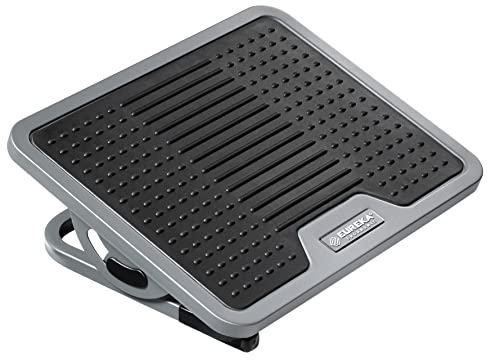
EUREKA ERGONOMIC Adjustable Tilt Footrest
by EUREKA ERGONOMIC
The best firm-surface footrest for users who want a permanent ergonomic geometry that does not compress over time — five locking angles, wood-and-metal construction, and a 5-plus-year horizon that no foam design can match.
Pros
- Firm wood-and-metal construction does not compress at all under foot weight — the ergonomic geometry stays exactly where it is set across the full lifespan of the product
- Five locking tilt angles between flat and approximately 30 degrees give users a precise position match that foam designs cannot replicate by flipping or stacking
- Wider 18-inch surface accommodates a fuller foot range than most foam options — appropriate for users above 6'0" or those who like to shift their feet laterally during calls
- Long-horizon durability — wood and metal will outlast every foam footrest on this list by years, which makes the cost-per-year math favorable over a 5-year procurement cycle
Cons
- Hard wood surface provides no cushioning whatsoever — users who want pillowy underfoot comfort should choose the ComfiLife or ErgoFoam instead
- Heavier than foam alternatives and harder to reposition under the desk during sit-stand transitions — best suited to a fixed seated workstation rather than a hot-desk environment
OLYDON Electric Heated Foot Warmer Mat — Best Heated Specialty
The OLYDON is the right purchase for cold home offices, basement workspaces, and converted-garage setups where the ambient temperature drops below comfortable seated working levels from October through March. This is not a primary footrest in the traditional sense — it is a seasonal supplement that addresses a specific problem (cold feet during winter desk work) that no foam, plastic, or wood-and-metal footrest can solve. For users in poorly heated workspaces where cold feet are the limiting factor on focus and comfort, this category of product genuinely changes the seated experience during winter months.
The three-temperature heat setting and the four-position auto shut-off timer (1, 2, 3, or 4 hours) are the two features that make this a viable office product rather than a fire-risk concern. The auto shut-off in particular addresses the safety question that prevents most office workers from using a heated mat at a desk on its own — a 4-hour timer covers a typical morning or afternoon focus block and powers down without user intervention. The lower energy draw than a space heater is also worth noting; warming only the foot zone is far more efficient than heating an entire under-desk volume, which is practical for users in mixed-temperature buildings where central heat does not reach the workstation evenly. The soft fleece surface accommodates both shoed and barefoot use, though most users prefer the warmth-on-skin sensation of barefoot or sock-only use.
The realistic limitation is that this is a single-purpose seasonal product — most relevant from October through March, with limited utility in summer months when warming is unwanted. Plan to swap it out for a standard foam footrest during warmer months unless your workspace is genuinely cold year-round. Power cord routing also requires planning at the desk; users with cable-managed setups need to factor in the additional cable run before purchase. Within the cold-workspace use case, the OLYDON is the practical add-on that pairs with a standard year-round footrest like the ComfiLife or ErgoFoam — not a replacement for one.

OLYDON Electric Heated Foot Warmer Mat
by OLYDON
The best heated specialty footrest for cold home offices and basement workspaces — three heat settings and an auto shut-off timer make this a practical winter add-on rather than a year-round primary footrest.
Pros
- Three-temperature heat setting addresses cold-feet complaints in poorly heated home offices and basement workspaces during fall and winter — a category that no standard foam footrest solves
- Auto shut-off timer (1, 2, 3, or 4 hours) handles the safety concern that prevents most office workers from using a heated mat on its own at a desk
- Lower energy draw than a space heater and warms only the foot zone, which is far more efficient than heating an entire under-desk volume — practical for users in mixed-temperature buildings
- Soft fleece surface is comfortable for both shoed and barefoot use — one of the few footrests on this list that genuinely accommodates either
Cons
- Single-purpose seasonal product — most relevant from October through March, with limited utility in summer months when warming is unwanted
- Power cord routing requires planning at the desk; users with cable-managed setups need to factor in the additional cable run before purchase
Best Adjustable Footrests
If you specifically want a footrest you can tune — height to match your chair, angle to dial in ankle position, or both — the fixed-height foam pads above are the wrong category. Adjustability matters most in three situations: a shared or hot-desk workstation where one footrest must fit multiple users, a user outside the roughly 5’2”–5’10” window that fixed foam is calibrated for, and anyone who wants to change ankle angle through the day rather than accept a single manufacturer-set tilt. The three picks below are the adjustable options on this list, ranging from washable adjustable foam to a precision wood-and-metal tilt platform to an active rocking design.
| Product | Price | Buy |
|---|---|---|
| ErgoFoam Adjustable Foot Rest Under DeskBest adjustable overall Three height positions (4/5/6 inches) plus a washable cover and the highest verified rating on this list — the most flexible pick when one footrest needs to fit a range of users or a single user's changing chair. | $41.95 | View on Amazon |
| EUREKA ERGONOMIC Adjustable Tilt FootrestBest for precise tilt angles Five locking tilt angles on a wood-and-metal platform that never compresses — the right choice when you want a precise, permanent ankle angle that foam designs cannot hold over time. | $45.99 | View on Amazon |
| Mount-It! Adjustable Tilt Footrest with Massage RollerBest adjustable for active sitting Three-position tilt plus active rocking and massage rollers — adjustable angle combined with the micro-movement engagement that flat foam pads cannot provide for long seated sessions. | $37.99 | View on Amazon |
For most buyers who want adjustability, the ErgoFoam is the best all-around adjustable pick on height, rating, and washability. Choose the EUREKA if you want a firm, precise, buy-once tilt platform, or the Mount-It! if active rocking and foot-fatigue relief matter as much as the adjustable angle. All three are reviewed in full above.
Buyer's Guide
Choosing the right footrest is less about brand and more about matching the design to your actual desk reality — your shoe habits, your floor type, your chair adjustability, your daily standing-vs-seated rotation, and whether you want passive cushioning or active micro-movement engagement. Six factors separate a footrest you use every day from one that ends up under the desk gathering dust within a month.
Shoes vs Barefoot Use
The single most consequential decision in footrest selection — and the one most reviews skip past in the first paragraph. Foam footrests with breathable fabric covers (ComfiLife, ErgoFoam, Everlasting Comfort, BlissTrends) work well for either shoed or barefoot use and accommodate the realistic mix that most users actually maintain across a workday. Plastic-shell active and rocking designs (Mount-It!) and hard-surface wood-and-metal options (EUREKA) are calibrated for shoed feet and feel uncomfortably hard against bare skin. Heated mats (OLYDON) work for either but most users prefer the warmth-on-skin sensation of barefoot or sock-only use. If you regularly kick off your shoes at your desk, prioritize foam with a removable washable cover. If you keep shoes on through the day, the firm-surface options become viable and offer durability that foam cannot match.
Material — Foam vs Plastic vs Wood/Metal
Three primary material categories cover the modern footrest market. Memory foam (ComfiLife, ErgoFoam, Everlasting Comfort, BlissTrends) provides immediate cushioning, accommodates both shoed and barefoot use, and typically lasts 2-4 years before compression noticeably reduces support. Plastic shells (Mount-It! rocking) provide a hard active surface that engages micro-movement and resists wear from shoed use, with effective lifespan extending past 5 years before any failure. Wood-and-metal (EUREKA) is the longest-horizon option — these footrests effectively never compress and the geometry stays calibrated across the full life of the product. Heated mats (OLYDON) sit in their own seasonal category and supplement rather than replace a primary footrest. Match the material to your durability horizon: foam for replacement-cycle thinking under a 4-year planning window, plastic or wood-and-metal for buy-once setups in stable workstations.
Height Adjustability
Adjustable-height footrests (ErgoFoam at 4/5/6 inches, Mount-It! at three tilt angles, EUREKA at five locking angles) are the right choice when one footrest needs to fit multiple users — a procurement context, a hot-desk environment, or a household where multiple people share a single workstation. Fixed-height options (ComfiLife, Everlasting Comfort, BlissTrends) work fine for single-user workstations where the desk-and-chair geometry is stable. The under-recognized variable is that adjustability lets a single user fine-tune the footrest as their chair and desk are adjusted over time — a chair caster replacement, a desk height change, or a switch between sitting positions can all change which footrest height is correct. For long-horizon flexibility, adjustable wins; for simplicity at lower price tiers, fixed is sufficient.
Active vs Stationary Design
Stationary foam footrests provide passive support — they do not move, they do not require user engagement, and they deliver consistent cushioning under the foot. Active designs include the Mount-It! rocking footrest (continuous gentle motion under engaged feet) and the EUREKA tilting platform (locked angles that the user can change throughout the day). The biomechanics research on active sitting parallels the research on standing desk terrain mats: micro-movement engagement reduces the static-posture fatigue that accumulates during multi-hour seated sessions, but it requires user participation to deliver the benefit. Choose a stationary design if you sit in short focused intervals and want immediate passive comfort. Choose an active design if you sit for 4-plus-hour stretches and want a counterforce against the muscle fatigue that builds during long sessions.
Anti-Slip Performance — Carpet vs Hardwood
Floor type matters more than most footrest reviews acknowledge. On low-pile carpet and area rugs, almost any non-slip base grips reliably and migration is rarely an issue. On bare hardwood, polished tile, or sealed concrete, anti-slip performance varies dramatically between products. The ErgoFoam's industrial-grade non-slip base is the most-confirmed performer on smooth office laminate, while the ComfiLife and Everlasting Comfort grip well on textured surfaces but can shift incrementally on polished hardwood under active foot engagement. The EUREKA's heavier wood-and-metal construction does not migrate at all on any floor type but brings the trade-off of less portability. If your workstation is on smooth flooring, prioritize anti-slip rubber-or-textured bases over fabric-only undersides — the difference is the line between a footrest that stays put and one that drifts an inch every hour.
Washability and Durability
The single most underrated feature in foam footrests is whether the cover is removable and machine-washable. Non-removable covers (Everlasting Comfort, BlissTrends) absorb shoe contact, dust, and surface debris over time and cannot be deeply cleaned — practical lifespan in shoed offices is 12-18 months before visible wear and odor. Removable washable covers (ComfiLife, ErgoFoam) extend useful life to 2-4 years because the fabric stays clean while the foam underneath continues to provide support. Hard-surface footrests (Mount-It! plastic, EUREKA wood) wipe clean with a damp cloth and have effectively no surface degradation timeline. For shared workstations, hot-desks, or any environment where multiple users will contact the footrest, washability is not a nice-to-have — it is a hygiene requirement that determines how many years the purchase justifies itself.
Do You Actually Need a Footrest?
The honest answer is that not everyone does, and the question is worth asking before you spend money on the wrong solution. The 90-90-90 posture rule — knees at 90 degrees, hips at 90 degrees, elbows at 90 degrees — is the seated baseline that ergonomic professionals reference, and a footrest enters the picture when chair adjustment alone cannot get you there. The rough rule of thumb is straightforward: if your desk height is fixed (which is true for most office desks at standard 29 inches) and your chair is adjusted high enough to keep your elbows at 90 degrees relative to the desk surface, your feet may not reach the floor flat. For users below approximately 5’4”, this is the typical scenario — and a footrest is the correct solution because lowering the chair to put feet flat would push elbows into a flexed position below 90 degrees and create wrist and forearm strain.
For users between roughly 5’5” and 5’10”, whether a footrest helps depends on chair geometry. If your chair seat depth is appropriate and the front edge does not press into the back of your knees, your feet probably already touch the floor flat with the 90-degree knee bend in place. If your chair seat is slightly too deep — a common issue with large executive chairs sized for taller users — your feet may dangle slightly even when the rest of the geometry is correct, and a footrest fills the gap. For users above 6’0”, a footrest is rarely needed for posture reasons; chair height adjustment usually keeps feet flat without help. But all three height categories can benefit from a footrest used as an active engagement platform — the rocking, tilting, or flip-tilt designs deliver micro-movement benefit independent of whether feet would otherwise reach the floor. The decision tree, in short, is: posture-correction footrest if your feet do not reach the floor with elbows at 90 degrees, active-engagement footrest if you sit for 4-plus-hour stretches and want a counterforce against static-posture fatigue, or both. Pair the right footrest choice with our complete home office setup guide to address the full ergonomic picture.
Final Verdict
After evaluating footrests across the full material and design spectrum, the ComfiLife Foot Rest Under Desk remains my top recommendation for the majority of office professionals working 7-plus-hour seated days. The high-density memory foam, the removable washable cover, the two-position flip-for-tilt design, and the reliable anti-skid base across both carpet and hardwood combine into the most practical year-round footrest at a price that justifies replacement once every 3-4 years. For budget-constrained setups or secondary workstations where ergonomic-foot-support-on-a-shoestring is the right framing, the Everlasting Comfort Foot Rest delivers the core ergonomic benefit at the most accessible price on this list — pure memory foam, a teardrop profile that does what 90 percent of users actually need, and the largest verified review base in the category.
For procurement contexts where one footrest needs to fit multiple users, or for users above 5’10” or below 5’4” who need height adjustability, the ErgoFoam Adjustable Foot Rest is the right upgrade with three height positions, the highest verified rating in the category, and a washable cover that extends useful life past 2-3 years. For users in cold home offices during fall and winter, the OLYDON Electric Heated Foot Warmer Mat is the seasonal add-on that addresses cold-feet complaints in a way no standard footrest can. For users committed to a buy-once permanent workstation and a multi-year horizon, the EUREKA ERGONOMIC Adjustable Tilt Footrest with its wood-and-metal construction is the longest-horizon investment on this list. Match the footrest to your shoes-versus-barefoot habits, your floor type, your daily seated duration, and your replacement-cycle planning window — and pair it with a properly fitted office chair and a calibrated keyboard wrist rest to address the full ergonomic picture rather than one variable in isolation.
Frequently Asked Questions
Do I need a footrest if my feet already touch the floor?
Should I use a footrest with shoes on or barefoot?
Is a rocking or active footrest better than a stationary one?
Can I use a footrest with a standing desk?
How long does foam in a footrest last before it flattens?
Related Articles
7 Best Keyboard Wrist Rests of 2026
ergonomic-accessories
7 Best Anti-Fatigue Standing Desk Mats of 2026
desk-setup-furniture
8 Best Desk Mats of 2026
desk-setup-furniture
7 Best Office Chairs of 2026
desk-setup-furniture
11 Best Lumbar Support Pillows for Office Chairs of 2026: Tested for All-Day Desk Comfort
comfort-wellness
About the Reviewer

Sarah Chen, CAP, PMP
B.A. Business Administration, UCLA
Sarah Chen spent 10 years in office management and operations at Fortune 500 companies before founding DeskRated in 2026. After managing supply budgets for teams of 50+ people and testing thousands of products through daily use, she started writing the honest, no-fluff supply reviews that office professionals actually need. Sarah holds both CAP and PMP certifications and is based in Los Angeles.