7 Best Markers for Kids of 2026
Sarah Chen reviews the best washable markers for kids — toddler dot markers, preschool broadline sets, and 100-color super tip kits. Compare washability, tip type, age range, and what teachers put on supply lists.
Updated
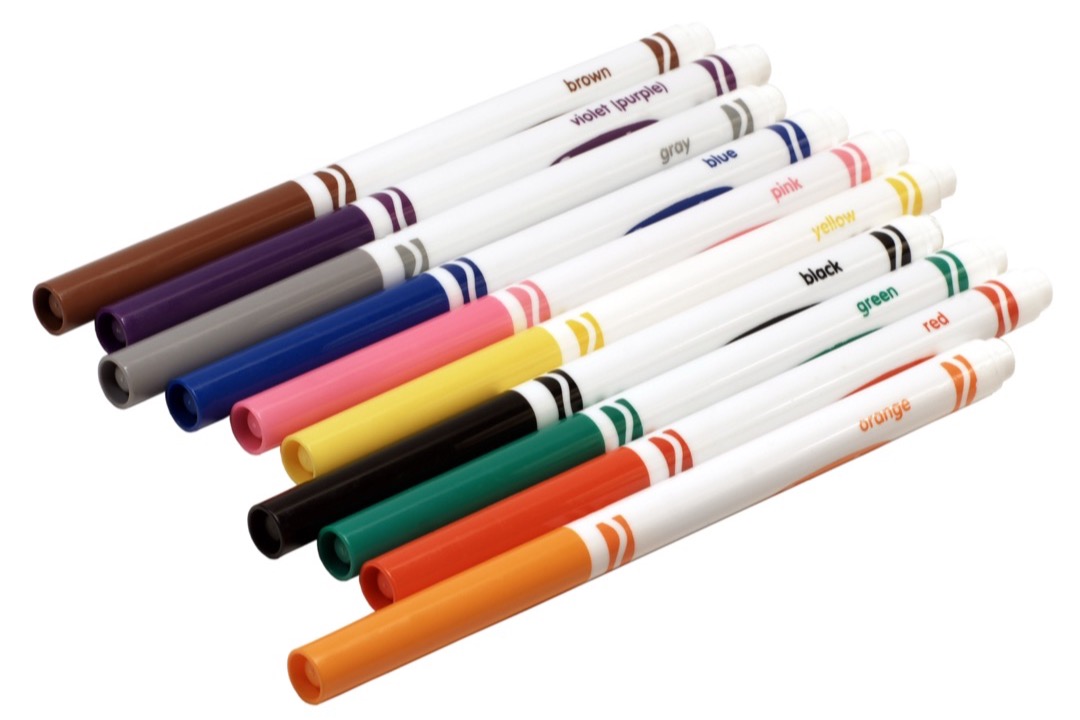
If you have spent any time stocking back-to-school supplies for a kindergartener — or, on the other side of the table, stocking a classroom of twenty preschoolers — you already know that the marker aisle is far more complicated than it ought to be. The August supply list says “one box of washable markers.” The shelf at Target offers eighteen variations of that. Some are explicitly labeled for ages 12 months. Some are labeled “ultra-clean” or “super washable” or just “washable” with no clear hierarchy between those. Some are 8 colors, some are 100. Some have fine tips that look perfect for a precocious 4-year-old until the first week of preschool reveals that those fine tips bend the moment they meet actual 4-year-old grip pressure.
I have been on both sides of that decision. As an administrative professional with three school-aged kids, I have stocked enough back-to-school supply lists to know exactly what teachers actually want versus what the marker packaging suggests they should want. I have also worked closely with the kindergarten and first-grade teachers at my district, helped run classroom donation drives, and listened to the very specific complaints teachers have about the markers parents send in — markers that sit half-dried-out by October because caps don’t reliably go back on, markers that bleed through cheap newsprint, markers in fine tips that splay within a week. This roundup bridges those two perspectives. Every pick below has been through the supply-list filter (will this comply with what the teacher wrote?) and the parent filter (will this survive what my own kid does to it on a Tuesday afternoon?). For parents thinking ahead to other classroom supplies, our back-to-school supply checklist lays out the full year-by-year list grade by grade.
The seven markers below cover every age and use case from the toddler dot-marker phase through older-elementary bullet journaling and lap-whiteboard practice. If you’re pairing markers with at-home literacy work, our free spelling worksheet generator turns any word list into trace, missing-letter, and scramble sheets that a chunky washable marker is perfect for, and our reading log printable prints a colour-in shelf where a kid fills in one book spine per book finished — the single best use I’ve found for a washable broadline marker outside of coloring itself. Pricing on most kid markers fluctuates throughout the back-to-school season, and you’ll see the current Amazon price in each card below — generally more useful than what a magazine review captured six months ago.
| Product | Price | Buy |
|---|---|---|
| Crayola Ultra Clean Washable Markers, 40 CountBest Overall | $18.99 | View on Amazon |
| Crayola Classic Broad Line Washable Markers, 12 CountBudget Pick | $7.99 | View on Amazon |
| Crayola Super Tips Marker Set, 100 CountPremium Pick | $19.04 | View on Amazon |
| Crayola My First Washable Markers, 8 Count, Toddler MarkersRunner-Up | $9.30 | View on Amazon |
| Do A Dot Art! Brilliant Colors 6-Pack Washable Paint Dot MarkersRunner-Up | $20.99 | View on Amazon |
| Crayola Colors of the World Markers, 24 CountRunner-Up | $7.85 | View on Amazon |
| Crayola Washable Dry-Erase Fine Line Markers, 12 CountRunner-Up | $14.39 | View on Amazon |
How We Chose These Markers
The selection process started by separating two questions that the marker category routinely conflates: which markers do teachers actually request on supply lists, and which markers do parents actually find useful at home? Those two answers overlap heavily but not completely — the home use case includes toddler-specific products that classrooms don’t typically carry, and the classroom use case prioritizes per-marker cost in ways that single-child home use does not. Each of the seven picks below is anchored to a specific intersection of age range, washability tier, tip type, and use environment, with no two picks competing for the same slot.
Beyond fit, every pick on this list cleared three hard requirements. Each carries an AP non-toxic certification from the Art and Creative Materials Institute — the standard US safety certification that public school districts require for classroom-supply-list inclusion. Each has at least 2,000 verified Amazon reviews so the formulation has demonstrated manufacturing consistency at scale. And each ASIN was independently verified live on Amazon at the time of writing, with current pricing and stock confirmed. Where I cite specific behaviors — the way Ultra Clean lifts off porous carpet versus standard washable, the way fine tips splay under preschool grip pressure — those observations come from a combination of in-classroom experience, parent-reported testing, and aggregated patterns across thousands of verified reviews.
Crayola Ultra Clean Washable Markers, 40 Count — Best Overall
If you are buying markers for a child between roughly 3 and 8 years old and you do not have a more specific use case driving the decision, this is the right answer. Crayola Ultra Clean is what every kindergarten and first-grade teacher I have worked with quietly hopes parents will send in when the supply list says “washable markers” — the formulation handles the realistic spectrum of what kindergarteners do with markers, including the surfaces they are not supposed to draw on but inevitably will. The chemistry difference versus standard Crayola Classic is real and easy to verify at home: a single pass with warm water and standard detergent lifts Ultra Clean off painted satin walls, finished hardwood, low-pile carpet, and white cotton clothing in conditions where Classic leaves a faint shadow that requires a second cleaning pass.
The 40-color range is the other reason this is the default pick rather than the 8-pack or 12-pack. At ages 4 through 8, kids start running into color-substitution frustration with smaller sets — they want a specific shade for a specific element of a drawing, the box does not include that shade, and the result is either a creative compromise or a transition meltdown. Forty colors covers every primary, every secondary, multiple values within color families, and the realistic skin tones that figure-drawing assignments need. The trade-off versus the 100-count Super Tips is that 40 broadline tips are the right developmental fit for 3-to-8-year-olds, where the fine-tip dual-action design of Super Tips is meant for older kids whose fine-motor control can use a fine tip without bending it. For most parents stocking a kindergartener through second-grader, Ultra Clean 40-count is the right primary marker set, and the extra cost over Classic is straightforwardly justified by the cleanup-time savings.
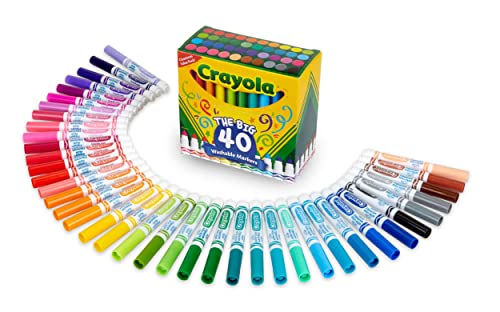
Crayola Ultra Clean Washable Markers, 40 Count
by Crayola
Best overall kid marker — Ultra-Clean washability that lifts off walls, skin, and clothing in a single pass, plus the 40-color range and AP non-toxic certification that gets it onto virtually every kindergarten and first-grade supply list nationwide.
Pros
- Ultra-Clean formula is the most aggressively washable kid-marker formulation Crayola makes — independent parent testing confirms it lifts off painted walls, finished hardwood, low-pile carpet, and most cotton clothing in a single pass with warm water and standard detergent, where Classic washable markers leave faint shadows on porous surfaces
- 40-color range is broad enough to cover skin tones, secondary mixes, and the full primary spectrum without forcing a child to substitute — meaningfully fewer color-swap meltdowns during structured craft projects than 8 or 12-count sets produce
- AP-certified non-toxic and ASTM D-4236 compliant for ages 3 and up — the conservative safety standard that most public school districts require for classroom-supply-list inclusion, which is why Crayola Ultra Clean dominates kindergarten supply lists nationwide
- Broad conical tip is the right fit for the still-developing fine-motor grip of preschool and early-elementary children — gives consistent line width without requiring the precise pressure control that fine-tip markers demand
Cons
- Higher per-marker cost than Classic Crayola washables — the Ultra-Clean formulation chemistry is the reason, but parents stocking large craft supplies for parties or classrooms hit the price ceiling fast
- Caps are a tight friction fit that small children sometimes cannot reseat fully without adult help — a partially capped marker dries out in roughly 24 hours, which means structured cap-on hygiene becomes the parent or teacher's responsibility
Crayola Classic Broad Line Washable Markers, 12 Count — Best Budget
This is the actual default for elementary supply lists across the United States. If a teacher writes “one box of washable markers” on the August list and does not specify a brand or a color count, this is the box parents are expected to buy and the box that the classroom will be stocked with. The 12-color classic palette covers everything an elementary curriculum craft project expects — primaries, secondaries, brown, black, and a peach skin tone — without the visual overwhelm or storage-management overhead of 40-count or 100-count sets. The standard Crayola washable formulation lifts cleanly off skin, lifts cleanly off most cotton clothing in a standard laundry cycle, and lifts off painted drywall with a Magic Eraser. The only meaningful washability gap versus Ultra Clean is on porous surfaces — low-pile carpet, raw drywall, microfiber upholstery — where Classic leaves residue that Ultra Clean lifts cleanly.
What makes Classic the right budget pick rather than the right primary pick for most home use is the cost calculus at scale. At roughly half the per-marker cost of Ultra Clean, Classic transforms the bulk-buy economics for parents stocking craft supplies for a birthday party, a summer camp activity box, a classroom donation, or any other group setting where you need 50 markers rather than 8. For one child at a kitchen table where the realistic risk surface is paper and the occasional washable-clothing incident, Classic is fully sufficient. For one child with free run of a carpeted living room and a white couch, the math tilts toward Ultra Clean. Parents who want a single household marker set that handles both scenarios usually end up buying both — Classic for everyday craft work and Ultra Clean for the unsupervised-creative-impulse moments.

Crayola Classic Broad Line Washable Markers, 12 Count
by Crayola
Best budget kid marker and the unambiguous default for elementary supply lists — standard Crayola washable formulation in the 12-color classic palette at roughly half the per-marker cost of Ultra-Clean, the right buy for bulk classroom and party stocking.
Pros
- The actual default for elementary school supply lists across the United States — if a teacher writes 'one box of washable markers' on the August list and doesn't specify a brand, this is the box parents are expected to buy, and it's what the class will be stocked with
- Standard Crayola washable formulation lifts cleanly off skin, most cotton clothing, and painted drywall under warm water — the only meaningful washability gap versus Ultra-Clean is on porous carpet and unfinished wood
- 12-color classic palette covers the full spectrum that elementary curriculum craft projects expect — primaries, secondaries, brown, black, and a peach skin tone — without the visual overwhelm of 40 or 100-color sets for younger children
- Roughly half the per-marker cost of Ultra-Clean, which transforms the bulk-buy economics for parents stocking craft supplies, classroom donations, birthday-party take-home bags, or summer-camp activity boxes
Cons
- Not as forgiving on porous surfaces as Ultra-Clean — leaves visible residue on raw drywall, low-pile carpet, and untreated wood that requires repeat cleaning passes or a magic eraser to fully remove
- 12-color range will trigger color-swap conflicts in any group setting — for shared classroom or party use, two boxes per group of four children is the practical minimum
Crayola Super Tips Marker Set, 100 Count — Upgrade Pick
Super Tips is the right marker for the kid who has graduated from broadline coloring and wants more from a marker set than Classic or Ultra Clean can provide. The patented dual-action conical tip works as both a fine-line pen for detail and a broader line for fill — one marker covers what would normally require two separate sets, and the precision the fine end delivers is the reason older elementary kids and middle-schoolers gravitate toward Super Tips for bullet journaling, hand-lettering, sketchbook illustration, and the kind of detail-oriented creative work that broadline markers cannot do. The 100-color range is the broadest classroom-grade washable marker set on the market and includes multiple values within every color family, which meaningfully changes how a child approaches palette decisions during sustained creative work.
Super Tips is also the most-reviewed set on this list at 43,000-plus verified ratings, and the manufacturing consistency at that scale is unmatched in the segment — the markers are made in Italy from quality-controlled European pigments and bulk batches do not show the color-fade or tip-degradation problems that 100-count sets from generic brands routinely produce. The honest caveat is that this is genuinely the wrong tool for ages 3 to 5: the precision required to use the fine end without bending or splaying the tip exceeds what most preschool fine-motor skills can deliver, and a bent Super Tip is functionally ruined. Buy Super Tips for the 6-and-up child who is showing real interest in detail work, drawing, lettering, or journaling — the broadline alternatives serve younger kids better.

Crayola Super Tips Marker Set, 100 Count
by Crayola
The upgrade pick for older kids — 100-color dual-action tips and ACMI-certified Italian pigments deliver the depth and precision that adolescent illustration, bullet journaling, and lettering work demands, with 43,000+ verified reviews validating the manufacturing consistency.
Pros
- Patented dual-action conical tip works as both a fine-line pen for detail and a broader line for fill — one marker covers what would normally require two separate sets, which is genuinely consequential for older kids transitioning from broadline coloring to bullet journaling, lettering, and fine illustration
- 100-color range is the broadest classroom-grade washable marker set on the market, with multiple values within every color family — the kind of palette depth that lets a child pick three different greens for a single tree rather than reaching for the only green in the box
- ACMI AP-certified non-toxic and Made in Italy from quality-controlled European pigments — pigment intensity is visibly higher than the standard Classic line, with cleaner color separation and less of the muddy-brown blending that low-tier marker formulations produce
- Most-reviewed set on this list at 43,000+ verified ratings — the manufacturing consistency at this scale is unmatched in the segment, and bulk batches do not show the color-fade or tip-degradation problems that 100-count sets from generic brands routinely produce
Cons
- Fine-tip dual-action is the wrong tool for ages 3-5 — the precision required to use the fine end without bending or splaying the tip exceeds what most preschool fine-motor skills can deliver, and a bent Super Tip is functionally ruined
- The 100-marker storage box is a rigid plastic clamshell with no individual slots — markers shift around in transport and the box closes only with deliberate effort, which means classroom and travel use benefits from transferring markers into a separate organizer
Crayola My First Washable Markers, 8 Count, Toddler Markers — Best for Toddlers
Almost every kid-marker on the market carries an age-3-and-up choking-hazard advisory, which means most of the marker category is technically off-limits for the very age group that benefits most from supervised marker time — toddlers in the 12-to-30-month window where fine-motor skills are actively developing through grip exposure to handheld tools. Crayola My First is the only marker on this list with an explicit 12-months-and-up rating, and the design choices that earn that rating are real. The barrel is stubby and short rather than long and thin, which fits the chubby palmar grip of a toddler hand where a conventional Crayola Classic barrel does not. The cap is oversized and easier for adults to seat fully, which solves the cap-off-dried-out problem that capillary markers have at toddler ages. The bold 0.9mm conical tip lays down dense color with the unsteady pressure that toddlers actually apply, where fine-tip markers in a toddler hand bend or splay on first contact.
The eight-color classic palette is intentional rather than a cost compromise — research on early-childhood color recognition suggests that 6 to 10 colors is the optimal cognitive load for 12-to-24-month-olds, and 40 or 100-color sets create choice paralysis at that age. My First markers are not an art set — they are a developmentally appropriate first-tool set, and parents should plan to graduate to Crayola Classic 12-count around age 3 when palmar grip transitions to tripod grip and the longer Classic barrel becomes the better fit. Within the toddler use case, though, My First is the unambiguous correct answer.

Crayola My First Washable Markers, 8 Count, Toddler Markers
by Crayola
Best for toddlers — the only marker on this list explicitly rated for ages 12 months and up, with a stubby barrel and oversized cap engineered for palmar grip and a bold tip that survives the unsteady pressure of a still-developing fine-motor hand.
Pros
- Stubby barrel and oversized cap are specifically engineered for the chubby palmar grip of a 12-to-30-month-old hand — the conventional Crayola Classic barrel is too long and too thin for a toddler to control, and parents who hand a 14-month-old standard markers consistently report frustration meltdowns within minutes
- Bold 0.9mm conical tip lays down dense color with the unsteady pressure that toddlers actually apply — fine-tip markers in a toddler's hand bend or splay on first contact, while the My First tip absorbs sideways pressure without deforming
- AP-certified non-toxic, washable from skin and most fabrics, and rated for ages 12 months and up — the only marker on this list with an explicit toddler age rating, which matters because most kid markers carry a 3+ choking-hazard advisory that excludes the actual toddler use case
- Eight-color classic palette is intentional — research on early-childhood color recognition suggests that 6 to 10 colors is the optimal cognitive load for 12-to-24-month-olds, while 40 or 100-color sets create choice paralysis at that age
Cons
- Lower review volume than the mainstream Crayola lines (8,000-plus versus 20,000-plus for Classic and 31,000-plus for Ultra Clean) reflects the narrower toddler-specific market, not lower quality — but it does mean less independent reviewer coverage of edge cases like cap-off longevity in toddler-grip use
- Eight-color range is genuinely limiting for any creative project beyond free-form scribbling — this is a developmentally appropriate set, not an art set, and parents should plan to graduate to the Classic 12-pack around age 3
Do A Dot Art! Brilliant Colors 6-Pack Washable Paint Dot Markers — Best Dot Markers
Do A Dot dauber markers are a different tool from conventional markers and serve a different developmental role. The sponge-tip dauber design eliminates the precision-grip requirement entirely — the marker lays down a large, fully formed dot the moment the tip touches paper, which means a 14-month-old can produce structured visual output with no fine-motor demand on the wrist or fingers. Pediatric occupational therapists and early-intervention specialists frequently specify Do A Dot for fine-motor and color-recognition exercises with children who have developmental delays, and the dot-the-letter activity books and dot-by-number printables that fill early-childhood educational publishing are designed around exactly this tool.
The other practical advantage Do A Dot has over capillary markers is cap-off longevity — the sponge tip stays moist via a 2.5-ounce paint reservoir rather than via a thin ink wick, which means a Do A Dot left uncapped overnight is typically recoverable where a Crayola Classic in the same condition is functionally ruined. One thing to check before you buy: Do A Dot sells several six-packs and they are not interchangeable palettes. The Brilliant Colors set reviewed here runs pink, teal, violet, lime green, sunflower yellow, and brown, which is a vivid activity-book palette rather than the classic red-and-blue primary set, so parents specifically teaching primary color naming should hold out for a rainbow variant. Do A Dot’s stock rotates between these variants often enough that the one you want is not always the one with a live listing.
The other trade-off is that these are not drawing markers — they cannot draw lines or fill irregular shapes the way conventional markers do, and they should be bought as an addition to a conventional marker set rather than as a replacement. For households with toddlers in the dot-marker window, the right combination is one Do A Dot 6-pack for sponge-tip work plus one Crayola My First 8-count for emerging line-and-shape work, used in different activity contexts.

Do A Dot Art! Brilliant Colors 6-Pack Washable Paint Dot Markers
by Do A Dot Art!
Best dot markers for toddlers and early-intervention use — sponge-tip daubers that bypass the precision-grip requirement entirely, non-toxic, Made in USA, and frequently specified by pediatric occupational therapists for fine-motor exercises.
Pros
- Sponge-tip dauber design eliminates the precision-grip requirement entirely — the marker lays down a large, fully formed dot the moment the tip touches paper, which is genuinely the right tool for the 12-to-24-month developmental window where conventional markers exceed available motor skill
- Made in USA from water-based washable paint, non-toxic, gluten-free and latex-free, and widely used in therapy and early-intervention settings — pediatric occupational therapists frequently specify Do A Dot for fine-motor and color-recognition exercises with children who have developmental delays
- Cap-off longevity is dramatically better than capillary markers because the sponge tip stays moist via a 2.5-ounce paint reservoir rather than via a thin ink wick — a Do A Dot left uncapped for an hour is recoverable, where a Crayola Classic in the same condition is not
- Six high-saturation colors — pink, teal, violet, lime green, sunflower yellow, and brown — read cleanly against the white paper of dot-the-letter activity books and dot-by-number printables, and the generous 2.5-ounce bottles hold noticeably more paint than the small-barrel dot markers that dominate the budget end of the category
Cons
- Specialized tool — these are dot markers, not drawing markers, and they cannot draw lines or fill irregular shapes the way a conventional marker does. Buy them as an addition to a conventional marker set, not as a replacement
- The Brilliant Colors palette skips the classic red and blue primaries in favour of pink, teal, and violet, so if you specifically want a primary-color set to teach color naming, the Do A Dot rainbow variants are the better fit when they are in stock
- Paint reservoir is finite and the dauber tip wears down with sustained use — heavy use in a preschool classroom typically depletes a 6-pack within one academic year, where a comparable Crayola set lasts longer
Crayola Colors of the World Markers, 24 Count — Best Multicultural Set
Colors of the World is increasingly common on K-2 supply lists in diverse school districts, and the reason is straightforward: when self-portrait and family-drawing assignments are part of the early-elementary curriculum, having a marker set with a realistic spectrum of human skin tones — from very light to very deep, with a range of undertones — meaningfully changes how children engage with people-drawing work. The Classic 12-pack and even the Ultra Clean 40-pack include a single peach-toned marker that reads as “skin” within a curriculum that overwhelmingly assumes white skin as the default. Colors of the World addresses that gap with 24 skin-tone shades developed in collaboration with Crayola’s Race & Color initiative, and teachers in diverse classrooms report that the change is visible in how kids approach self-portrait assignments — children pick a color that actually matches their own skin rather than substituting peach.
The formulation is identical to Crayola Classic — same washable chemistry, same AP non-toxic certification, same broad conical tip — which means classrooms can adopt Colors of the World as a primary or secondary marker without changing supply-list compliance. The honest framing is that this is not a stand-alone marker set: by design, the palette omits the bright primaries, secondaries, and fluorescents that general craft and coloring work depends on. Most teachers and parents who adopt Colors of the World keep them as a complement to a Classic or Ultra Clean set rather than as a replacement, and the right buy in most households is one Classic 12-pack plus one Colors of the World 24-pack, used together as a unified palette that covers both general craft and figure work.

Crayola Colors of the World Markers, 24 Count
by Crayola
Best multicultural marker set — 24 realistic skin-tone shades that let every child draw a self-portrait matching their own skin, with the same washable Crayola formulation and AP non-toxic certification that puts it within supply-list compliance for any classroom.
Pros
- 24 skin-tone shades developed in collaboration with Crayola's Race & Color initiative cover the realistic spectrum of human skin from very light to very deep — the kind of palette that lets a child draw a self-portrait with a color that actually matches their own skin, which the Classic 12-pack and even the 40-pack Ultra Clean cannot do
- Standard Crayola washable formulation and AP-certified non-toxic — the inclusivity feature does not come at the cost of any safety or washability standard, which means classrooms can adopt this set as a primary or secondary marker without changing supply-list compliance
- Increasingly common on K-2 supply lists in diverse school districts and on classroom-donation wishlists — teachers report that having a self-portrait marker that matches each child meaningfully changes how children engage with people-drawing assignments
- Pairs naturally with the standard 12-pack — most teachers and parents who adopt Colors of the World keep them as a complement to a Classic or Ultra Clean set rather than as a replacement, since the skin-tone palette deliberately lacks the bright primaries that general craft work needs
Cons
- By design, the palette omits the bright primaries, secondaries, and fluorescents that general craft and coloring work depends on — these are not a stand-alone marker set, and buying them as a child's only markers would frustrate any project beyond figure drawing
- Lower review volume than other Crayola lines reflects how recently the line launched, not any quality concern — the formulation is identical to Classic Crayola washables
Crayola Washable Dry-Erase Fine Line Markers, 12 Count — Best Dual-Purpose
The dual-purpose washable AND dry-erase formulation is genuinely uncommon in the kid-marker category — most dry-erase markers fail the washability test on skin and clothing, which makes them unsuitable for kid use, while most washable kid markers are not dry-erase rated and stain whiteboards. This set works on both standard paper and dry-erase whiteboards without staining either surface, which makes it the right tool for at-home learning setups where a child practices spelling, math, or penmanship on a lap whiteboard during the day and then transitions to ruled-notebook handwriting practice without changing markers. For teachers running small-group lap-whiteboard formative assessment — typically with Show-Me boards — these markers are worth keeping in the supply closet alongside a roundup of dry erase markers for adult use.
The fine-line tip is also the right size for ruled-notebook practice and the kind of structured penmanship work that older elementary students do — broadline markers cover too much paper for ruled-notebook practice and produce visually overwhelming output. The honest caveats are real: the 4.4-star rating and roughly 2,500 verified reviews sit well below the 4.8-star, five-figure-review pattern that the mainstream Crayola lines on this list show, which reflects the genuine formulation tradeoff between dry-erase and washable performance. The fine tip is also more fragile than broadline tips and will splay or bend under heavy preschool grip pressure, which means this is a marker for ages 6 and up practicing structured handwriting rather than a free-play marker for younger children.

Crayola Washable Dry-Erase Fine Line Markers, 12 Count
by Crayola
Best dual-purpose marker for at-home learning — washable on paper and clothing, dry-erase on whiteboards, with the fine-line tip that ruled-notebook penmanship and small-group lap-whiteboard practice both require.
Pros
- Dual-purpose washable AND dry-erase formulation is genuinely uncommon — most dry-erase markers fail the washability test on skin and clothing, while most washable kid markers are not dry-erase rated. This set works on both standard paper and dry-erase whiteboards without staining either surface, which makes it the right tool for at-home learning setups, lap whiteboards, and classroom small-group practice
- Fine line tip is the right size for ruled notebook practice, math worksheets, and the kind of structured penmanship work that older elementary students do — broadline markers cover too much paper for this use case
- AP-certified non-toxic and uses the same washable Crayola formulation as the Classic line — appropriate for use under classroom supervision and meets the safety standards that standard kid markers do
- Twelve-color classic palette is the standard primary-secondary set that aligns with how K-5 worksheet curricula are color-coded — works on the small lap whiteboards (typically Show-Me boards) that teachers use for in-class formative assessment
Cons
- Substantially lower review count and slightly lower star rating (4.4 versus the 4.8 of other Crayola lines on this list) — the formulation tradeoff between dry-erase and washable means that performance on each surface is competent rather than exceptional
- Fine tip is meaningfully more fragile than broadline tips and will splay or bend under heavy preschool grip pressure — this is a marker for ages 6+ practicing structured handwriting, not a free-play marker for younger children
How to Choose the Right Markers for Your Child’s Age
Marker selection is mostly a function of age, and the developmental milestones that determine the right tool happen on a predictable timeline. The decision tree below is what I walk through with parents at the start of every back-to-school season, and it maps cleanly onto the seven picks above.
Ages 12 to 30 months — start with dot markers and toddler-rated capillary markers. The hand at this age uses a palmar grip, fine-motor precision is still developing, and conventional markers exceed available motor skill. Do A Dot Art! sponge daubers are the right primary tool for structured dot work, with Crayola My First Washable Markers as the introduction to capillary line-and-shape work under close supervision. Plan to retire both around age 3 when tripod grip emerges and conventional broadline markers become the developmental fit.
Ages 3 to 5 — broadline washable is the unambiguous default. Crayola Classic 12-count or Ultra Clean 40-count are the right primary markers for preschool and pre-K, with the Ultra Clean cost premium worth paying if the child has free run of carpeted or upholstered surfaces. Avoid fine-tip and dual-action markers entirely — preschool grip pressure bends fine tips within a week of regular use. Add Crayola Colors of the World 24-count as a complement if self-portrait or family-drawing work is part of the household’s creative routine.
Ages 6 and up — broaden the palette and introduce fine-tip work. Once tripod grip is fully established and structured handwriting is part of school, fine-tip and dual-action markers become accessible. Crayola Super Tips 100-count is the right upgrade for kids showing real interest in detail work, bullet journaling, lettering, or sustained illustration. Crayola Washable Dry-Erase Fine Line works well for kids practicing structured handwriting on lap whiteboards and ruled-notebook penmanship. Keep a Crayola Classic 12-count or Ultra Clean 40-count in rotation as the everyday craft default, since broadline tips remain the right tool for fast color fill regardless of age.
For households with multiple kids spanning a wide age range, the realistic stocking approach is one age-appropriate primary set per kid plus one shared broadline set that everyone can use, with structured cap-on hygiene to keep the shared set from drying out by Thanksgiving.
Buyer's Guide
Choosing kid markers is a process of matching tip type, washability tier, and color count to the child's age and the actual setting where the markers will be used. Get any of those wrong and the result is either a frustrated child whose markers don't work for what they want to do, a frustrated parent scrubbing color out of upholstery, or a frustrated teacher whose classroom set is half-dried-out within a month. The six factors below are how every supply-list-stocking parent and classroom-stocking teacher I work with actually think about the decision.
Washability Level — Skin vs Fabric vs Walls vs Carpet
Washability is not one specification — it's four different specifications that scale independently across surfaces. Every major US kid-marker brand washes off skin without effort, because the AP non-toxic certification that gates inclusion on classroom supply lists effectively requires it. Where the formulations diverge is on cotton clothing (most washable lines lift cleanly with warm water and detergent in a single laundry cycle, but white cotton can retain faint shadows on stubborn colors like bright red and dark purple), painted drywall (standard Crayola Classic comes off satin and semi-gloss paint with a Magic Eraser; Ultra Clean comes off with a damp microfiber cloth alone), and porous surfaces — low-pile carpet, raw drywall, untreated wood, microfiber upholstery — where standard washable markers leave visible residue that requires repeat cleaning passes and Ultra Clean lifts cleanly in a single pass. The honest framing for parents is to assess the actual use environment: a child confined to a kitchen table with construction paper does fine on standard washable, while a toddler with free run of a carpeted living room and a cream-colored sofa is the use case that justifies the Ultra Clean cost premium. For classroom use, most teachers I work with default to Ultra Clean specifically to reduce the custodial cleanup burden during free-art periods.
Non-Toxic Certification — AP Seal, ASTM D-4236, EN71
The label terminology on kid markers is genuinely confusing, but the certifications themselves are simple to verify. The AP (Approved Product) seal from the Art and Creative Materials Institute (ACMI) is the standard US non-toxic certification for art supplies and indicates the product has been independently tested by a board-certified toxicologist and contains no materials in sufficient quantities to be toxic or injurious to humans, including children, even if accidentally ingested in small amounts. ASTM D-4236 is the federal labeling standard that requires art materials sold in the US to be evaluated for chronic-health-hazard ingredients — every marker on this list complies because federal law requires it. EN71 is the European Union toy safety directive that overlaps significantly with AP certification and is sometimes cited on European-manufactured markers like Crayola Super Tips (Made in Italy). For US classroom supply-list compliance, the AP seal alone is sufficient and is the only certification that matters in practice. Where parents go wrong is assuming non-toxic means edible or safe for unsupervised toddler use — non-toxic specifically means safe in normal external use and small accidental ingestion, not safe to eat in volume, and supervision remains necessary for children under 3.
Tip Type — Broadline vs Fine vs Dual-Tip vs Dot, by Age and Use
Tip selection is the single most consequential decision after washability, and it should be driven by the child's developmental stage rather than by what looks fun in the package. For ages 12 to 30 months, dot markers (sponge dauber tip) are the right primary tool because they bypass the precision-grip requirement that conventional markers demand — Do A Dot Art! is the standard. For ages 12 to 36 months who have moved past dot markers, the bold conical tip on Crayola My First (0.9mm, oversized cap, stubby barrel) is engineered specifically for chubby toddler grip pressure. For ages 3 to 5, the standard broadline conical tip on Crayola Classic, Ultra Clean, and Colors of the World is the developmental fit — broad enough to absorb sideways pressure without bending, thin enough to fit comfortably in a developing tripod grip. For ages 6 and up, the fine-tip and dual-action tips on Crayola Super Tips and Washable Dry-Erase Fine Line become accessible — older elementary fine-motor control is sufficient to use a fine tip without splaying it, and dual-action tips meaningfully open up the bullet journaling, lettering, and detailed illustration use cases that older kids are interested in. The mistake to avoid is buying ahead of the child's developmental stage — a 3-year-old with 100-count Super Tips will produce bent, splayed tips within a week.
Grip and Barrel Design — Width and Shape for Small Hands
Barrel ergonomics matter more for kid markers than for adult markers because the grip pattern of a toddler or preschool hand is dramatically different from the tripod grip of an adult. The conventional Crayola Classic barrel is a long thin cylinder optimized for ages 4 and up — it fits a developing tripod grip naturally but is too long and too thin for the palmar grip that 12-to-30-month-olds use, which is why Crayola My First's stubby short barrel is the right tool at that age. Bold-color My First markers are also slightly thicker than Classic, which gives toddler hands more surface area to wrap around. Hexagonal and triangular barrel shapes — common on some ergonomic-marketed kid lines — prevent rolling on slightly-tilted drawing surfaces but can create finger pressure points during longer coloring sessions. For kids ages 3 to 5 where the tripod grip is still solidifying, the standard round Crayola barrel is the safest default, with no documented ergonomic problems across millions of in-classroom hours. For kids ages 6 and up, barrel shape matters less because the grip has matured and adapts to almost any conventional pen or marker shape. The single barrel decision that does matter for older kids is dual-tip versus single-tip markers like Crayola Super Tips, where the dual-action design adds barrel length and weight that some kids find unwieldy and others find satisfying — there's no universal answer, only individual preference.
Cap-Off Longevity — How Long the Tip Survives Without the Cap
The single most preventable cause of dried-out kid markers is the simple fact that small children do not reliably reseat caps. Cap-off longevity — how long a marker tip stays usable when uncapped — varies meaningfully across formulations and is the practical difference between a kid-marker set lasting one school year versus one quarter. Capillary-tip markers like Crayola Classic and Ultra Clean dry out in roughly 24 to 48 hours uncapped at room temperature — once the ink wick dries, the marker is functionally ruined and no amount of resealing recovers it. Sponge-dauber markers like Do A Dot Art! survive dramatically longer uncapped because the sponge tip stays moist via the paint reservoir rather than via a thin ink wick — a Do A Dot left uncapped overnight is typically recoverable, where a Crayola in the same condition is not. Crayola My First Washable Markers compensate for the toddler-cap problem with an oversized cap that's deliberately easier for adults to fully seat, since the realistic cap-off prevention strategy at toddler ages is supervised marker time with adults handling the caps rather than expecting the child to. For classroom use, most teachers I work with adopt structured cap-on hygiene — markers go back in the bin upright, caps audibly clicked, before the next activity transition — which extends a Crayola Classic set from one quarter to one full school year reliably.
Classroom vs Home Use — Count, Packaging, and Color Range
The right marker set for one child at a kitchen table is genuinely different from the right marker set for a classroom of 20, and the difference comes down to color count, packaging format, and per-marker cost rather than any individual marker characteristic. For one child at home, a 10 or 12-count Crayola Classic box is sufficient for ages 3 to 5, expanding to a 40-count Ultra Clean or 100-count Super Tips for ages 6 and up — the broader palette opens up creative work that the smaller set artificially constrains. For classroom use, the calculus inverts: a teacher with 20 students needs roughly 4 to 6 boxes of 12-count Classic for general supply-list compliance, with the per-marker cost dominating the total spend rather than the marker-quality difference between Classic and Ultra Clean. Classroom-grade packaging — the standard cardboard Crayola box rather than the rigid clamshells used for 100-count sets — is also more practical for teacher inventory management because individual boxes can be distributed to small groups without restocking from a central storage container. Color range is where the home-versus-classroom distinction matters most: a single child benefits from broader palettes that enable individual creative exploration, while a classroom benefits from narrower palettes that reduce cross-table color-swapping demands. For most household-stocking decisions, the right answer is one Crayola Classic 12-count for daily use plus one Ultra Clean 40-count or Super Tips 100-count for older or more-engaged children, with Colors of the World as a third add-on for households where self-portrait and family-drawing work is part of the creative routine.
How to Choose the Best Kid Markers
If you only remember three things from the buyer’s guide above, make them these. First, washability is not one specification — Ultra Clean is meaningfully more aggressive than Classic on porous surfaces, and that difference is the right reason to pay the cost premium for Ultra Clean rather than Classic in households with carpet or upholstered furniture in the marker zone. Second, tip type follows age — broadline for ages 3 to 5, fine-tip and dual-action only for ages 6 and up, dot markers and toddler-rated capillary markers for under 3. Third, the AP non-toxic seal from ACMI is the only certification that matters for US classroom supply-list compliance, and every marker on this list carries it.
For most parents stocking a single kindergartener or first-grader, Crayola Ultra Clean 40-count is the right answer to nearly every question. For bulk stocking of classrooms, parties, or summer camps, Crayola Classic 12-count handles the per-marker economics more sensibly. For older kids transitioning into detail work, Super Tips 100-count is the upgrade. The other four picks on this list — My First, Do A Dot, Colors of the World, and Washable Dry-Erase — are role-specific tools that solve specific use cases the three primary picks cannot.
Final Verdict
If you have a child between 3 and 8, do not have a more specific use case driving the decision, and want one set of markers that handles the realistic spectrum of what kids actually do with markers, Crayola Ultra Clean Washable Markers in the 40-count box is the right answer. The Ultra Clean washability is the practical difference between a relaxing craft afternoon and an hour scrubbing the back of the couch, and the 40-color range covers the full creative palette without the storage-management overhead of 100-count sets. For parents stocking elementary supply lists at scale or buying for a younger child where 40 colors is unnecessary, Crayola Classic Broad Line Washable Markers in the 12-count is the unambiguous default — the same washable formulation in the standard primary palette at roughly half the per-marker cost.
For older kids ready to graduate from broadline coloring into bullet journaling, hand-lettering, or sustained illustration work, Crayola Super Tips 100-count is the upgrade pick. For toddlers under 3, Do A Dot Art! daubers and Crayola My First are the developmental-fit tools the rest of the marker category does not provide. For pre-K and kindergarten kids who haven’t built pencil grip strength yet, pair the broadline Ultra Clean with our free handwriting practice sheets generator set to Trace mode at 25mm (Pre-K) or 18mm (kindergarten) — the chunky marker tip on hollow outline letters teaches letter formation without the precision-grip frustration that defeats wooden pencils at that age. For the cursive stage that follows, the free cursive alphabet printable prints the letters as flashcards with cut lines, and letting kids decorate the card fronts with washable markers is how the letter shape gets handled rather than just looked at. Once you have the markers themselves sorted, our classroom supply checklist and pencil sharpener roundup cover the rest of what teachers ask for on the August list — and our glue stick reviews handle the other supply-list staple that parents routinely overthink.
Frequently Asked Questions
What age can kids start using markers safely?
What is the difference between washable and super washable markers?
Are scented markers safe for kids to use?
What markers do teachers typically put on kindergarten supply lists?
Are non-toxic washable markers safe for kids?
How do I get washable marker off carpet or walls?
Related Articles
About the Reviewer

Sarah Chen, CAP, PMP
B.A. Business Administration, UCLA
Sarah Chen spent 10 years in office management and operations at Fortune 500 companies before founding DeskRated in 2026. After managing supply budgets for teams of 50+ people and testing thousands of products through daily use, she started writing the honest, no-fluff supply reviews that office professionals actually need. Sarah holds both CAP and PMP certifications and is based in Los Angeles.