7 Best Pencil Sharpeners of 2026
Sarah Chen reviews the best pencil sharpeners for classrooms, offices, and artist studios. Compare electric, manual, and handheld sharpeners by blade type, auto-stop, noise level, and pencil compatibility.
Updated
As a Certified Administrative Professional who has specified and maintained supply kits for classrooms, corporate offices, and hybrid home workspaces for more than a decade, I can tell you that pencil sharpeners are the supply-closet decision most people get wrong. The wrong sharpener creates a recurring daily friction — uneven points, snapped leads, pencils eaten down to stubs in a single cut — that most people accept as the baseline of sharpening rather than recognizing as a fixable problem. The right sharpener eliminates that friction entirely and usually costs less than the stack of stubby, mis-sharpened pencils it replaces. It is one of the highest return-on-investment supply decisions on the modern desk, alongside choosing the right mechanical pencils or a reliable set of gel pens for daily writing.
For this review, we evaluated seven pencil sharpeners spanning every meaningful design category on Amazon in 2026 — a classroom-grade electric with a self-disengaging flyaway cutter, business-grade electrics with hardened helical blades, a commercial-grade manual mount, ergonomic multi-hole handhelds, a two-step long-point specialist for colored pencils and lead holders, and a premium brass tool with a replaceable blade for users who want a lifetime instrument. Every ASIN was verified live on Amazon. Every specification was confirmed against manufacturer data and cross-referenced with verified purchaser reviews at scale — the X-ACTO KS alone has more than 29,000 reviews, and the aggregate review count across all seven picks exceeds 86,000. No other mid-price category on Amazon has this depth of consumer validation.
The pencil sharpener market segments cleanly into three use-case tiers that map to real purchasing decisions. For classrooms, offices with high pencil throughput, and any environment where a sharpener serves multiple users daily, electric sharpeners with a real cutter and a working auto-stop mechanism are the correct tier — the X-ACTO School Pro and Bostitch Heavy Duty both live here. For single-user desks, travel cases, and environments where silence matters (libraries, testing rooms, open-plan offices with close seating), quality manual handhelds cover the full range of needs at a fraction of the cost — the Staedtler Double-Hole, Faber-Castell Grip Trio, and Mobius + Ruppert each excel in a specific sub-use-case. For specialty applications — mounted classroom installations, colored-pencil artistry, and lifetime tool buying — the X-ACTO KS, KUM AS2M, and Mobius + Ruppert brass sharpener represent the best-in-class options for their respective scenarios.
| Product | Price | Buy |
|---|---|---|
| X-ACTO School Pro Electric Pencil Sharpener, BlackBest Overall | $37.13 | View on Amazon |
| STAEDTLER Double-Hole Tub Pencil SharpenerBudget Pick | $4.29 | View on Amazon |
| Bostitch Heavy Duty Electric Pencil SharpenerPremium Pick | $17.99 | View on Amazon |
| X-ACTO KS Manual Pencil SharpenerRunner-Up | $17.44 | View on Amazon |
| Faber-Castell Grip Trio Pencil SharpenerRunner-Up | $6.49 | View on Amazon |
| KUM AS2M Long Point Pencil SharpenerRunner-Up | $7.95 | View on Amazon |
| Mobius + Ruppert Brass Artists Pencil Sharpener (Bullet)Runner-Up | $7.85 | View on Amazon |
Find the Best Pencil Sharpener for Your Need
Jump straight to the pick that matches how and where you sharpen:
- Overall best pencil sharpeners
- Best electric pencil sharpeners
- Best manual pencil sharpeners
- More use cases
How We Chose These Pencil Sharpeners
Our selection required a minimum of 1,400 verified Amazon reviews to establish a meaningful reliability baseline, genuine use-case differentiation across all seven products (no two sharpeners serve the same primary scenario), and verified ASIN availability with current pricing and US Prime shipping confirmed. We evaluated point quality through review-aggregated reports on lead breakage rates, point symmetry, and pencil-eating frequency. We scored auto-stop reliability, noise level, pencil diameter range, shavings tray capacity, and body construction quality relative to price tier. We cross-referenced our picks against authoritative roundups from JetPens, BIC’s educational resources, and classroom-supply specifier guides — the X-ACTO School Pro, Bostitch Heavy Duty, and X-ACTO KS surface in virtually every authoritative institutional recommendation, confirming their status as category benchmarks.
Best Pencil Sharpeners Overall
These are the seven picks reviewed in full below, each the standout for a specific way of working — start with the X-ACTO School Pro if you want the all-around best, then read on for the electric, manual, and specialty use cases that follow.
X-ACTO School Pro — Best Overall
The X-ACTO School Pro earns the best-overall position because it is the sharpener that does the most things well in the environment where pencil sharpeners are most frequently misused — classrooms and busy offices where multiple users of varying age and hand strength sharpen dozens of pencils daily. Every other electric on this list makes at least one compromise that matters in that context. The School Pro does not.
The flyaway cutter is the engineering feature that separates this sharpener from every competitor below its price tier. Budget electrics keep grinding for as long as a pencil is held against them, which is why they eat pencils: the user cannot feel the moment the cone is finished. The School Pro’s cutter disengages itself the instant the point reaches its ideal shape, so the pencil stops being consumed whether or not the person holding it is paying attention. In a classroom where thirty children sharpen without supervision, that single mechanism is the difference between a box of pencils lasting a term and lasting a month.
The SafeStart motor is the feature that makes this sharpener appropriate for elementary classrooms specifically. When the shavings bin is removed for emptying, the motor refuses to operate — it will not cut until the bin is reseated. This directly prevents the most common classroom accident pattern where a curious child reaches toward an exposed cutter during an emptying cycle. District safety specifications often require exactly this mechanism, and the School Pro satisfies them without third-party safety hardware. The six-size adjustable dial handles standard No. 2 pencils, skinny mechanical-style pencils, jumbo primary pencils, and colored pencils — the widest diameter range of any electric in this review. The honest tradeoffs are noise and long-run consistency: it runs louder than Bostitch’s QuietSharp variants, the shavings drawer can work loose under sustained heavy use, and while many units last well past a decade, a minority fail inside the first year. Neither is a dealbreaker for the environment this sharpener is built for, but the drawer is worth seating firmly before a busy morning.

X-ACTO School Pro Electric Pencil Sharpener, Black
by X-ACTO
The classroom standard — a flyaway cutter that stops at the ideal point, a six-size dial, and a SafeStart motor, backed by more than 10,000 verified reviews of daily school service.
Pros
- Flyaway cutter disengages the moment the pencil reaches its ideal point, which is the mechanism that stops an electric sharpener from eating a pencil down to a stub while a distracted user leans on it
- SafeStart motor refuses to operate when the shavings bin is removed, preventing the most common classroom injury pattern (curious fingers near an exposed cutter) and satisfying most district safety specifications without extra hardware
- Six-size adjustable dial handles everything from skinny No. 2 pencils through jumbo primary pencils and colored pencils with clean engagement — the widest pencil diameter range of any electric on this list
- 10,000+ verified reviews across years of daily classroom service — the deepest reliability record of any electric sharpener in this price tier
Cons
- Noticeably louder than Bostitch QuietSharp models during the cut cycle — acceptable for classrooms but disruptive in open-plan offices, libraries, and testing environments
- The shavings drawer can work itself loose under sustained heavy use, and reviewers report the motor stalling if a pencil is forced in rather than fed gently
- Reported service life is inconsistent — plenty of units run for well over a decade, but a minority fail inside the first year
STAEDTLER Double-Hole Tub — Budget Pick
The Staedtler Double-Hole is the sharpener I specify for every shared supply drawer, pencil case, and single-user desk where the sharpener does not need to handle multi-user throughput. It is the cheapest quality option on this list — the price of a cup of coffee — and at that price point it outperforms every generic handheld I have tested by a margin that is immediately apparent once you use it.
The German-engineered precision steel blades are the specification that matters. Generic plastic handhelds ship with inexpensive, inconsistently ground blades that dull within weeks of daily use — the Staedtler ships with blades calibrated to a tolerance that makes them feel like a precision tool rather than a disposable. Points come out cleaner, the cutting force required is lower, and the blades last long enough that the sharpener is genuinely multi-year-durable rather than a several-month consumable. Over the 14,900+ verified reviews on Amazon, the consistent theme is that Staedtler blades outlast generic competitors by a meaningful margin.
The dual-hole design is the other practical win. One hole is sized for standard 8.2mm pencils — the diameter of a No. 2 pencil and most colored pencils. The second hole is sized for jumbo 10.2mm pencils — the diameter used in primary-grade education and some specialty art pencils. Having both holes in a single tool eliminates the wrong-sharpener-for-this-pencil frustration that forces dual-sharpener kits in mixed-pencil environments. The push-button lock lid is the detail that makes this sharpener genuinely portable — the integrated tub seals when the lid engages, so the sharpener rides in a backpack, a purse, or a pencil case without dusting the contents with graphite. For a student, a home office, or a travel kit, the Staedtler is the complete answer at a price where replacing it every five years is effectively free.

STAEDTLER Double-Hole Tub Pencil Sharpener
by Staedtler
Unbeatable value — German precision blades, dual-hole standard-plus-jumbo compatibility, and a lock-lid tub at a price point that makes replacement a non-decision.
Pros
- German-engineered precision steel blades deliver cleaner point geometry than any other sharpener under ten dollars — the feature that separates Staedtler from generic plastic handhelds
- Dual-hole design accepts both standard 8.2mm pencils and jumbo 10.2mm pencils in a single tool, eliminating the need for two separate sharpeners when a classroom or studio uses mixed pencil sizes
- Push-button lock lid seals the integrated shavings tub so the sharpener can travel in a pencil case, backpack, or desk drawer without spilling graphite dust across its contents
- 14,900+ verified reviews at a 4.6-star rating makes this the most consumer-validated manual sharpener at its price point — reliability signal no generic competitor matches
Cons
- Manual operation requires physical effort across long sharpening sessions — not practical when a full class needs to sharpen pencils before a test
- Integrated tub fills within a few pencils during heavy use and requires opening and emptying before it overflows
Bostitch Heavy Duty — Upgrade Pick
The Bostitch Heavy Duty is the electric I recommend for business offices, small businesses, and art studios where the sharpener serves five-to-twenty regular users and runs multiple sharpening sessions per day. It is the business-grade electric — quieter, more durable, and more capable of sustained throughput than the School Pro — and it earns the upgrade-pick position through one engineering decision above all others.
The HHC — Hardened Helical Cutter — is rated at roughly four times the service life of the conventional straight-blade cutters used in most budget electrics. Helical cutters spread cutting force across a spiral edge rather than concentrating it on a single straight edge, which means the cutter engages each point on its cutting surface less frequently and wears more evenly. The hardening treatment further extends blade life by resisting the micro-nicks that progressively degrade cutting quality over time. The practical effect is a sharpener that produces clean points three-to-five years into daily office use, where a conventional-blade electric would have been producing uneven, pencil-eating results for a year or more.
The stall-free motor is the second engineering decision that defines this sharpener. Budget electrics bog down under back-to-back sharpening loads — a second pencil inserted immediately after the first produces a noticeably slower cut as the motor struggles to maintain speed under repeated load. The Bostitch’s stall-free design maintains cutting RPM across successive pencils without performance degradation, which matters in any environment where multiple users sharpen in sequence rather than waiting between cuts. The high-capacity removable tray holds roughly twice the shavings of classroom-grade electrics, reducing the emptying frequency that accumulates as a real time cost in busy offices. A review pool north of 23,000 is the external validation signal here: this sharpener has held its position as a category leader for years, not a flash-in-the-pan release. The honest limitation is that the pencil guide does not accept jumbo-diameter pencils — if your office mixes standard No. 2 with jumbo primary pencils, the School Pro’s six-size dial is the better match despite the noise and capacity tradeoffs.

Bostitch Heavy Duty Electric Pencil Sharpener
by Bostitch Office
The business-grade electric — a stall-free motor paired with a hardened helical cutter rated for four times the service life of conventional blades, proven across a very deep base of verified reviews.
Pros
- HHC Hardened Helical Cutter is rated at 4x the service life of conventional straight-blade cutters — the engineering upgrade that justifies stepping up from budget electrics to a business-grade sharpener
- Stall-free motor keeps cutting under back-to-back sharpening loads that would bog down lesser electrics — backed by 23,000+ verified reviewers, one of the deepest satisfaction records of any electric sharpener on Amazon
- High-capacity removable tray holds roughly twice the shavings of classroom-grade electrics before requiring emptying — meaningful in busy offices and art rooms where interruptions compound
- Safety switch auto-stop disables the motor when the tray is removed, meeting the same workplace and classroom safety specification as the X-ACTO School Pro at a lower price
Cons
- Does not accept jumbo-diameter pencils — the narrower pencil guide is sized for standard No. 2 and colored pencils only
- Louder than Bostitch's QuietSharp variants that use acoustic dampening — still quieter than most classroom electrics but not silent
X-ACTO KS — Runner-Up (Best Manual Mount)
The X-ACTO KS is the sharpener that outlasts every electric on this list by a significant margin, and it does so while producing point quality that rivals the mid-tier electrics through a pure mechanical design — no motor, no circuit board, no electrical components to fail. For classrooms without reliable outlets, workshops, makerspaces, remote field offices, and any environment where a power failure cannot be allowed to interrupt work, the X-ACTO KS is the correct answer.
The dual helical cutters are the specification that elevates this sharpener above every other manual on this list. Most manual sharpeners use a single straight or single helical cutter that engages one side of the pencil at a time. The KS uses two helical cutters positioned on opposite sides of the pencil, engaging both sides simultaneously — multi-point engagement applied to a hand-cranked tool. The resulting point is symmetric, clean, and indistinguishable from an electric-sharpened point to any user who has not run a side-by-side comparison under a lamp.
The eight-size adjustable dial is the second feature that makes this the most versatile manual on the market. Where the Staedtler Double-Hole handles two sizes and the Faber-Castell Grip Trio handles three, the KS handles eight — from skinny mechanical-style pencils through jumbo primary pencils and specialty art pencils with clean engagement at every size. The three mounting options (wall, desk edge, or tabletop via the integrated clamp) make installation flexible enough to fit any classroom, workshop, or workspace layout. The commercial-grade housing is designed for five-to-ten-plus years of daily classroom use, a service life that most electrics do not approach. The honest tradeoff is speed — manual sharpening is slower than electric, which matters during pre-test pencil rushes or before-project sharpening bursts. For installations where multi-year reliability and power independence outweigh sharpening speed, the KS is the sharpener that will still be running after three electrics have been replaced.

X-ACTO KS Manual Pencil Sharpener
by X-ACTO
The near-indestructible manual mount — dual helical cutters and an 8-size dial in a commercial-grade housing that outlasts most electric sharpeners by a decade.
Pros
- Dual helical cutters produce a cleaner, more symmetric point than any single-blade manual sharpener — the same spiral-blade engineering principle used in professional electric sharpeners, applied to a hand-cranked tool
- Eight-size adjustable dial covers the widest pencil diameter range in the manual category, from skinny mechanical-style pencils through jumbo primary pencils and specialty art pencils
- Three mounting options — wall, desk edge, or tabletop — make this the most installation-flexible sharpener on this list for classrooms, workshops, and makerspaces where desk real estate varies
- Commercial-grade construction survives five-to-ten-plus years of classroom use — the only manual sharpener on this list with that kind of verified service life
Cons
- Performance depends on stable mounting — the built-in clamp works but the sharpener feels unbalanced when used freestanding on a loose surface
- Slower than any electric on this list when sharpening multiple pencils in succession, which matters during before-test pencil rushes
Faber-Castell Grip Trio — Runner-Up (Best Ergonomic Handheld)
The Grip Trio is the sharpener I specify for kindergarten classrooms, occupational therapy applications, and any environment where users have reduced hand strength or are still developing fine-motor grip control. Its triangular body with rubberized contact points is the most ergonomic handheld on this list by a meaningful margin — children, older adults, and users with arthritis or hand-tremor conditions find it dramatically easier to stabilize than round-bodied or square-bodied handhelds.
The three-hole design is the feature that solves the dedicated-blade-angle problem that most multi-hole sharpeners ignore. Each of the three holes has its own blade calibrated to a specific cutting angle optimized for that pencil type. The standard-pencil hole uses a conventional sharp angle for clean graphite points. The jumbo-pencil hole uses a wider blade seat sized for primary-education pencils. The colored-pencil hole uses a shallower cutting angle that dramatically reduces the soft-core tip breakage that general-angle sharpeners cause on wax-core colored pencils. Most multi-hole handhelds use a single blade geometry across all their holes and accept soft-core breakage as inevitable — the Grip Trio is engineered to prevent it. For art classrooms, elementary education where children mix standard pencils with crayons or jumbo beginner pencils, and anyone who works with colored pencils alongside graphite, the dedicated-angle approach is meaningfully better than the compromise geometry of typical multi-hole sharpeners.
The generous integrated tub holds a full day of classroom or studio shavings before requiring emptying — larger capacity than most handhelds in this tier, which fill within a few pencils and require frequent interruption. The honest limitation is that the three-hole layout can be initially confusing without visual guides — users sometimes try to fit a jumbo pencil into the standard hole or vice versa. A small label on the sharpener or a quick orientation reduces the learning curve to seconds.
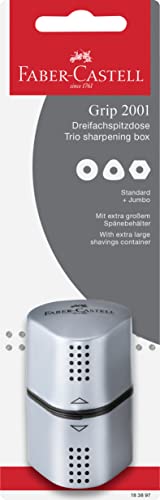
Faber-Castell Grip Trio Pencil Sharpener
by Faber-Castell
Three dedicated holes with optimized cutting angles for standard, jumbo, and colored pencils — the ergonomic handheld that solves soft-core color tip breakage without an electric.
Pros
- Three dedicated blade holes sized specifically for standard pencils, jumbo pencils, and colored pencils — each with its own cutting angle optimized for that pencil type rather than a compromise blade that works poorly on all three
- The dedicated colored-pencil hole uses a shallower cutting angle that dramatically reduces soft-core tip breakage compared to sharpening colored pencils in a standard-angle sharpener
- Ergonomic triangular grip with rubberized contact points gives young children and users with reduced hand strength a substantially easier hold than round or square-bodied handhelds
- Generous integrated tub holds a full day of classroom or studio shavings before needing emptying — larger capacity than most handheld sharpeners in this tier
Cons
- Three-hole layout can be visually confusing without a guide — users initially struggle to identify which hole fits which pencil diameter
- Not suitable for extra-wide specialty pencils (carpenter pencils, some woodless color sticks) that exceed the jumbo hole's diameter
KUM AS2M Long Point — Runner-Up (Best for Colored Pencils)
Colored pencils fail in general-purpose sharpeners for a specific mechanical reason: the soft wax binder that holds the pigment core is structurally weaker than the graphite in a standard pencil, and the aggressive cutting angle of a conventional sharpener cracks or pulls the pigment core out of the wood casing rather than shaving it cleanly. Artists who rely on Prismacolor Premier, Faber-Castell Polychromos, or any professional-grade colored pencil watch their expensive tips snap repeatedly in sharpeners that work perfectly on their No. 2 pencils, and most accept the breakage as unavoidable. The KUM AS2M exists specifically because the breakage is not unavoidable — it is a mismatch between pencil type and how the cut is staged.
The KUM splits the cut into two stages, and that is the whole trick. A conventional sharpener asks one blade to chew through the wood casing and shape the core in the same pass, which loads the fragile pigment core with all the force needed to cut cedar. The AS2M’s first hole shaves the wood back and stops. The second hole then hones only the exposed core, at a much lighter cutting load, with the surrounding wood already out of the way. The practical output is a dramatic reduction in tip breakage — users consistently report sharpening a full set of Prismacolor pencils without a single tip loss, where a general-purpose sharpener would have broken three or four across the same set.
The long point is the second reason to buy it. Because the core is honed separately, the AS2M produces a noticeably longer exposed point than a single-hole sharpener can — the shape draughtsmen and illustrators want, because a long taper holds a usable edge through far more strokes before it needs sharpening again. The spare blades are the detail I appreciate most: two replacements ship inside the housing, so when the steel finally dulls you swap it for pennies instead of buying another sharpener. It also carries lead pointers for 2mm and 3.2mm leads, which no other pick here handles, making it the one tool on this list that serves clutch pencils and lead holders alongside ordinary wood-cased pencils. The honest tradeoff is the shell. It is polystyrene, it feels light and cheap next to a brass sharpener, and the hinged lid is the part reviewers report cracking after enough open-and-close cycles. The mechanism outlasts the housing, which is a strange thing to say about an inexpensive tool but is exactly how buyers describe it.

KUM AS2M Long Point Pencil Sharpener
by KUM
The long-point specialist — a two-step mechanism that shaves wood and hones the core in separate stages, which is what keeps soft colored-pencil cores from snapping, with spare blades in the housing.
Pros
- Two-step design separates the jobs a single-hole sharpener tries to do at once — the first hole shaves back the wood casing, the second hones only the exposed core, so the fragile pigment core is never asked to survive the wood cut
- The gentler second stage is why colored-pencil users report finishing a full Prismacolor set without a single lost tip, where a general-purpose sharpener typically snaps several across the same set
- Ships with two spare high-carbon steel blades stored in the housing, so it is a serviceable tool rather than a disposable one — swap the blade instead of replacing the sharpener
- Includes lead pointers sized for 2mm and 3.2mm leads, which covers clutch pencils and lead holders that no other sharpener on this list accommodates
Cons
- The polystyrene housing and its hinged lid are the weak point — reviewers report the hinge cracking after enough open-and-close cycles
- Body feels light and inexpensive in the hand next to a metal sharpener, which matters to buyers who want the tool to feel like an instrument
- Sold in a single colour only, so it is easy to lose track of in a crowded pencil case
Mobius + Ruppert Brass Bullet — Runner-Up (Premium Artist Pick)
The Mobius + Ruppert brass sharpener is the lifetime tool on this list. It is the only sharpener here that a fine artist, architect, or hand-letterer will buy once and keep for a decade or more — and the only one that, when its blade eventually dulls, is repaired by swapping the blade rather than replacing the entire tool. At a 4.7-star rating across 1,890+ reviews, it ties the highest rating on this list.
The solid-brass body is the specification that defines this sharpener’s character. Where every other handheld on this list is made of plastic — appropriate for the price points they occupy but disposable in feel — the brass body has the tactile weight and cold-metal feel of a precision instrument. It is the closest handheld pencil sharpener experience to a fine mechanical writing tool. The weight is not decorative: a heavier body stabilizes the sharpener against the pencil during the cut, reducing wobble and producing a cleaner, more consistent point geometry than a lighter plastic body can achieve under the same cutting force. Architects and fine illustrators who sharpen dozens of pencils per day during detailed line work notice the difference immediately.
The replaceable steel blade is the feature that elevates this from a premium handheld into an indefinitely-lasting tool. Every other sharpener on this list has either a non-replaceable blade (the sharpener is disposable when it dulls) or a factory blade replacement that requires shipping the sharpener back to the manufacturer. The Mobius + Ruppert’s blade is held in place by a single screw — when the blade dulls, you unscrew it, install a replacement blade for a few dollars, and the sharpener is effectively new again. Over a ten-year service life, this sharpener will cost less in total than two or three mid-tier electrics. The point it produces is longer and finer than any other sharpener in this review — a characteristic that fine artists and architects specifically want for detailed line work where point length translates directly to control.
The two honest limitations are easy to state and easy to work around. Single-hole, standard-diameter only — no jumbo support, no secondary size option. And no integrated shavings container — you sharpen into a trash receptacle or over a cupped hand rather than collecting shavings in the tool. For artists who already have a dedicated pencil case with a shavings pouch or a small tin for portable sharpening, the lack of an integrated container is a non-issue. For users who need a self-contained sharpener that travels dust-free in a backpack, the Staedtler Double-Hole is the better match. For the lifetime-tool buyer who wants the precision-instrument feel and the indefinite lifespan of a replaceable blade, the Mobius + Ruppert is the correct and final answer.

Mobius + Ruppert Brass Artists Pencil Sharpener (Bullet)
by Mobius + Ruppert
A solid-brass precision tool, made in Germany, with a replaceable blade and a rating that ties the best on this list — the sharpener you buy once and keep for a decade.
Pros
- Solid brass body delivers the tactile weight, cold-metal feel, and decade-plus service life of a precision instrument rather than the disposable character of plastic handhelds — the closest experience to a fine mechanical tool in this category
- User-replaceable steel blade means the sharpener effectively has an indefinite lifespan — when the blade dulls, you swap it for pennies rather than replacing the whole tool, making this the only sharpener on this list that is genuinely permanent
- A 4.7-star rating across 1,890+ reviews ties the highest rating on this list, from buyers who are mostly working artists and drafters rather than casual users
- Produces a longer, finer exposed graphite point than any other sharpener reviewed — ideal for detailed illustration, architectural line work, and fine hand lettering where point length determines control
Cons
- Single-hole standard-diameter only — does not accept jumbo pencils and offers no secondary size option
- No integrated shavings container — requires sharpening directly into a trash receptacle or over a cupped hand, which limits portability without a separate shavings pouch
Best Electric Pencil Sharpeners
When a sharpener serves a room full of people every day, electric is the only mode that keeps up — the motor removes the physical effort and delivers a consistent point no matter who is holding the pencil. Between the two electrics I recommend, the choice comes down to environment. The X-ACTO School Pro is the classroom pick: its self-disengaging flyaway cutter and SafeStart bin lockout are built for young hands and mixed pencil sizes. The Bostitch Heavy Duty is the office pick: its hardened helical cutter and stall-free motor shrug off back-to-back sharpening loads that would bog down a lighter unit. Both use a tray-removed auto-stop, so neither eats pencils when a distracted user walks away.
| Product | Price | Buy |
|---|---|---|
| X-ACTO School Pro Electric Pencil Sharpener, BlackBest for classrooms Flyaway cutter that stops at the ideal point, plus a SafeStart bin lockout — built for busy classrooms and mixed pencil sizes. | $37.13 | View on Amazon |
| Bostitch Heavy Duty Electric Pencil SharpenerBest for heavy office volume Hardened helical cutter and stall-free motor rated for four times the blade life under office throughput. | $17.99 | View on Amazon |
Best Manual Pencil Sharpeners
Manual sharpeners win wherever noise, power access, or budget rules out an electric — and the right one depends on how you mount and carry it. The X-ACTO KS is the sharpener I specify when there is no outlet or the unit needs to bolt to a wall; its dual helical cutters produce a point that rivals an electric. The Faber-Castell Grip Trio is the portable choice for anyone juggling standard, jumbo, and colored pencils in one ergonomic body. And the Staedtler Double-Hole is the budget answer for kids and pencil cases, with German steel blades and a lock-lid tub that seals shut for a backpack.
| Product | Price | Buy |
|---|---|---|
| X-ACTO KS Manual Pencil SharpenerBest wall-mount manual Dual helical cutters and an 8-size dial in a commercial housing that bolts to a wall and needs no power. | $17.44 | View on Amazon |
| Faber-Castell Grip Trio Pencil SharpenerBest portable multi-size Three dedicated angled holes for standard, jumbo, and colored pencils in one grippy travel body. | $6.49 | View on Amazon |
| STAEDTLER Double-Hole Tub Pencil SharpenerBest budget for kids German precision blades and a lock-lid tub at a price where replacing it is effectively free. | $4.29 | View on Amazon |
Best Pencil Sharpeners by Use Case
A few needs sit outside the electric-versus-manual split — soft colored-pencil cores, sharpening on the move, and pure heavy-duty throughput each point to a specific tool.
| Product | Price | Buy |
|---|---|---|
| KUM AS2M Long Point Pencil SharpenerBest for colored pencils A two-step cut that shaves wood first and hones the core second, which is what stops soft tips snapping. | $7.95 | View on Amazon |
| Mobius + Ruppert Brass Artists Pencil Sharpener (Bullet)Best for artists on the go Solid-brass pocket sharpener with a replaceable blade — the lifetime tool for art on the move. | $7.85 | View on Amazon |
| Bostitch Heavy Duty Electric Pencil SharpenerBest heavy-duty electric Hardened helical cutter and stall-free motor for the highest sustained volume on this list. | $17.99 | View on Amazon |
Buyer's Guide
The right pencil sharpener depends less on raw cutting power and more on how it fits your specific environment — classroom volume, office noise tolerance, artistic pencil type, and available power all push the decision toward different blade geometries, body designs, and operating modes.
Electric vs. Manual vs. Handheld
The operating mode determines how the sharpener fits into your daily workflow more than any other specification. Electric sharpeners (X-ACTO School Pro, Bostitch Heavy Duty) are the correct choice for classrooms, busy offices, and any environment where multiple users sharpen pencils in rapid succession — the motor eliminates the physical effort and produces consistent results across users of different hand strength. The tradeoffs are cost, noise, and dependency on an AC outlet. Manual mount sharpeners (X-ACTO KS) are the preferred option when you want electric-quality results without the electric price tag or power dependency — a hand crank with dual helical cutters produces points nearly indistinguishable from a mid-tier electric, and mounted sharpeners last a decade or more in classroom environments with no motor or electrical components to fail. Handheld sharpeners (Staedtler Double-Hole, Faber-Castell Grip Trio, Prismacolor Premier, Mobius + Ruppert) are the correct choice for travel, pencil cases, single-user desks, and any situation where portability and silence matter more than throughput. The practical rule: if more than one user shares the sharpener, go electric or mounted manual; if one user owns the pencils, a handheld is usually the better match.
Blade Type (Helical vs. Standard)
Blade type is the engineering detail that most determines point quality and sharpener longevity, and it is also the specification that manufacturers obscure most aggressively in product listings. Helical cutters are cylindrical blades with spiral cutting edges — they engage the pencil at multiple contact points simultaneously, producing a symmetric conical point with less lead breakage and significantly longer blade life than straight-edge blades. Straight blades are a single flat cutting edge — they shave one side of the pencil at a time while the pencil rotates, which produces acceptable points but leaves more asymmetry, breaks lead more often, and dulls faster. Helical cutters are standard in mid-tier and premium electrics and in the X-ACTO KS manual mount. Straight blades dominate budget handhelds (Staedtler Double-Hole, Faber-Castell Grip Trio). For classrooms, offices, and artist studios where point quality affects output, the helical-cutter premium is worth paying. For occasional desk-drawer use, a quality straight-blade handheld is sufficient.
Auto-Stop Mechanism
Auto-stop — the feature that halts the cutter automatically when the point is fully formed — is the single most important feature for any electric sharpener that will be used by multiple people or left unattended with young users. The pencil-eating failure mode where a sharpener consumes excessive pencil length in a single session is almost entirely eliminated by a working auto-stop system. The three common implementations are mechanical sensors that detect the completed cone shape, electrical sensors that detect resistance dropping off when the point is fully cut, and safety-driven mechanisms like the X-ACTO School Pro's Safe Start that refuse to operate when the shavings tray is removed. The Bostitch Heavy Duty combines a safety-switch auto-stop with the HHC helical cutter for a doubly-protective system. The Safe Start feature on the X-ACTO School Pro is particularly valuable in elementary classrooms because it prevents the most common accident pattern — curious fingers reaching toward an exposed cutter when the tray is out for emptying. Auto-stop is effectively absent from manual handheld sharpeners, which rely on user feel to know when the point is sharp. For manual sharpeners, the best analog to auto-stop is a blade angle that naturally resists over-sharpening once the cone is formed.
Noise Level
Noise level is the specification that matters more than buyers expect once the sharpener is installed. A loud electric sharpener in an open-plan office, a library, or a testing room creates a disruption that affects everyone within hearing range every time any user sharpens a pencil. The drivers of sharpener noise are motor size (larger motors are louder), blade type (helical cutters generally run quieter than straight blades because the cutting load is distributed), and body design (acoustic dampening in premium bodies reduces transmission). Manual and handheld sharpeners are effectively silent — the Staedtler Double-Hole, Faber-Castell Grip Trio, Prismacolor Premier, and Mobius + Ruppert produce only the quiet scrape of the blade on wood. Among electrics, the Bostitch QuietSharp family uses acoustic dampening to keep the sharpener below conversational volume. High-RPM budget electrics produce a sustained grinding sound that carries across open floor plans. For classrooms, noise is usually acceptable. For open-plan offices, libraries, and shared workspaces, noise should be weighted equally with cutting performance in the buying decision — and a quiet manual handheld at each desk is often a better arrangement than a single loud electric at a shared station.
Pencil Diameter Compatibility
Pencil diameter compatibility is the specification that most commonly creates the wrong-tool-for-the-job outcome. Standard No. 2 pencils measure roughly 8mm in diameter. Colored pencils range from 7mm to 8.3mm depending on brand. Jumbo pencils — common in primary education, beginning writers, and specialty art applications — measure up to 12mm in diameter and will not fit in a standard-sized sharpener guide at all. Sharpeners with adjustable dials (X-ACTO School Pro six-size, X-ACTO KS eight-size) handle the full range including jumbo pencils by physically expanding the guide to match the pencil. Dual-hole handhelds (Staedtler Double-Hole, Faber-Castell Grip Trio) solve the same problem with dedicated holes sized for each pencil type. Single-hole sharpeners (Bostitch Heavy Duty, Mobius + Ruppert) are sized for standard diameter only and cannot accommodate jumbo pencils at all. Before buying, inventory the actual pencils you will sharpen — if your classroom mixes standard No. 2 pencils with primary-grade jumbo pencils, a single-hole sharpener is the wrong choice regardless of blade quality.
Power Source
Power source determines where the sharpener can be installed and how it behaves during power outages or off-site use. AC adapter power (X-ACTO School Pro, Bostitch Heavy Duty) is the standard for desk-based and wall-mounted classroom sharpeners — it provides the sustained cutting power that high-throughput environments require, but ties the sharpener to an outlet and renders it useless during power interruptions. AA-battery power is common in portable and travel-oriented electric sharpeners but is not represented among this review's electric picks because battery-powered motors typically lack the cutting force for durable daily use. USB-C rechargeable power is an emerging option in 2026-generation sharpeners and offers a practical middle ground for home offices and hybrid workers — portable enough to move between desks, powerful enough for sustained use, without the battery-replacement cost. Wall-mounted manual sharpeners (X-ACTO KS) require no power at all and work identically during an outage as they do during normal operation — the correct choice for outdoor classrooms, remote field offices, and any environment where power reliability is uncertain. Handheld manual sharpeners similarly require no power. Match your power strategy to your environment rather than buying the highest-performance sharpener regardless of fit.
How to Choose the Best Pencil Sharpener
Pick the operating mode first, then the blade type. If the sharpener serves multiple users daily — classrooms, offices, art studios — you want an electric with a helical or planetary cutter and a working auto-stop mechanism (X-ACTO School Pro, Bostitch Heavy Duty). If the sharpener serves a single user or a small group, or if noise and power independence matter, a quality manual covers the full range at much lower cost (Staedtler Double-Hole, X-ACTO KS, Mobius + Ruppert). Match pencil diameter compatibility to your actual pencil inventory — if your environment mixes standard, jumbo, and colored pencils, specify a dual-hole, multi-hole, or adjustable-dial sharpener rather than a single-hole unit no matter how good its blade. And weight noise level appropriately: in classrooms it is secondary, in open-plan offices and libraries it is often decisive.
Final Verdict
For most buyers outfitting a classroom, office, or heavy-use shared workspace in 2026, the X-ACTO School Pro is the correct choice. Its flyaway cutter stops the moment the point is formed rather than eating the pencil, the SafeStart motor meets elementary classroom safety specifications without added hardware, the six-size dial handles every pencil diameter you will realistically encounter, and more than 10,000 verified reviews of daily school service is a reliability track record no competitor at this price matches. It is the sharpener I recommend as the default for any environment that does not have a specific reason to choose something else.
For single-user desks, pencil cases, and travel kits, the STAEDTLER Double-Hole Tub is the unambiguous value winner at its price point — German precision blades, dual standard-plus-jumbo hole compatibility, and a lock-lid tub that makes the sharpener genuinely portable. For business offices and art studios where the hardened helical cutter and stall-free motor matter more than the widest diameter range, the Bostitch Heavy Duty is the upgrade pick that earns its premium through engineering decisions that pay back across multi-year service life. For fine artists, architects, and anyone buying a lifetime tool, the Mobius + Ruppert brass sharpener is the precision instrument you buy once and repair with blade swaps forever — and for colored-pencil work specifically, the KUM AS2M Long Point is the specialist whose two-step cut eliminates the soft-core tip breakage that general sharpeners accept as inevitable. Whatever sharpener you select, pair it with the correct pencils for your work and set up the rest of your desk environment around the same principle — the right desk organizer to keep sharpeners and pencils accessible, and a full set of writing instruments tuned to your daily tasks — because the sharpener is the tool that makes every other pencil decision on your desk work the way it should.
Frequently Asked Questions
What is the difference between a helical blade and a standard blade pencil sharpener?
Why does my electric pencil sharpener keep eating pencils?
What pencil sharpener is safest for a quiet office or library?
Are electric pencil sharpeners safe for colored pencils?
How long do electric pencil sharpeners last, and when should I replace the blade?
Can you sharpen carpenter pencils in a regular pencil sharpener?
Related Articles
About the Reviewer

Sarah Chen, CAP, PMP
B.A. Business Administration, UCLA
Sarah Chen spent 10 years in office management and operations at Fortune 500 companies before founding DeskRated in 2026. After managing supply budgets for teams of 50+ people and testing thousands of products through daily use, she started writing the honest, no-fluff supply reviews that office professionals actually need. Sarah holds both CAP and PMP certifications and is based in Los Angeles.