About Texas Instruments
Texas Instruments was founded in 1930 in Dallas, Texas, where it remains headquartered, and built the first electronic handheld calculator in 1967. The company's core business today is analog and embedded processing chips, and its education calculator lineup, sold under the TI-84, TI-Nspire, TI-30/34 MultiView, and BA II Plus names, spans graphing, scientific, financial, and elementary models used across American classrooms.
The TI-84 Plus CE and TI-84 Plus are approved for the SAT, ACT, AP, IB, and PSAT, the CAS-equipped TI-Nspire CX II is approved for the SAT, AP, and IB but excluded from the ACT by that exam's own rules, and the BA II Plus is one of two calculators the CFA Institute approves for the CFA exam, alongside the HP 12C. That exam-approval footprint, plus a classroom base built on TI keystrokes and TI textbooks, is why a TI model shows up on both of our calculator pages alongside Casio, HP, and NumWorks alternatives.
Brand website: ti.com
What Texas Instruments makes
Texas Instruments's range runs wider than the products we review. The lines we know best from our own testing are marked with a star:
Graphing calculators
the TI-84 Plus CE, TI-84 Evo, and TI-84 Plus, plus the CAS-equipped TI-Nspire CX II line — featured on DeskRated
Scientific calculators
the TI-30 and TI-34 MultiView families for middle and high school classroom use — featured on DeskRated
Financial calculators
the BA II Plus and BA II Plus Professional, used for time-value-of-money, amortization, and cash-flow work — featured on DeskRated
Elementary calculators
the TI-10, TI-15 Explorer, TI-108, and Little Professor Solar for early math instruction
Basic calculators
four-function desktop and handheld models including the TI-503 SV and TI-1706 SV
Why we recognized Texas Instruments
The DeskRated Top Brand recognition isn't paid for and can't be applied for. We award it to the brands whose products consistently stand out in our hands-on category reviews. Texas Instruments earned it on the strength of the products below, evaluated the same way every product on this site is: bought, used at a real desk, and judged on merit.
Texas Instruments products we rated highly
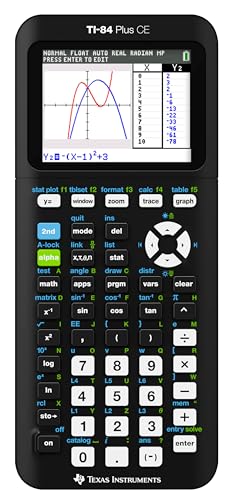
Texas Instruments TI-84 Plus CE Color Graphing Calculator
Approved for the SAT, ACT, AP, IB, and PSAT exams, so one calculator covers every major standardized test a student will face through high school. The full-color backlit display distinguishes multiple plotted functions at a glance, and a rechargeable USB battery replaces the AAA-swapping routine of older graphing calculators. It ships with more than 30 built-in apps and is Python-ready for coursework that introduces programming.
Read the 7 Best Calculators of 2026 guide →
Texas Instruments TI-34 MultiView Scientific Calculator
A MathPrint display renders fractions, stacked exponents, and roots the way they appear on a printed page, which helps students move from paper math to calculator entry. A scrollable calculation history lets students check earlier steps without retyping a problem, and a slide-on cover protects the keypad in a backpack. Solar power with a battery backup keeps it running through a full school day.
Read the 7 Best Calculators of 2026 guide →
Texas Instruments BA II Plus Financial Calculator
One of two calculators the CFA Institute approves for the CFA exam, alongside the HP 12C, and also accepted for the CPA, CFP, and FRM exams. Worksheet-based prompts walk through time-value-of-money, amortization, and cash-flow calculations step by step rather than requiring a single long formula entry.
Read the 7 Best Calculators of 2026 guide →
Texas Instruments TI-Nspire CX II CAS Color Graphing Calculator
Built around a full computer algebra system that solves equations symbolically, including derivatives, integrals, and factoring with variables intact, work the TI-84 family cannot do. The 3.5 inch color display supports animated path plotting and draggable coefficients, and it ships with TI-Nspire CX Student Software so the same files move between the handheld and a desktop. Because CAS calculators are barred from the ACT, students who still need to take that exam should pair it with a non-CAS model.
Read the 8 Best Graphing Calculators of 2026 guide →
Texas Instruments TI-84 Evo Graphing Calculator
A newer TI-84 model, with an icon-based home screen and reorganized menus built on the TI-84 platform teachers already know. It carries roughly three times the processing speed and about 50 percent more graphing area than the TI-84 Plus CE, and it charges over USB-C instead of TI's older mini-USB cable. It is approved for the SAT, ACT, AP, and IB exams.
Read the 8 Best Graphing Calculators of 2026 guide →
Texas Instruments TI-84 Plus Graphing Calculator
Uses the same file format, programs, and lists as the TI-84 Plus CE and TI-84 Evo, so a household replacing a lost or broken unit keeps every saved program and compatible accessory. It runs on four AAA batteries with a lithium memory backup instead of a rechargeable cell, and it is approved for the SAT, ACT, AP, IB, and PSAT exams.
Read the 8 Best Graphing Calculators of 2026 guide →What earned Texas Instruments the recognition
- The TI-84 Plus CE and TI-84 Plus are approved for the SAT, ACT, AP, IB, and PSAT, and the TI-Nspire CX II CAS for the SAT, AP, and IB, with the ACT excluded under that exam's ban on CAS calculators.
- The BA II Plus is one of only two calculators the CFA Institute approves for the CFA exam, alongside the HP 12C, and is also accepted for the CPA, CFP, and FRM exams.
- The TI-Nspire CX II CAS adds a full computer algebra system for symbolic algebra work that the TI-84 family cannot perform, extending TI's lineup into college calculus and CAS-permitted coursework.
- The TI-34 MultiView uses a MathPrint display that renders fractions, exponents, and roots in textbook notation, built for middle and high school classroom use with a slide-on keypad cover and solar-plus-battery power.
- TI's calculator lineup traces back to 1967, when the company built the first electronic handheld calculator, and today spans graphing, scientific, financial, and elementary models.