8 Best Bulletin Boards of 2026
Sarah Chen reviews the best bulletin boards for home offices, cubicles, conference rooms, and classrooms. Compare cork, linen, felt, and combo boards by size and mounting.
Updated

As a Certified Administrative Professional who manages the supply budget and workspace setup for the teams I support, I see the bulletin board purchase land on my desk constantly — and it is almost always approached as a decorating question when it is really a logistics one. A bulletin board is a piece of working infrastructure: it holds the schedule the team checks every morning, the agenda that drives a meeting, the rotation chart in a classroom, or the reference document a cubicle worker needs at a glance. The wrong board does not just look wrong; it stops getting used. A flimsy foam-backed board stops holding pins within a year, an oversized board collects clutter in its empty half, and a board mounted with the wrong hardware sags off a rental wall and takes the paint with it. Getting the decision right is the difference between a board the team relies on and one everyone walks past.
For this review, I evaluated seven of the best bulletin boards currently available on Amazon — spanning compact single-user cork boards, large team-wall boards, a decor-forward linen board, modular frameless tiles, and a combination cork-and-calendar unit. I weighed surface material against real-world pin-cycle durability, size against the space and the number of people actually using the wall, frame material against the room it lives in, and mounting method against the very common constraint of a wall you are not allowed to drill into. If you are wiring up a full workspace, this board sits alongside the other planning surfaces — our guides to the best whiteboards and the best desk organizers cover the writing and storage halves of the same setup.
Find the Best Bulletin Board for Your Wall
Jump straight to the board that matches how the wall will be used:
How We Chose These Bulletin Boards
Our selection started from a real-world reliability floor: with one exception for the lower-volume VIZ-PRO black-frame runner-up, every board carries thousands of verified Amazon reviews, and the picks lean toward the most-reviewed options in their use-case tier. We required genuine use-case differentiation across all seven — no two boards here serve the same primary buyer, spanning the solo home office, the shared cubicle, the conference room, the classroom, the no-drill rental, and the compact command center. We evaluated cork against fabric on long-term pin-cycle behavior and ghosting, assessed frame material against the spaces these boards realistically live in, and weighed mounting hardware against the very common renter constraint of a wall that cannot take screws. We were honest about the frameless cork tiles — because the adhesive-tape complaints behind their occasional low reviews trace to a fixable mounting issue rather than the cork itself, and the modular format genuinely solves a problem no framed board can.
Best Bulletin Boards Overall
Cork is the default surface for a working wall, and it anchors this list — full reviews of all eight picks come first. The use-case sections that follow (large boards, fabric and felt boards) reference these same products, so you can move between them freely.
Quartet Framed Cork Bulletin Board 2’ x 3’ — Best Overall
The Quartet 2’ x 3’ framed cork board earns its best-overall position the same way the most-trusted products usually do: it does the core job better than anything at the price and has 24,000+ verified reviews confirming it holds up. The 24” x 36” size is the most useful single dimension in the category — large enough for a week of reminders, a few reference documents, and a small project layout, but not so large that it dominates a wall or collects clutter in an empty half. It is the board the majority of home office workers, cubicle dwellers, and small-team managers should buy without further deliberation.
The surface is where this board separates from the foam-backed boards that flood the lower price tiers. This is dense natural self-healing cork — the cork cells compress around a pin and rebound when it is removed, so the surface stays smooth and keeps its grip across years of re-pinning. The cheap alternative, ground cork pressed over foam, perforates permanently: after a few hundred pin cycles the surface looks pocked and pins stop holding. If you re-pin your wall regularly, that difference is the entire lifespan of the board. The slim black metal-composite frame reads as professional rather than craft-store, which matters when the board is visible on a video call or shares a wall with the rest of your office hardware.
The one thing to plan for: like most quality cork boards, it ships without push pins, so order a box of pins alongside it. For a cork surface, standard map pins or flat-head pins both grip well — I cover the pin-type details in the buyer’s guide below, because the right pin matters more than most people assume. Mount it with all the provided hardware (not just the corners) to keep the cork seated flat, and the board will outlast several rounds of whatever you pin to it.

Quartet Framed Cork Bulletin Board, 2' x 3', Black Frame
by Quartet
The best all-around bulletin board — dense self-healing cork, a professional black frame, and 24,000+ reviews at the most useful single-user size.
Pros
- 24,000+ verified reviews make this the most-trusted framed cork board on Amazon — an unmatched real-world reliability signal at the 2' x 3' size
- Natural self-healing cork surface closes around pin holes and rebounds, keeping the board looking clean after thousands of pin cycles rather than perforating like foam-backed boards
- Slim black metal-composite frame reads as professional rather than craft-store — appropriate for client-facing home offices and shared office walls
- Mounts horizontally or vertically with included hardware, so the same board adapts to portrait planning walls or landscape document strips
Cons
- Ships without push pins — you will need to buy pins separately before the board is usable on day one
- Cork can develop a slight bow if mounted only at the corners on a humid wall — use all provided anchors and seat the board flat
U Brands Cork Bulletin Board 18” x 24” — Budget Pick
The U Brands 18” x 24” birch-framed board is the budget pick not by being the most stripped-down option, but by delivering genuine self-healing cork and a real wood frame at the lowest price of any framed board on this list — backed by 8,800+ reviews, which is remarkable validation at this price. There is no meaningful quality compromise here versus boards costing twice as much; the cork is dense and MDF-backed, holds pins firmly, and self-heals the same way the more expensive boards do.
The birch wood frame is the quiet upgrade that makes this board feel more expensive than it is. Aluminum frames are office-neutral but cold; the warm birch suits a home office, a dorm room, or any wall where the board is visible and you would rather it not look institutional. It also ships with two starter push pins and mounting hardware, so unlike the cork boards that arrive surface-only, this one is usable the moment it comes out of the box — a small but real convenience for a budget buyer who does not want a second order.
The honest limitation is size. At 18” x 24” this is a single-user board: enough for one person’s reminders and a small cluster of notes, but undersized the moment two people share the wall or you try to run a standing project layout. If you need shared-wall capacity, step up to one of the 36” x 24” boards below. But for a solo desk-side spot — especially one that shares wall space with a monitor or a whiteboard — this is the most board you can buy for the money.

U Brands Cork Bulletin Board, 18" x 24", Light Birch Wood Frame
by U Brands
The best budget bulletin board — dense self-healing cork and a warm birch frame at the lowest price of any framed board here, with 8,800+ reviews and push pins included.
Pros
- 8,800+ reviews at the lowest price of any framed board here — a deeply validated budget cork board, with no meaningful quality compromise versus boards costing twice as much
- Dense MDF-backed cork holds pins firmly and self-heals, avoiding the loose, crumbly cork that plagues the cheapest big-box boards
- Light birch wood frame is warmer and more decorative than aluminum — fits a home office or dorm wall without looking institutional
- Includes two starter push pins and mounting hardware, so the board is usable the moment it arrives
Cons
- At 18" x 24" it is genuinely small — adequate for a single user's reminders, but undersized for a shared or team wall
- The wood frame can show minor finish variation between units, since it is real wood rather than a printed laminate
U Brands Farmhouse Linen Bulletin Board 30” x 20” — Upgrade Pick
The U Brands linen board is the upgrade pick for a specific and underserved buyer: someone whose board lives on a visible, decor-forward wall and who does not want it to look like a pin-pocked office supply. The cream linen surface is the differentiator. Where cork shows every pin hole, linen fabric closes around the pin and hides the mark almost completely, so the board stays presentable even after months of use. For a reception area, a styled home office, or any wall guests actually see, that difference is the whole point.
Linen also solves a problem cork cannot: ghosting from repeated same-spot pinning. On a cork board, pinning the same calendar or photo in the same place over and over eventually leaves a visible cluster of holes. Linen’s woven surface springs back, so a fixed layout that rarely changes stays clean indefinitely. That makes this the right board for a display that stays put — a standing photo wall, an inspiration board, a permanent reference layout — rather than a working wall you reshuffle daily. The FSC-certified white wood frame leans into the decor angle, reading as an intentional design element rather than a utility object.
The trade-off to understand before buying: linen grips thin pins less firmly than cork. Lightweight notes hold fine, but for heavier items or thick layering, use flat-head push pins or T-pins whose wider heads bear against the weave — thin map pins can slide or pull through. The fabric also attracts a bit of dust over time, so an occasional pass with a lint roller keeps it looking sharp. Treat it as a display surface rather than a heavy-duty working board and it will outperform any cork board on aesthetics.

U Brands Farmhouse Linen Bulletin Board, 30" x 20", White Wood Frame
by U Brands
The upgrade pick for visible, decor-forward walls — a linen surface that hides pin holes and resists ghosting, framed in FSC-certified white wood that doubles as decor.
Pros
- Cream linen fabric surface hides pin holes far better than cork — pins leave almost no visible mark, so the board stays presentable in a visible, decor-forward space
- Linen resists the ghosting that develops on cork when you pin repeatedly in the same spot, making it ideal for a fixed layout that rarely changes
- FSC-certified white wood frame doubles as wall decor — the board reads as an intentional design element rather than an office supply
- Landscape 30" x 20" format suits a horizontal run of notes, photos, or a project strip above a desk
Cons
- Linen grips thin pins less firmly than cork — use flat-head or T-pins rather than thin map pins for heavy items
- Fabric surface attracts dust and can show marks from oily fingers over time, requiring occasional lint-roller cleaning
VIZ-PRO Cork Notice Board 36” x 24” Black Frame — Runner-Up
The VIZ-PRO 36” x 24” with the black aluminum frame is the runner-up because it delivers nearly everything the best-overall Quartet does — dense self-healing cork, a clean professional frame, and a genuinely useful size — in a contemporary black finish that coordinates with modern office hardware. If your space already runs black-frame monitors, a black-frame whiteboard, or dark-toned furniture, this is the board that visually belongs there rather than fighting the room.
The black anodized aluminum frame with hidden screw covers is the detail that elevates it. The screw caps conceal the mounting hardware entirely, so the installed board sits flush against the wall with no visible fasteners — the same clean look you get from a premium whiteboard installation. At a full 36” x 24”, it crosses from single-user into shared-wall territory, with enough cork to run a team schedule, a set of reference documents, or a small project layout that two people contribute to.
The reasons it lands at runner-up rather than the top spot are minor but real: its review volume is the lowest on this list, and like the Quartet it ships without push pins. Inspect the aluminum corners on delivery, since a recurring (if uncommon) review note is transit scuffing on the frame. Mounted horizontally or vertically, it makes an excellent cork companion to an existing dry-erase board — pair it beside one of our recommended whiteboards and you have a complete write-and-pin planning wall in matching black frames.

VIZ-PRO Cork Notice Board, 36" x 24", Black Aluminum Frame
by VIZ-PRO
The runner-up — a 36" x 24" cork board with a contemporary black aluminum frame and hidden screw covers, matching modern black-frame office gear.
Pros
- Black anodized aluminum frame with hidden screw covers gives a clean, contemporary edge that matches modern black-frame whiteboards and monitors
- Full 36" x 24" of dense self-healing cork provides genuine team-wall capacity at a single-user price
- Hidden screw caps conceal the mounting hardware for a flush, professional installation with no visible fasteners
- Mounts horizontally or vertically, so it pairs as a portrait or landscape companion to an existing whiteboard
Cons
- Ships without push pins, so budget for a separate pin purchase before first use
- Aluminum frame corners can arrive with minor transit scuffs — inspect the packaging on delivery
VIZ-PRO Cork Notice Board 36” x 24” Silver Frame — Best for Standard Offices
The silver-frame version of the VIZ-PRO 36” x 24” is the same well-built cork board in the finish that disappears into a conventional office. With 5,500+ reviews, it is actually the more validated of VIZ-PRO’s two finishes, and silver aluminum is the universal office-neutral frame — it coordinates with the gray and silver hardware already standard in most cubicles, conference rooms, and corporate fit-outs without anyone having to think about whether it matches.
For a shared office wall, that neutrality is a feature rather than a compromise. A board that quietly fits the existing environment is the one that gets approved by facilities, installed without comment, and used by the whole team. The full 36” x 24” of dense self-healing cork gives you real shared-wall capacity: post the team agenda, pin the week’s schedule, hold a set of reference documents, all on a surface that holds up to the constant re-pinning a working office wall sees. Hardware is included for both horizontal and vertical mounting, so it adapts to whatever wall run is available.
This is the board to choose when the goal is a dependable working surface in a standard office rather than a styled statement piece. The silver frame is more utilitarian than the wood or black-frame options, so it suits a working office better than a designed home wall — but in the context it is built for, that is exactly right. As with the other cork boards, plan to add push pins, and consider pairing it with a tidy set of desk organizers so the supplies the board references stay within arm’s reach.

VIZ-PRO Cork Notice Board, 36" x 24", Silver Aluminum Frame
by VIZ-PRO
The office-neutral choice — the same 36" x 24" self-healing cork board in a silver aluminum frame that coordinates with standard cubicle and conference-room hardware.
Pros
- 5,500+ reviews on the silver-frame version make it the more validated of VIZ-PRO's two finishes — a reliable choice for a standard office aesthetic
- Silver aluminum frame is the universal office-neutral finish that coordinates with most existing cubicle and conference-room hardware
- Full 36" x 24" self-healing cork surface delivers shared-wall capacity for agendas, schedules, and reference documents
- Hardware included for both horizontal and vertical mounting adapts the board to the available wall run
Cons
- No push pins included — plan a separate pin purchase before installation
- Silver frame is more utilitarian than decorative, so it suits a working office better than a styled home wall
Quartet Cork Tiles 12” x 12” 4-Pack — Best Frameless for Custom Layouts
The Quartet cork tile 4-pack solves a problem no framed board can touch: covering a wall, column, or odd-shaped space that a rigid rectangle simply will not fit. Four modular 12” x 12” tiles let you build a board to any layout — a horizontal strip above a workbench, a vertical column beside a monitor, a compact feature wall, or a custom grid that wraps an alcove. For a classroom rotation wall, a craft or studio space, or any installation where the shape of the wall drives the shape of the board, this flexibility is the entire reason to buy — and if you need to cover a larger area, add a second or third pack.
The cork itself is not a compromise. At 3/16” thick, it is dense self-healing cork that holds pins as well as any framed board on this list — you are trading the frame for flexibility, not trading away function. Each pack ships with adhesive mounting tape included, so the tiles arrive ready to put up with no separate hardware order.
I have to be honest about the one real weakness: the included adhesive tape is the weak point. A meaningful share of reviews report tiles loosening after a few months, and while the tiles carry a solid 4.3 rating across more than 8,900 reviews, nearly all of the complaints trace to that single issue rather than to the cork. The fix is simple and cheap — most experienced users reinforce the tiles with stronger mounting tape or small nails from the start rather than trusting the stock adhesive. Do that, and you get a genuinely flexible, durable custom board for less than the framed options.

Quartet Cork Tiles, 12" x 12", Natural, 4-Pack (Frameless, Adhesive)
by Quartet
The best frameless option for custom layouts — four thick self-healing cork tiles for any wall shape, with the honest caveat that the included adhesive often needs reinforcing; buy multiple packs to cover a large wall.
Pros
- Four modular 12" x 12" tiles let you build a custom-shaped board to a wall, column, or odd alcove that a rigid framed board cannot fit
- 3/16" thick self-healing cork holds pins as well as a framed board, so you are not trading function for flexibility
- Frameless format suits a horizontal strip above a workbench, a vertical run beside a monitor, or a compact feature wall a framed board cannot economically cover
- Amazon's Choice with 8,900+ verified ratings and included adhesive mounting tape, so it arrives ready to install with no extra hardware to buy
Cons
- The included adhesive tape is the weak point — reviews report tiles loosening after a few months, so most users reinforce with stronger mounting tape or small nails
- A 4-pack covers four square feet — for a full feature wall you will need two or three packs, which erodes the per-square-foot savings
Quartet Combination Magnetic Calendar & Corkboard 17” x 23” — Best Combination Board
The Quartet combination board is the most space-efficient option here, pairing a magnetic dry-erase calendar with a cork panel in a single 17” x 23” unit — and at a 4.7 rating across 6,200+ reviews, it is the highest-rated board on this list. The appeal is the workflow it enables on one footprint: lay out the month on the writable calendar side, then pin the supporting material — a deadline reminder, a printed agenda, a reference card — to the cork beside it. For a cubicle wall, a kitchen command center, or a dorm space where wall room is scarce, that two-in-one design replaces two separate boards.
Because the whiteboard half is magnetic, the board does triple duty: write on the calendar, pin to the cork, and hold a lightweight document or photo with the included magnets. It ships fully functional on both surfaces, with a marker, two magnets, and mounting hardware in the box, so there is nothing to buy before it works. That out-of-the-box completeness is unusual on this list and makes it the easiest board here to put up and start using the same day.
The trade-off is inherent to the format: splitting one compact board across two surfaces means each zone is small. The calendar is right-sized for a personal month-at-a-glance but not for a team’s detailed planning, and the cork panel suits a handful of notes rather than a full project layout. If your main need is heavy writing, pair a dedicated whiteboard with a separate cork board instead. But if you want both functions in the least possible space, this is the most elegant solution — and it complements a paper planning system nicely, the way our favorite desk calendars anchor a desk while this board anchors the wall above it.

Quartet Combination Magnetic Whiteboard Calendar & Corkboard, 17" x 23", Black Frame
by Quartet
The best combination board — a magnetic dry-erase calendar paired with a cork panel in one compact, highly rated unit for cubicles and command centers.
Pros
- Combines a magnetic dry-erase calendar and a cork panel in one board — plan the month on the whiteboard side and pin supporting notes to the cork beside it
- Highest rating on this list at 4.7 across 6,200+ reviews, reflecting strong satisfaction with the dual-surface design
- Ships with a marker, two magnets, and mounting hardware, so it is fully functional out of the box on both surfaces
- Compact 17" x 23" footprint fits a cubicle wall, kitchen command center, or dorm space where a full board would not
Cons
- The split surface means each individual zone is small — neither the calendar nor the cork is large enough for heavy use on its own
- Mounts horizontally only, so it cannot be rotated to portrait orientation like the single-surface boards here
Bumusty Felt Bulletin Board Tiles 48” x 36” — Best Large Felt Board
The Bumusty felt tiles answer a request the cork boards on this list cannot: a large, soft, decor-forward surface that reads as an intentional design element rather than an office supply. Twelve modular oatmeal-colored felt tiles assemble into a full 48” x 36” board — the largest fabric surface here — and the muted felt hides pin marks the way linen does, so a vision board, a photo wall, or a styled home-office layout stays presentable after months of re-pinning. Felt has become the default modern alternative to cork for exactly this reason: it delivers the pin-friendly surface without the pocked, craft-store look that dense cork develops on a highly visible wall.
The practical advantage over the framed boards is completeness and flexibility. The set ships with 30 push pins and 60 adhesive tabs, so unlike the cork boards that arrive surface-only, this one mounts and works straight out of the box — and the tile format means you are not locked into a rectangle. Run the tiles wide above a desk, stack them in a vertical column beside a monitor, or wrap them around a window. The honest trade-offs are inherent to the material: felt grips thin pins less firmly than dense cork, so use the included pins and keep heavy or thickly layered items on the framed cork boards, and reinforce the adhesive tabs with stronger mounting tape on textured or freshly painted walls for a permanent hold. Treat it as the display-and-decor board it is — the fabric counterpart to the framed linen board above — and it outperforms any cork board on a wall people actually look at.
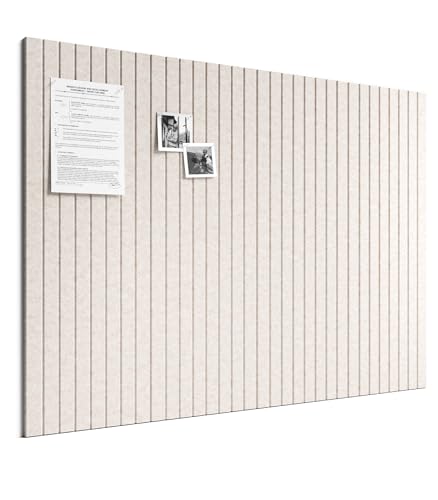
Bumusty Felt Bulletin Board Tiles, 48" x 36", Oatmeal, 12-Pack
by Bumusty
The best large felt board — twelve oatmeal tiles that cover a 4x3 wall with a soft, decor-forward fabric surface, and the only pin board here that ships with both pins and mounting tabs.
Pros
- Twelve modular felt tiles cover a full 48" x 36" wall — the largest fabric-surface board here and a warm, modern alternative to a rigid cork rectangle
- Soft oatmeal felt hides pin holes and reads as intentional decor, making it a natural fit for vision boards, photo walls, and styled home offices
- Ships complete with 30 push pins and 60 adhesive tabs, so it mounts and is usable the moment it arrives with no separate pin or hardware order
- Tile format adapts to any layout — a wide horizontal run, a vertical column beside a monitor, or a custom grid that wraps a window or alcove
Cons
- Felt grips thin pins less firmly than dense cork — use the included push pins and reserve heavy or thickly layered items for the framed cork boards
- Adhesive-tab mounting is convenient but, like any tile board, holds best when reinforced with stronger tape on textured or freshly painted walls
Best Large Bulletin Boards
A large board is the right call for a shared wall, a conference room, or a classroom — 36” wide or larger, with enough surface to run a team schedule, a project layout, or a set of reference documents without overlapping. Three framed cork boards here reach true large dimensions, and they differ by frame finish rather than surface. (For an even bigger, softer wall, the Bumusty felt tiles reviewed above scale to a full 48” x 36”.)
| Product | Price | Buy |
|---|---|---|
| Quartet Framed Cork Bulletin Board, 2' x 3', Black FrameBest large board overall The Quartet 2' x 3' pairs dense self-healing cork with a slim professional black frame and 24,000+ reviews — the large board most home offices and small teams should buy without further deliberation. | $29.76 | View on Amazon |
| VIZ-PRO Cork Notice Board, 36" x 24", Black Aluminum FrameBest large board for modern offices The VIZ-PRO 36" x 24" in black anodized aluminum hides its screw covers for a flush, contemporary install that coordinates with black-frame monitors and whiteboards. | $29.50 | View on Amazon |
| VIZ-PRO Cork Notice Board, 36" x 24", Silver Aluminum FrameBest large board for standard offices The silver-frame VIZ-PRO is the same 36" x 24" cork board in the office-neutral finish that disappears into a standard cubicle or conference room — the more-reviewed of the two finishes. | $29.50 | View on Amazon |
Best Fabric & Felt Bulletin Boards
When the wall is visible and the layout rarely changes, a fabric surface beats cork: linen and felt close around pin holes and resist the ghosting cork develops from repeated same-spot pinning, so the board stays presentable as decor. Two picks here cover the fabric category — a framed linen board for a styled, decor-forward wall and a large felt-tile set for a modern vision-board wall.
| Product | Price | Buy |
|---|---|---|
| U Brands Farmhouse Linen Bulletin Board, 30" x 20", White Wood FrameBest framed fabric board The U Brands Farmhouse Linen board wraps a cream linen surface in an FSC-certified white wood frame that doubles as wall decor — the pick for a reception area, a styled home office, or any wall guests actually see. | $30.39 | View on Amazon |
| Bumusty Felt Bulletin Board Tiles, 48" x 36", Oatmeal, 12-PackBest large felt board The Bumusty felt tiles cover a full 48" x 36" in soft oatmeal felt and ship with pins and mounting tabs — the largest, most flexible fabric surface here for a vision board or photo wall. | $31.99 | View on Amazon |
How to Choose the Best Bulletin Board
The six factors below cover the decisions that separate a board your team actually uses from one that becomes wall furniture within a few months. The throughline: match the board to how the wall will be used, not to how it looks empty in the listing photo.
Map the Board to the Space, Not the Decor
Before anything else, name the scenario. A solo home office wants a compact single-user cork board — the 18” x 24” or 24” x 36”. A shared cubicle or conference room wants a 36”-wide team board, ideally in a frame that matches the existing hardware. A classroom wants durable, dense cork at a generous size, or modular tiles for a rotation wall. A visible, decor-forward wall wants linen that hides pin holes. And a renter or no-drill office wants a light board it can hang on adhesive strips. Identify which of those you are before you compare specs, because the right scenario eliminates two-thirds of the options immediately.
Cork vs Fabric Is a Behavior Question
The surface decision comes down to how often you re-pin. Cork is the working surface: it grips pins firmly, self-heals around the holes, and stays functional through thousands of pin cycles, so it is right for schedules, project walls, and classroom rotations. Linen and fabric are the display surface: they hide pin holes almost completely and resist the ghosting that builds up on cork when you pin the same spot repeatedly, so they suit a fixed, visible layout that rarely changes. Be honest about your behavior — a wall you reshuffle weekly wants cork, a wall you set up once and admire wants linen.
Test Cork Density Before You Trust It
On any cork board, density predicts lifespan. Quality self-healing cork (roughly 8 to 12 lbs per cubic foot) rebounds when you pull a pin, keeping the surface smooth and the grip firm for years. Cheap reconstituted or foam-backed cork perforates permanently and stops holding pins within a year. The simplest in-store or unboxing test: press your thumbnail into the cork. Good cork resists the dent and springs back; bad cork holds the impression. Every cork board reviewed here passes that test, which is precisely why they survive heavy use.
Match the Pin to the Surface
This is the detail almost every bulletin board guide skips, and it changes how well your board works. On cork, thin map pins grip beautifully and look clean. On linen or fabric, switch to flat-head push pins — their wider heads bear against the weave and hold without slipping through. Whenever you are pinning through several layers at once, on either surface, reach for T-pins: the longer shaft anchors deeper and carries the weight that a short pin cannot. Buying the right pin for your surface is the cheapest upgrade you can make to a board’s daily usability.
Plan the Mount Around Your Wall’s Limits
Every board here is light — 2 to 4 pounds — which means you have options even if you cannot drill. Adhesive mounting strips rated for at least 50 percent more than the board’s weight (a 5–6 lb strip set) hold securely on a clean, dry wall; spread them across the top and corners and let them cure before hanging. For a permanent install, land a sawtooth hanger or screws on a stud, or use toggle bolts where no stud is available. The one product that needs extra attention is the frameless cork tiles, whose stock adhesive is the documented weak point — reinforce those with stronger tape or small nails from the start.
Decide Whether You Need One Board or Two Surfaces
If you want both a writable surface and a pin surface in a tight space, a combination board gives you both in one compact unit — ideal for a cubicle or command center where wall room is the constraint. The cost is that each zone is smaller, so a combo board suits light dual use rather than heavy use of either half. If writing is your primary need, you will be happier pairing a full dedicated whiteboard with a separate cork board than splitting one small unit between the two jobs.
Buyer's Guide
Choosing the right bulletin board comes down to where it will live, how often you re-pin, and whether the wall is a working surface or a visible one. As someone who has speced out boards for everything from a two-person home office to a 300-person headquarters, these are the six factors that actually decide the purchase.
Surface Material
Bulletin board surfaces fall into two practical categories: cork and fabric/linen. Cork is the working surface — natural self-healing cork grips pins firmly, closes around holes, and stays functional through thousands of re-pin cycles, making it the right call for project walls, schedules, and classroom rotations. Linen and fabric are the display surface — they hide pin holes almost completely and resist ghosting from repeated same-spot pinning, so they suit visible, decor-forward walls where the layout rarely changes. Match the surface to your behavior, not your budget: a heavily re-pinned wall wants cork, a styled display wall wants linen. Avoid cheap foam-backed cork entirely — it perforates permanently and stops holding pins within a year.
Board Size
Size should follow how much you actually pin, not how much empty wall you have. For a single-user home office, 18" x 24" to 24" x 36" covers reminders, a few documents, and a small inspiration cluster. Step up to 36" x 24" when two people share the wall or you run a standing project layout that grows over the week. For a true team wall, conference room, or classroom, plan on 36" wide or wider, or build a custom run from modular tiles. An oversized board that sits half-empty just collects clutter in the unused half, while an undersized board forces you to overlap and lose visibility — measure the content you keep visible today and add about a third for growth.
Frame Material
Frame choice is mostly aesthetic, but it determines whether the board reads as decor or as an office supply. Aluminum frames (black or silver) are the office-neutral standard — silver coordinates with most existing cubicle and conference-room hardware, while black matches modern monitors and black-frame whiteboards. Wood frames, like the birch and white-wood U Brands boards, are warmer and more decorative, suited to a home office or visible wall where the frame is part of the design. Frameless modular tiles trade any frame for total layout flexibility. There is no wrong answer here — pick the frame that disappears into the space you are putting it in, since a frame that clashes is the detail people notice first.
Mounting Method
Mounting is where renters and no-drill offices get tripped up. Every board on this list is light (2 to 4 lbs), so adhesive mounting strips rated for at least 50 percent more than the board's weight (a 5–6 lb strip set) hold securely on a clean, dry wall — just distribute the strips across the top and corners and let them cure before hanging. For a permanent install, land a sawtooth hanger or screws on a wall stud, or use toggle bolts where no stud is available. The frameless cork tiles are the one caution: their stock adhesive is the weak point and reviews report tiles loosening after a few months, so reinforce them with stronger tape or small nails from day one rather than trusting the included strips.
Self-Healing Surface & Cork Density
On a cork board, density is the single best predictor of how long the surface lasts. Self-healing cork uses intact natural cork cells that rebound and partially close each pin hole when you remove the pin, keeping the surface smooth and the grip firm over years. Reconstituted or foam-backed cork perforates permanently and degrades fast. Test density before you commit: press your thumbnail into the cork — quality self-healing cork (around 8 to 12 lbs per cubic foot) resists the dent and springs back, while cheap cork holds the dent. Every cork board reviewed here uses dense self-healing cork, which is why they survive heavy classroom and team use. This factor matters more than frame or color on any board you plan to re-pin regularly.
Combination & Magnetic Features
Combination boards pair two surfaces — typically a magnetic dry-erase calendar or whiteboard alongside a cork panel — in a single unit, letting you plan on the writable side and pin supporting notes to the cork beside it. They are excellent for cubicles, kitchen command centers, and dorm spaces where wall room is limited and you want both functions without two separate boards. The trade-off is that each zone is smaller, so a combo board is ideal for light dual use but not for heavy use of either surface on its own. If your main need is writing, pair a dedicated whiteboard with a separate cork board instead; if you want a compact all-in-one, the combination format is the most space-efficient choice.
Final Verdict
The Quartet Framed Cork Bulletin Board 2’ x 3’ is our best overall pick for the same reason it has earned 24,000+ reviews: dense self-healing cork that holds up for years, a professional black frame that fits a working office or a home wall, and the most useful single-user size in the category. For the majority of buyers setting up a home office or a cubicle, this is the correct default — it does the core job better than anything at the price and asks only that you bring your own push pins.
For cost-conscious buyers, the U Brands 18” x 24” birch board is the budget alternative that gives up almost nothing — real self-healing cork and a warm wood frame at the lowest price of any framed board here, with push pins already in the box. If your board lives on a visible, decor-forward wall, the U Brands linen board is worth the upgrade for a surface that hides pin holes and resists ghosting. And if you need to cover an odd-shaped wall or build a custom layout, the Quartet cork tiles are the most flexible option on the list — just plan to reinforce the adhesive from day one. Whichever you choose, pair it with the matching write surface from our whiteboards guide and a tidy desk organizer setup, and you have a planning wall the whole team will actually use.
Frequently Asked Questions
Cork or fabric bulletin board — which should I choose?
How do I mount a bulletin board without damaging the wall?
What size bulletin board do I need for a home office?
Are self-healing cork bulletin boards actually better?
Can you use push pins on a fabric or linen bulletin board?
Related Articles
About the Reviewer

Sarah Chen, CAP, PMP
B.A. Business Administration, UCLA
Sarah Chen spent 10 years in office management and operations at Fortune 500 companies before founding DeskRated in 2026. After managing supply budgets for teams of 50+ people and testing thousands of products through daily use, she started writing the honest, no-fluff supply reviews that office professionals actually need. Sarah holds both CAP and PMP certifications and is based in Los Angeles.