About HHKB
HHKB, short for Happy Hacking Keyboard, was conceived by Dr. Eiiti Wada, Professor Emeritus at the University of Tokyo, as a keyboard for programmers. By HHKB's own account, the first model, the KB01, was released in the winter of 1996 in a run of 500 units. The keyboards are made by PFU, a Ricoh company, and PFU America, Inc. is the primary authorized seller of HHKB keyboards in the United States.
The current Professional range pairs Topre switches with a compact 60 percent layout. HHKB states that the HYBRID and HYBRID Type-S models, released in December 2019, connect up to four Bluetooth devices, also work over USB Type-C, and can be remapped with its Keymap Tool. Our keyboard review focuses on the Professional HYBRID Type-S, the silent-key version, and on how its Unix-style layout and Topre feel suit programmers.
Brand website: hhkeyboard.us
What HHKB makes
HHKB's range runs wider than the products we review. The lines that earned places in our roundups are marked with a star:
HHKB Professional HYBRID Type-S
silent-key version of the HYBRID, with Bluetooth for up to four devices, USB Type-C and keymap customization (featured on DeskRated)
HHKB Professional HYBRID
Bluetooth and USB Type-C model that connects up to four devices and supports keymap customization
HHKB Professional Classic Type-S
wired, compact model with silent keys and the keymap customization function
HHKB Professional Classic
HHKB describes it as the updated original HHKB experience
HHKB Studio
a separate line from the Professional series: a wireless mechanical 60 percent keyboard
Why we recognized HHKB
The DeskRated Top Brand recognition isn't paid for and can't be applied for. We award it to the brands whose products consistently stand out in our category roundups. HHKB earned it on the strength of the products below, evaluated the same way every product on this site is: checked against the specs and verified buyer reviews, and judged on merit.
HHKB products we rated highly
HHKB Professional Hybrid Type-S
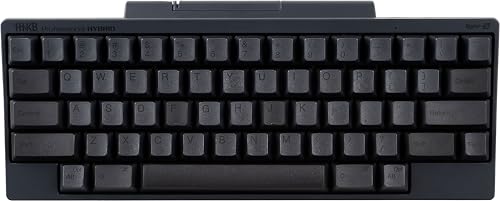
Our review calls it the board people choose for its layout and switch feel rather than its spec sheet. Control sits where Caps Lock normally does, the arrangement Unix and vim conventions were written around, so it needs no remapping. The Topre switches use a rubber dome over a conical spring for a cushioned, tactile bottom-out, and the Type-S dampening makes them noticeably quieter than standard Topre. It pairs with four devices over Bluetooth, falls back to USB-C, and our review expects its PBT keycaps and legends to survive years of daily work.
Read our Mechanical Keyboards for Programmers guide →What earned HHKB the recognition
- A layout designed around Unix conventions, with Control in the Caps Lock position, which our review highlights for vim and terminal-heavy work.
- Topre electrostatic capacitive switches, which our review describes as a cushioned, tactile alternative to MX-style switches.
- Type-S dampening that our review finds noticeably quieter than standard Topre, which suits a shared room.
- Four-device Bluetooth with a USB-C fallback in a compact 60 percent footprint.
- Build quality and PBT keycaps that our review expects to hold up for years of daily use.