7 Best Resume Paper Options of 2026
Sarah Chen reviews the best resume paper for job seekers. Compare top-rated cotton, linen, and premium papers by weight, finish, printer compatibility, and value per sheet.
Updated
| Product | Price | Buy |
|---|---|---|
| Southworth 100% Cotton Resume Paper, 24lb, IvoryBest Overall | $12.92 | View on Amazon |
| Southworth 100% Cotton Resume Paper, 32lb, WhitePremium Pick | $17.32 | View on Amazon |
| Southworth Premium Weight Resume Paper, 32lb, 100% Cotton, IvoryRunner-Up | $32.48 | View on Amazon |
| Southworth 25% Cotton Linen Business Paper, 24lb, Ivory, 100 SheetsRunner-Up | $26.35 | View on Amazon |
| Southworth 25% Cotton Linen Business Paper, 24lb, White | $12.52 | View on Amazon |
| HP Premium 32lb PaperRunner-Up | $21.94 | View on Amazon |
| Hammermill Premium Laser Print 32lb PaperBudget Pick | $18.30 | View on Amazon |
Find the Right Resume Paper for Your Job Search
Jump to the paper that matches your weight, finish, and color:
- Best 24 lb resume paper
- Best 32 lb resume paper
- Best linen resume paper
- Best white resume paper
- All picks & full reviews
Why Resume Paper Still Matters in 2026
Digital applications dominate the hiring process. You submit a PDF, it passes through an ATS, and a recruiter skims it on a screen. So why does printed resume paper still matter?
Because at some point in most hiring processes, your resume gets printed. The recruiter prints it for the interview panel. You bring copies to the in-person interview. You hand one to a contact at a networking event or career fair. And in that moment, the physical quality of the paper communicates something about you before the interviewer reads a single line.
I have reviewed office supplies for over a decade, and resume paper is one of those categories where a small investment creates a disproportionate impression. The difference between handing someone a resume on standard copier paper versus 100% cotton stock is immediately obvious — the weight, the texture, the subtle watermark when held to light. It signals preparation and attention to detail, which are exactly the qualities most hiring managers are evaluating.
This guide compares every major resume paper option available on Amazon — from traditional 100% cotton to modern high-brightness alternatives. Most “best resume paper” articles online are informational guides that describe paper types without actually comparing specific products. This is the product comparison those guides are missing.
Cotton vs Non-Cotton: The Core Decision
The first decision in choosing resume paper is whether to buy cotton or non-cotton stock. This single choice determines the feel, appearance, and price point of your paper.
100% cotton papers (like the Southworth options that dominate this category) use cotton fiber instead of wood pulp. The result is a softer, cloth-like texture with a distinctive hand-feel that experienced professionals recognize immediately. Cotton paper is also naturally acid-free and archival-grade, meaning it resists yellowing and degradation over decades. The trade-off is cost: per sheet, the cotton papers here run from about one and a half times the cheapest non-cotton option up to nearly nine times it, depending on weight, shade, and pack size.
Non-cotton premium papers (like the HP Premium and Hammermill) achieve their premium feel through weight and brightness rather than fiber content. A 32lb non-cotton sheet feels heavier and more substantial than standard 20lb copier paper, and 100-brightness ratings produce the sharpest possible text contrast. These papers excel at print quality but lack the distinctive texture that makes cotton paper feel like dedicated stationery.
The practical guidance: if you are applying to law firms, financial institutions, government agencies, or academic positions — industries where tradition and presentation carry weight — 100% cotton is the right choice. If you are targeting technology companies, startups, or creative agencies where modern aesthetics matter more than traditional signals, a high-brightness 32lb non-cotton paper delivers better print quality at a fraction of the cost. And if you want the best of both approaches, consider keeping a small supply of cotton paper for high-priority interviews and using non-cotton stock for volume printing. For more on organizing your job search materials, see our guide to the best file folders for keeping application documents crisp and protected.
Understanding Paper Weight
Paper weight directly affects how your resume feels in someone’s hand. The two weights you will encounter in resume paper are 24lb and 32lb, and the difference is noticeable.
24lb paper is the traditional resume standard. It feels distinctly heavier than the 20lb paper in your office copier but maintains enough flexibility to feed smoothly through every printer type without adjustments. The 24lb Southworth cotton (our best overall pick) has been the go-to recommendation from career counselors and the National Resume Writers’ Association for years — it strikes the right balance between premium feel and universal compatibility.
32lb paper adds a substantial, almost card-like heft. When a hiring manager picks up a 32lb resume from a stack, the weight difference is immediately apparent. This added heft communicates executive-level professionalism and is particularly effective for senior roles, C-suite applications, and industries where presentation is part of the evaluation criteria. The trade-off is that some older printers may need their media settings adjusted to handle the thicker stock reliably.
The weight difference interacts with cotton content in an important way. A 24lb 100% cotton sheet often feels more premium than a 32lb non-cotton sheet because texture influences perceived quality more than weight alone. This is why the 24lb Southworth cotton earns the best-overall pick over heavier non-cotton alternatives — the cotton feel compensates for the lower weight.
Wove, Linen, and Smooth: Choosing Your Finish
Paper finish affects both the tactile experience and print quality of your resume. Each finish type has a specific use case.
Wove finish is the standard for cotton resume paper. It has a subtle, even texture that feels premium without any visible pattern — run your finger across it and you feel soft cotton fiber rather than a smooth, slick surface. Wove is the most versatile finish because it performs consistently across all printer types and looks professional in every industry context. If you are buying cotton resume paper and are not sure which finish to choose, wove is always the safe answer.
Linen finish has a distinctive cross-hatch texture that is visible to the eye and immediately recognizable as high-end stationery. It makes the strongest tactile impression of any finish type — hand someone a linen-finish resume and they will notice. The trade-off is printer variability: laser printers handle linen well because toner sits on the surface, but inkjet printers may show slightly uneven ink absorption in heavy-coverage areas. Linen is the right choice for candidates who want maximum tactile differentiation and are willing to test-print to confirm quality on their specific printer.
Smooth finish (found on non-cotton papers like the HP Premium and Hammermill) is engineered for print optimization rather than touch. These ultra-smooth surfaces produce the sharpest text edges and most consistent ink coverage of any finish type. If your priority is the crispest possible print output — particularly important for resumes with fine lines, small text, or detailed formatting — smooth finish non-cotton paper delivers better results than textured cotton alternatives.
Color Guide: White or Ivory
Resume paper color is partly an aesthetic choice and partly an industry signal. Here is how to match color to context.
Bright white is the modern default. It provides maximum contrast for black text, scans and photographs cleanly for digital copies, and reads as contemporary and professional. White resume paper is appropriate in every industry and is the only correct choice for technology, creative, and startup applications where warm tones may read as dated. When in doubt, choose white.
Ivory is the traditional resume color with a warm, cream-adjacent tone that pairs naturally with serif typefaces and classic resume layouts. Ivory signals tradition and formality — it is the historic default for legal, academic, and government applications. The warmth of ivory also softens the visual contrast slightly, which some people find more pleasant to read than stark black-on-white.
Almond and other deeper cream tones used to be available in Southworth’s linen line and are worth knowing about if you find them, but as of this update the almond linen stock is no longer sold on Amazon. If you want a warm tone with linen texture, ivory is the shade to buy.
Printer Tips for Resume Paper
Nothing undermines a premium paper investment like a smeared print or a paper jam the night before an interview. Follow these steps to get perfect results.
First, always test-print one sheet before batch printing. Load a single sheet of your resume paper, print your resume, and inspect the output for smearing, uneven coverage, feed marks, or alignment issues. This two-minute test prevents the midnight-before-the-interview panic of discovering your paper jams on sheet fifteen.
Second, check your printer’s media settings. Most printers have a paper type or media weight setting in their properties dialog. For 32lb papers, switch from “Plain Paper” to “Thick Paper” or “Cardstock” — this adjusts the roller pressure and print speed to accommodate the heavier stock. For 24lb cotton papers, the standard “Plain Paper” setting usually works fine.
Third, match your finish to your printer type. Smooth-finish papers work equally well on inkjets and lasers. Cotton wove papers work well on both but print slightly sharper on lasers. Linen-finish papers perform best on laser printers — if you only have an inkjet, test carefully before committing to linen. If your printer is due for maintenance, printing on premium paper is a good reason to make sure everything is functioning properly. Keeping your workspace equipment in order — from printers to your document scanner — ensures your job search materials always look their best.
Fourth, let prints dry before stacking. Inkjet output on cotton paper needs slightly more drying time than smooth paper because the cotton fibers absorb ink differently. Give each printed page thirty seconds of air exposure before stacking to prevent offset transfer.
Fifth, if you also use cotton paper for handwritten thank-you notes or fountain-pen practice, our free printable lined paper generator outputs a clean Manuscript-ruled or Custom-spacing PDF — pair the broad-nib bleed-resistance of 32 lb cotton with a ruling tuned to your pen instead of the default 7.1mm college rule.
When to Use Printed Resumes
In 2026, these are the scenarios where printed resume paper earns its cost.
In-person interviews: Bring three to five printed copies on premium paper. Even though the interviewers have your digital resume, handing them a crisp cotton copy demonstrates preparation and makes your resume a physical presence on the table throughout the conversation.
Career fairs and networking events: A printed resume on quality paper stands out dramatically against the sea of standard copier prints. At career fairs where recruiters collect hundreds of resumes in a single day, the tactile quality of your paper is one of the few differentiating signals available. For tracking which events and contacts matter most, a well-organized planner keeps your job search on schedule.
Executive and senior-level applications: At the director level and above, presentation signals matter more because the candidate pool is smaller and the evaluation is more holistic. A 32lb cotton resume reinforces the executive-level positioning of your application.
Traditional industries: Law firms, financial institutions, government agencies, and academic institutions maintain stronger expectations around printed document quality. Cotton resume paper is not optional in these contexts — it is expected.
Thank-you notes and follow-up correspondence: Printing a post-interview thank-you letter on the same paper as your resume creates a cohesive stationery impression across all your application touchpoints. If you want to further organize your professional correspondence and mailing, a quality label maker streamlines address labeling for envelopes and packages.
Making the Right Choice
For most job seekers, the decision comes down to two paths. If you want the traditional premium experience, meaning cotton texture, a watermark, and archival quality, the Southworth 24lb ivory is the gold standard for a reason. It has been the recommended choice of professional resume writers for years, works in every printer, and remains the least expensive 100% cotton stock on this list. If you want maximum print sharpness instead, the HP Premium 32lb is the highest-rated and brightest paper here, with 250 sheets to a pack.
If per-sheet cost is what actually governs the decision, the Hammermill 500-sheet pack is the clear budget answer: at 500 sheets it is comfortably the cheapest paper here per sheet, by a wide margin over every other option including the HP. Note that it is not the cheapest pack to buy outright, because it is also the largest — the 100-sheet Southworth packs cost less at the till and far more per page. The upgrade and specialty picks serve narrower needs: 32lb cotton for executive applications, and linen for traditional industries where texture signals prestige.
Whatever you choose, the fact that you are printing on dedicated resume paper already puts you ahead of the majority of candidates who hand over copies on standard copier stock. That small edge compounds with every other detail you get right — the formatting, the content, the interview preparation — and collectively, those details are what separate the candidate who gets the offer from the one who does not.
Product Reviews

Southworth 100% Cotton Resume Paper, 24lb, Ivory
by Southworth
The gold standard in resume paper — NRWA-endorsed, 100% cotton, watermarked, and universally compatible with all printer types. The 24lb weight strikes the ideal balance between premium feel and everyday printer reliability.
Pros
- 100% cotton fiber composition delivers a distinctive soft texture and weight that hiring managers immediately recognize as premium quality — this tactile first impression sets your application apart before a single word is read
- Endorsed by the National Resume Writers' Association (NRWA) as their recommended resume paper, providing third-party professional validation that no other paper on this list can claim
- Smudge-free performance across inkjet, laser, and copier output ensures your resume looks crisp regardless of which printer you have access to — critical when printing last-minute copies at an office supply store or hotel business center
- Lignin-free and acid-free archival-grade construction means your resume will not yellow, brittle, or degrade over time, making it suitable for portfolio copies you may store and reuse across multiple job searches over several years
Cons
- Some reviewers report batch-to-batch inconsistency in color tone, with occasional shipments appearing slightly more cream than the expected ivory — worth ordering early enough to verify before a critical interview
- Higher per-sheet cost compared to non-cotton alternatives means this paper is best reserved for final-round interviews and targeted applications rather than mass-mailing dozens of speculative resumes
- The wove finish has a noticeable texture 'tooth' that, while premium-feeling to the touch, can cause slightly uneven toner adhesion on older laser printers that are not calibrated for textured media

Southworth 100% Cotton Resume Paper, 32lb, White
by Southworth
The premium upgrade for executive-level applications — 32lb 100% cotton in bright white delivers maximum heft and readability. Ideal for final-round interviews where tactile impression matters most.
Pros
- Heavier 32lb weight delivers a noticeably luxurious, card-like feel that communicates executive-level professionalism the moment a hiring manager picks up your resume from the stack
- 100% cotton fiber content provides the same archival durability and premium hand-feel as the 24lb version but with added thickness that resists creasing, folding, and the general wear of passing through multiple hands during committee reviews
- Bright white color offers maximum contrast and readability for black text, making it the preferred choice for industries where clean, modern presentation matters — technology, finance, consulting, and design roles
- Compatible with inkjet, laser, and copier output without requiring special printer settings, despite the heavier weight — the wove finish feeds smoothly through standard paper trays on most modern printers
Cons
- Costs meaningfully more per sheet than the 24lb cotton standard, positioning it as a targeted investment for final-round interviews rather than an everyday printing stock
- The 32lb thickness may cause feed jams in older inkjet printers or printers with tight paper path bends — test-print a single sheet before committing to a full batch for a critical application
- Available in white only, so candidates who prefer the traditional ivory or cream resume aesthetic will need to choose the 24lb Southworth or the 32lb ivory alternative instead
Southworth Premium Weight Resume Paper, 32lb, 100% Cotton, Ivory
by Southworth
The heavyweight ivory pick in 100% cotton. Full 32lb stock with the Southworth watermark and a warm traditional tone, for candidates in fields where ivory still reads as the professional default. Priciest sheet here, and on a listing with few ratings so far.
Pros
- The only 32lb 100% cotton stock still buyable on this list in ivory, pairing executive-weight paper with the warm traditional tone that law, academia, and finance recruiters still read as the default
- The 32lb weight provides substantial durability that resists wrinkling and creasing during handling, mailing, and the general back-and-forth of multi-stage interview processes where your resume passes through several hands
- Watermarked with the Southworth hallmark, adding a subtle authenticity signal that distinguishes your resume paper from standard office copier stock when held up to light
- Compatible with all standard printer types including inkjet, laser, and photocopier — the wove finish is specifically engineered for consistent toner and ink adhesion across different printing technologies
Cons
- This is Southworth's RD18ICF stock on a newer listing with only a handful of ratings behind it, so there is no large review base to check before you buy — the paper itself is the long-established Southworth product, but the listing history is thin
- The most expensive paper here per sheet by a wide margin, which makes it a targeted buy for a small number of high-stakes applications rather than general printing
- Ivory tone may not be the ideal choice for technology, startup, or creative industry applications where bright white paper reads as more contemporary and aligns with modern design aesthetics

Southworth 25% Cotton Linen Business Paper, 24lb, Ivory, 100 Sheets
by Southworth
The best linen resume paper in ivory now that Southworth's 100% cotton linen line has left Amazon — genuine linen texture, watermarked and FSC certified. The right pick when a traditional industry expects the warm tone, though the white version of the same stock costs far less.
Pros
- Genuine Southworth linen finish with the same cross-hatch texture as the discontinued 100% cotton version — the tactile signal that reads as premium stationery in law, finance, and academic hiring
- The ivory twin of the white linen pick on this list: identical P56 stock, 24 lb and 25% cotton, so the texture and printer behaviour you read about on one apply to the other
- Watermarked, acid-free and lignin-free, so the sheet resists yellowing across the months a physical resume may sit in a file, and FSC certified with 30% post-consumer fiber
- Warm ivory tone pairs naturally with serif typefaces and traditional layouts, giving the same conservative, old-school look the discontinued almond stock provided
Cons
- Carries a steep premium over the identical stock in white — the same 100 sheets, the same 25% cotton linen, at roughly double the price purely for the ivory shade
- 25% cotton rather than 100% — experienced hiring managers in traditional industries can feel the difference in fiber quality against a full-cotton sheet
- 24 lb weight is lighter than the 32 lb options here, and it typically ships in a few days rather than immediately, so order it well before an interview deadline

Southworth 25% Cotton Linen Business Paper, 24lb, White
by Southworth
The best linen-finish resume paper for budget-conscious candidates — distinctive texture, watermarked, and acid-free at the same price as standard cotton wove. Ideal for anyone who wants the linen look without the 100% cotton premium.
Pros
- Distinctive linen texture at an accessible price point delivers the tactile differentiation of linen finish without the premium cost of 100% cotton — an effective compromise for candidates who want texture on a budget
- 94 brightness rating produces crisp, high-contrast text output that reads cleanly under both natural and fluorescent lighting — important because most resumes are first reviewed under office overhead lights, not daylight
- Acid-free and lignin-free construction provides archival stability despite the lower cotton percentage, ensuring the paper will not yellow or degrade during the weeks or months a resume may sit in a hiring manager's file
- Versatile enough for resumes, cover letters, reference lists, and business presentations, making it a practical multi-use purchase that justifies the 100-sheet quantity for candidates who also need professional stationery beyond just resumes
Cons
- Only 25% cotton content is noticeably less prestigious to the touch than 100% cotton options — experienced hiring managers in traditional industries may detect the difference in fiber quality and weight
- 24lb weight is lighter and thinner than the 32lb options on this list, which means the paper lacks the substantial heft that immediately communicates premium quality when picked up from a desk
- Linen texture reproduction varies across printer types and models — some inkjet printers produce slightly uneven coverage on the textured surface, particularly in areas with heavy ink saturation like bold headers or graphic elements
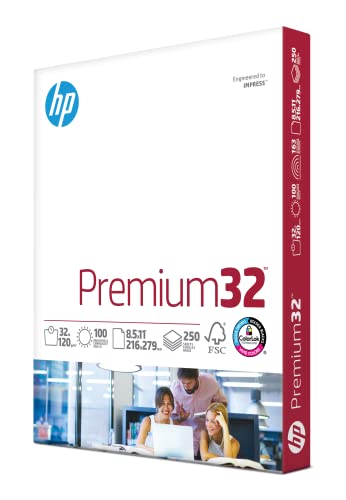
HP Premium 32lb Paper
by HP
The highest-rated and brightest paper on this list. 250 sheets of 32lb bright white at 100 brightness, for candidates who prioritize print sharpness over cotton prestige.
Pros
- Highest-rated paper on this list at 4.8 stars across 6,400+ verified reviews — the sheer volume and consistency of positive feedback reflects reliable real-world performance across thousands of different printers, climates, and use cases
- 100 brightness rating is the highest on this list and delivers the most vivid, high-contrast text reproduction — your resume text will appear sharper and darker on this paper than on any cotton alternative
- Ships 250 sheets, more than double the quantity of the 100-sheet cotton packs, which makes it practical for candidates printing several resume versions, cover letters, and reference sheets without restocking mid-search
- FSC certified, acid-free, and made in the USA with responsible forestry practices — important for environmentally conscious candidates and companies that value sustainability in their supply chain
Cons
- No cotton content means the paper lacks the distinctive soft texture and prestige feel that 100% cotton provides — the super-smooth finish feels like high-quality office paper rather than dedicated resume stationery
- No watermark means there is no embedded authenticity signal when the paper is held to light — a subtle distinction that matters in traditional industries where resume presentation is closely evaluated
- The 32lb weight, while premium, may cause occasional feed issues in older or lower-end printers with tight paper paths — test a single sheet before batch printing to avoid jams on critical interview-prep nights

Hammermill Premium Laser Print 32lb Paper
by Hammermill
The ultimate bulk-value resume paper — 500 sheets of 32lb laser-optimized stock with a 99.99% jam-free guarantee. The practical choice for high-volume job seekers who need reliable, sharp prints at the lowest per-sheet cost.
Pros
- 99.99% jam-free guarantee is the strongest reliability claim on this list — backed by Hammermill's ColorLok technology that optimizes fiber alignment for consistent, predictable feeding through laser printers, copiers, and high-volume print runs
- Ultra-smooth finish engineered for 2400 dpi laser output produces razor-sharp text edges and clean line reproduction — the surface is specifically optimized for toner adhesion rather than ink absorption, making it the best laser-printer choice on this list
- Best value per sheet on this list with 500 sheets included — five times the quantity of 100-sheet cotton packs, making it ideal for candidates running a high-volume job search who need to print dozens of resume versions, cover letters, and reference lists
- Acid-free, FSC certified, and manufactured in the USA — the same responsible forestry and archival-quality construction as the HP Premium but at a significantly lower per-sheet cost due to the larger quantity
Cons
- No cotton content means the paper feels like premium office stock rather than dedicated resume stationery — hiring managers accustomed to cotton paper will notice the absence of fiber texture and softness
- No watermark is a missing prestige signal for candidates applying to traditional industries like law, finance, or academia where presentation details are evaluated alongside content
- 98 brightness is slightly lower than the HP Premium's 100 brightness — a marginal difference that is barely visible to the naked eye but technically makes this the second-brightest option rather than the brightest
Best 24 lb Resume Paper
The 24 lb weight is the traditional resume standard — heavier and more substantial than everyday copier paper, yet flexible enough to feed cleanly through any printer without media adjustments. These two are the best 24 lb options, one classic cotton wove and one textured linen at the same price.
| Product | Price | Buy |
|---|---|---|
| Southworth 100% Cotton Resume Paper, 24lb, IvoryBest 24 lb overall 100% cotton, NRWA-endorsed, ivory wove — the standard 24 lb resume stock that hiring managers recognize by feel | $12.92 | View on Amazon |
| Southworth 25% Cotton Linen Business Paper, 24lb, WhiteBest 24 lb linen 25% cotton with a distinctive linen texture at the same price — 24 lb weight with a finish that stands out | $12.52 | View on Amazon |
Best 32 lb Resume Paper
Stepping up to 32 lb adds a card-like heft that reads as executive-level the moment your resume is picked up off the stack. These three cover the range — premium cotton, sharp-printing value, and warm cotton ivory.
| Product | Price | Buy |
|---|---|---|
| Southworth 100% Cotton Resume Paper, 32lb, WhiteBest 32 lb cotton 100% cotton in bright white — maximum heft and contrast for executive applications | $17.32 | View on Amazon |
| HP Premium 32lb PaperSharpest 32 lb print Non-cotton 32 lb at 100 brightness and 250 sheets — the sharpest, brightest print on this list | $21.94 | View on Amazon |
| Southworth Premium Weight Resume Paper, 32lb, 100% Cotton, IvoryBest 32 lb cotton (ivory) 100% cotton 32 lb in warm ivory — the traditional tone at full executive weight, and the priciest sheet here. Note the low rating count: this is long-standing Southworth stock on a newer listing | $32.48 | View on Amazon |
Best Linen Resume Paper
Linen’s woven cross-hatch texture is the strongest tactile signal a resume can carry — the choice for law, finance, academia, and other tradition-minded fields where presentation is part of the evaluation.
One honest caveat before you shop. As of this update, 100% cotton and a linen finish no longer come together on Amazon: the Southworth 100% cotton linen stock has gone unavailable, and what remains in a genuine linen finish is 25% cotton or a wood-fiber blend. Both papers below are 25% cotton. You still get the texture, which is what a recruiter actually notices; you are giving up some of the fiber quality a full-cotton sheet has in the hand.
| Product | Price | Buy |
|---|---|---|
| Southworth 25% Cotton Linen Business Paper, 24lb, WhiteBest linen overall 25% cotton linen in white, 100 sheets — the cheapest way into a real linen texture | $12.52 | View on Amazon |
| Southworth 25% Cotton Linen Business Paper, 24lb, Ivory, 100 SheetsBest linen in ivory The identical linen stock in warm ivory, 100 sheets — the traditional tone, at roughly double what the white version costs | $26.35 | View on Amazon |
Best White Resume Paper
Bright white is the modern default — maximum contrast for black text and a clean, contemporary read that fits tech, creative, and consulting applications. These two pair a premium cotton feel with the crispest value option.
| Product | Price | Buy |
|---|---|---|
| Southworth 100% Cotton Resume Paper, 32lb, WhiteBest cotton white 100% cotton 32 lb in bright white — premium feel with modern contrast | $17.32 | View on Amazon |
| HP Premium 32lb PaperBrightest white Non-cotton 32 lb at 100 brightness — the crispest, whitest print on this list | $21.94 | View on Amazon |
Buyer's Guide
Choosing the right resume paper depends on your industry, budget, and how many copies you need to print. Here are the six factors that matter most when selecting paper for professional job application documents.
Paper Weight
Resume paper comes in two standard weights: 24lb and 32lb. The 24lb weight is the traditional standard — it feeds reliably through every printer and feels noticeably heavier than 20lb copier paper. The 32lb weight adds a substantial, card-like heft that immediately communicates premium quality. For most candidates, 24lb cotton is the safe choice. If you are applying to executive, legal, or finance roles where tactile impression matters, 32lb is worth the upgrade. The trade-off: heavier paper costs more per sheet and may require printer tray adjustments on older models.
Cotton Content
Cotton percentage is the single biggest quality differentiator in resume paper. 100% cotton delivers a soft, cloth-like texture that is immediately recognizable as premium stationery — hiring managers who handle resumes regularly can tell the difference by touch. 25% cotton offers a middle ground with some texture at a lower price. 0% cotton papers (like the HP Premium and Hammermill) rely on brightness and weight instead of fiber quality for their premium feel. Choose 100% cotton for traditional industries (law, finance, academia, government) and high-quality non-cotton for modern industries (tech, startups, creative) where print sharpness matters more than paper texture.
Color
Resume paper comes in three main color families: white, ivory, and specialty tones like almond. Bright white (90-100 brightness) delivers maximum text contrast and reads as modern and clean — it is the default choice for technology, consulting, and creative roles. Ivory adds a warm, traditional tone that pairs well with serif typefaces and conservative layouts — it is the classic choice for legal, academic, and government applications. Almond and cream are niche options that work well for candidates who want to stand out visually. The safe rule: when in doubt, choose white. It works everywhere.
Finish
The three resume paper finishes are wove, linen, and smooth. Wove is the standard finish for cotton resume paper — a subtle, even texture that feels premium without being distracting. Linen has a distinctive cross-hatch pattern that is immediately recognizable as high-end stationery — it makes the strongest tactile impression but may not reproduce consistently on all printers. Smooth finish (found on non-cotton papers like the HP Premium) is optimized for print sharpness rather than hand-feel — it produces the crispest text edges and highest ink contrast. Match the finish to your priority: texture impression (linen), balanced (wove), or print quality (smooth).
Printer Compatibility
Not all resume papers perform equally across printer types. Smooth-finish papers feed most reliably through any printer — inkjet, laser, or copier. Cotton wove papers work well on most modern printers but may require switching to the thick or cardstock media setting on some models to prevent double-feeds. Linen-finish papers are the most variable: laser printers generally handle linen better than inkjets because toner sits on the surface rather than being absorbed into the textured fibers. Regardless of which paper you choose, always test-print a single sheet before batch printing — discovering a feed issue at 11 PM before a morning interview is a problem you can prevent with a two-minute test.
Sheet Count and Value
Resume paper is sold in quantities ranging from 100 sheets (standard for cotton packs) to 500 sheets (standard for non-cotton premium). The per-sheet cost varies widely: 100% cotton papers run roughly 13 to 33 cents per sheet, while non-cotton premium papers land between about 4 and 9 cents depending on pack size. For a targeted job search with 5-10 high-priority applications, a 100-sheet cotton pack provides plenty of material with room for test prints and mistakes. For a high-volume search where you are printing 50+ resume sets (resume, cover letter, references), the 250 or 500-sheet non-cotton packs deliver professional-quality output at a fraction of the per-sheet cost.
Frequently Asked Questions
Does resume paper really make a difference in getting hired?
What is the best paper weight for printing a resume?
Should I use white or ivory resume paper?
Can I use resume paper in a regular inkjet printer?
Do I need matching envelopes with my resume paper?
Related Articles
About the Reviewer

Sarah Chen, CAP, PMP
B.A. Business Administration, UCLA
Sarah Chen spent 10 years in office management and operations at Fortune 500 companies before founding DeskRated in 2026. After managing supply budgets for teams of 50+ people and testing thousands of products through daily use, she started writing the honest, no-fluff supply reviews that office professionals actually need. Sarah holds both CAP and PMP certifications and is based in Los Angeles.