7 Best Printer Paper of 2026
Sarah Chen reviews the best printer paper for home and office use. Compare multipurpose, premium, recycled, and photo paper by weight, brightness, sheet count, and value.
Updated
As someone who has managed office supply procurement for teams ranging from five-person startups to Fortune 500 departments, I can tell you that printer paper is the most frequently misordered item in any supply closet — and the mistakes are almost always the same. Someone buys the cheapest paper available and wonders why the laser printer jams three times a week. Someone else orders premium photo paper for a ten-page memo. The cost of getting printer paper wrong is not the paper itself — it is the wasted time clearing jams, reprinting smudged documents, and replacing printer rollers worn out by incompatible stock.
We evaluated seven printer papers across four categories — standard multipurpose, premium multipurpose, recycled, and photo — analyzing over 400,000 combined Amazon reviews, manufacturer specifications, environmental certifications, and cross-printer compatibility data. Whether you are stocking a home office, outfitting a classroom, provisioning a corporate print room, or printing family photos for holiday cards, this guide covers the right paper for your specific use case. If you are also setting up your workspace, our best document scanners and best laminators guides cover the tools that complete the paper workflow.
After evaluating papers across all four categories, here are our top picks at a glance. The summary table above shows all seven options side by side — scroll down for detailed reviews of each, or jump to the buyer’s guide at the bottom if you want to understand the selection criteria before reading individual product assessments. If you are stocking up for the school year — teachers provisioning classroom printers and families outfitting a home office for fall both buy heaviest through the summer — the three-ream case options below are where the per-sheet savings compound fastest.
How We Chose These Printer Papers
We selected products by cross-referencing Amazon bestseller rankings in Copy & Multipurpose Paper and Photo Quality Paper with manufacturer-verified specifications, environmental certification documentation, and user review sentiment analysis across over 400,000 combined reviews. Each paper was evaluated on print quality across inkjet and laser output, jam reliability, double-sided performance, environmental credentials, and per-sheet value at both single-ream and case quantities. We prioritized papers with verified cross-printer compatibility and documented certifications from FSC, SFI, or equivalent third-party auditors.
Amazon Basics Multipurpose Copy Printer Paper, 20 lb
The Amazon Basics 20 lb Copy Paper sits at #1 in Amazon’s Copy & Multipurpose Paper category for a straightforward reason: it does exactly what 90% of print jobs require at the lowest per-sheet cost available from a major brand. With 228,000+ verified reviews and a 4.8-star rating — a volume of real-world testing that no laboratory evaluation can replicate — this paper has been run through virtually every consumer and office printer model on the market and earned its position through sheer consistency.
The 20 lb weight and smooth finish feed cleanly through inkjet printers, laser printers, copiers, and fax machines without the jamming issues that plague off-brand papers with inconsistent caliper or moisture content. The acid-free composition is a detail that matters more than most buyers realize at purchase time: standard non-acid-free paper yellows and becomes brittle within a few years, making it unsuitable for any document with retention requirements. Tax records, signed contracts, student work portfolios, insurance documents — anything you might need to read again in five years benefits from acid-free paper.
The honest limitation is brightness. At 92, this paper produces clean, readable text output but lacks the vivid contrast that 96+ brightness papers deliver on color documents. If your printing is predominantly text — emails, memos, homework, invoices — the 92 brightness is entirely adequate. If you regularly print color charts, presentations, or marketing materials for external distribution, the HP MultiPurpose20 at 96 brightness or the Amazon Basics 24 lb at 97 brightness will produce noticeably better color output. For the 80% of print jobs that are black text on white paper, the Amazon Basics 20 lb is the correct default choice. Check our best label makers guide if you are also organizing your office filing system.

Amazon Basics Multipurpose Copy Printer Paper, 8.5 x 11, 20 lb, 500 Sheets
by Amazon Basics
The #1 bestselling printer paper on Amazon — 228,000+ reviews, jam-free performance, and the lowest per-sheet cost make this the default choice for everyday printing.
Pros
- Ranked #1 in Copy & Multipurpose Paper on Amazon with 228,000+ verified reviews — the single most battle-tested everyday printer paper available, purchased by over 100,000 buyers per month
- Works reliably across inkjet printers, laser printers, copiers, and fax machines without jamming — the 20 lb weight feeds consistently through virtually every consumer and office paper path
- Acid-free composition prevents yellowing over time, making it suitable for documents that need to remain legible for years — tax records, signed contracts, student portfolios
- Quick-drying ink absorption and consistent toner distribution produce clean, smudge-free output on both inkjet and laser devices without the premium price of coated paper
Cons
- 92 brightness is adequate but noticeably less vivid than 96+ brightness papers when printing color charts, marketing materials, or client-facing presentations
- 20 lb weight allows some show-through on double-sided printing — visible enough to be distracting on text-heavy duplex documents like reports and meeting agendas
HP Printer Paper, Copy and Print, 20 lb
The HP Copy and Print paper matches the Amazon Basics on price and rating but differentiates on two dimensions that matter to specific buyer segments: environmental certification and ink optimization. The FSC certification with verified 0% deforestation sourcing in North America means the fiber in this paper comes from forests managed under documented sustainability protocols — a credential that is increasingly required by corporate procurement policies and school district purchasing guidelines.
ColorLok technology is the second differentiator, and it is a real one. ColorLok is an industry standard (not HP-proprietary) that specifies paper surface chemistry optimized for inkjet ink absorption. The result is measurable: 30% brighter colors, 60% bolder blacks, and ink dry times approximately three times faster than non-ColorLok papers. For offices that primarily use inkjet printers, the ColorLok difference is visible in the first print. For laser-only offices, ColorLok provides no advantage since toner bonding is heat-based rather than absorption-based.
The 87,000+ reviews at 4.8 stars provide a substantial reliability dataset, confirming broad compatibility across HP, Canon, Brother, and Epson printers despite the HP branding. One practical caveat at the time of this update: Amazon lists this ream as usually shipping within one to three weeks rather than immediately, so if you need paper this week, the Amazon Basics ream at the same price is the one to order. The criticism that the polyurethane ream wrapper is not recyclable is a legitimate sustainability gap — the paper itself is FSC certified, but the packaging partially undermines the environmental positioning for buyers who track waste comprehensively. For organizations where FSC certification is a procurement requirement or where inkjet print quality is a priority, the HP Copy and Print paper delivers value that the Amazon Basics does not.

HP Printer Paper, Copy and Print, 8.5 x 11, 20 lb, 500 Sheets
by HP Papers
The environmentally responsible everyday paper — FSC certified with ColorLok technology for faster drying and bolder output at the same price as basic alternatives.
Pros
- FSC certified with 0% deforestation sourcing in North America — the strongest environmental credential among standard-weight printer papers on this list without sacrificing print quality
- ColorLok technology delivers 30% brighter colors, 60% bolder blacks, and 3x faster ink drying compared to non-ColorLok papers — a measurable quality difference on inkjet output
- 87,000+ verified reviews at a 4.8-star rating provide an extensive reliability record across virtually every consumer and office printer model currently on the market
- Optimized for HP printers but fully compatible with all major inkjet and laser brands — no vendor lock-in despite the HP branding
Cons
- Same 92 brightness as budget alternatives means you are paying for environmental certification and ColorLok technology rather than a visible brightness upgrade
- Polyurethane wrapper coating is not recyclable, which partially offsets the FSC-certified paper's environmental advantage for sustainability-conscious buyers
Hammermill 20 lb Copy Paper, 3-Ream Case
Hammermill has been manufacturing paper for over a century, and the 99.99% jam-free guarantee is the most confident reliability claim in the printer paper market. That guarantee is not marketing — it reflects a manufacturing precision in caliper consistency and moisture control that directly affects how paper feeds through printer mechanisms. Paper jams are almost always caused by inconsistent sheet thickness, excessive moisture content, or rough edges that catch on feed rollers. Hammermill’s quality control addresses all three factors at the manufacturing level.
The three-ream case makes this the procurement-smart choice for any environment that prints consistently: offices ordering monthly, teachers stocking classroom printers, home offices that go through a ream every two to three weeks. Case pricing in this category moves week to week, and as of this update the Hammermill case has moved above both the HP MultiPurpose20 and the Great White cases on a per-sheet basis rather than sitting just under them, which is why the bulk-value pick on this list is now the HP case. What you are buying here is the jam-free guarantee and the domestic supply chain, not a price advantage. Two practical notes at the time of writing: Amazon quotes an eight to fourteen day shipping window on this ASIN rather than immediate dispatch, so order ahead of running out, and re-check all three case prices before committing, because this ordering has flipped before. ColorLok certification adds the same inkjet optimization that the HP paper offers, delivering print quality above what the 92 brightness specification alone would predict.
The limitation — no single-ream option at this ASIN — means this is not the right choice for very light home use where 1,500 sheets would sit in a closet long enough to absorb ambient moisture and degrade. Paper stored outside its original wrapper in a humid environment can begin curling and feeding inconsistently within weeks. If you print fewer than 500 pages per month, the single-ream Amazon Basics or HP options are more practical, and they are also the cheapest paper here on a per-sheet basis. If you print regularly enough that restocking is the real cost, the Hammermill 3-ream case is the most reliable way to buy in bulk.
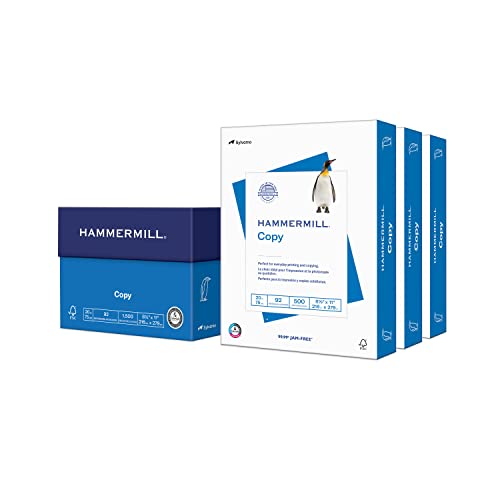
Hammermill Printer Paper, 20 lb Copy Paper, 8.5 x 11, 3 Ream Case
by Hammermill
The reliability pick for bulk buying — Hammermill's 99.99% jam-free guarantee and 3-ream packaging deliver 1,500 sheets with the lowest jam risk on this list, though you now pay a small premium per sheet over the other cases for it.
Pros
- 99.99% jam-free guarantee backed by a brand with over 100 years in the paper business — the lowest jam risk claim of any printer paper on this list, reducing wasted sheets and printer maintenance
- ColorLok technology produces 30% brighter colors and 60% bolder blacks on inkjet output, elevating print quality above what the 92 brightness rating alone would suggest
- 100% made in USA from sustainably sourced fiber — supports domestic manufacturing and verifiable supply chain traceability from forest to ream
- Three-ream case packaging keeps 1,500 sheets on hand, so restocking drops to a few times a year for an office that prints steadily — the practical argument for this case is the jam-free guarantee and the domestic supply chain, not the sticker
Cons
- Only available in the 3-ream configuration at this ASIN — no single-ream option for light-use buyers who do not want 1,500 sheets on hand
- Case pricing on this category moves week to week and this case currently sits above both the HP MultiPurpose20 and the Great White cases per sheet — check all three before a bulk order rather than assuming Hammermill is the cheap one
- Amazon currently quotes an eight to fourteen day shipping window on this ASIN rather than immediate dispatch, so it is the wrong choice if the printer is already empty
- 92 brightness is the standard tier, not the premium tier — offices printing client presentations or color-heavy marketing materials will notice the difference against 96+ brightness papers
Amazon Basics 24 lb Multipurpose Paper, 97 Bright
The step from 20 lb to 24 lb printer paper is one of those upgrades that sounds incremental on a spec sheet but is immediately obvious the moment you hold a printed page. The 24 lb weight gives documents a heft and rigidity that standard 20 lb paper simply does not have — pick up a printed report on each weight side by side, and the 24 lb page feels like a professional document while the 20 lb page feels like a photocopy. For client-facing materials, resumes, proposals, and any document where physical impression matters, this difference is worth the per-sheet premium.
The 97 brightness compounds the professional impression. At 97, this paper produces the highest contrast output among the multipurpose papers on this list — colors are more vivid, blacks are crisper, and the white background provides a cleaner canvas for both text and graphics. The combination of 24 lb weight and 97 brightness makes this the closest thing to specialty presentation paper that still feeds through a standard printer tray without manual bypass settings.
The practical deployment strategy for most offices is two-tier: keep a supply of 20 lb paper for everyday internal printing and a smaller supply of this 24 lb paper for documents that leave the building. The cost difference between the two tiers is modest enough that maintaining both stocks is economically rational for any office that sends printed materials to clients, vendors, or stakeholders. For home offices where every printed page goes into a file folder rather than into a client’s hands, the 24 lb upgrade adds cost without meaningful benefit. Pair professional documents with a clean workspace — our best desk lamps guide covers the lighting side of the equation.
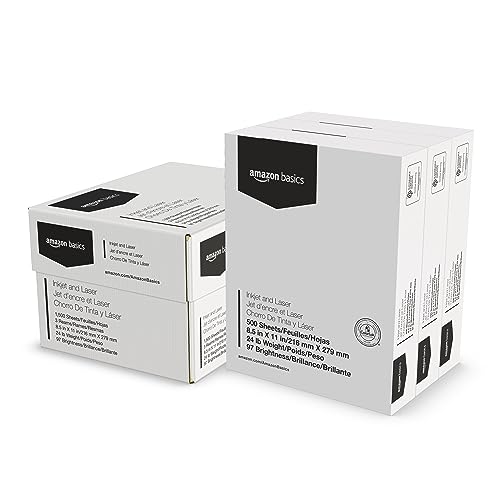
Amazon Basics Multipurpose Copy Printer Paper, 24 lb, 8.5 x 11, 3 Pack of 500 Sheets
by Amazon Basics
The premium multipurpose paper — 24 lb weight and 97 brightness deliver a professional look and feel that standard 20 lb paper cannot match, at a fraction of specialty paper prices.
Pros
- 97 brightness rating is the highest among multipurpose papers on this list — delivers noticeably sharper contrast and more vivid color reproduction on both inkjet and laser output
- 24 lb weight feels substantially thicker and more professional in hand than standard 20 lb paper — a tactile quality difference that clients and colleagues notice in printed reports and proposals
- Acid-free composition prevents yellowing and degradation over time, making this the right choice for documents with long retention requirements — HR files, legal records, portfolio prints
- 29,000+ verified reviews and a sustained top-5 bestseller ranking in Copy & Multipurpose Paper confirm broad cross-printer compatibility and consistent quality at scale
Cons
- Heavier 24 lb weight can increase ink consumption on some inkjet printers — the thicker fiber absorbs slightly more ink per page compared to 20 lb alternatives
- Higher per-sheet cost than 20 lb options makes this an unnecessary expense for internal drafts, rough copies, and everyday printing where the premium weight adds no value
HP MultiPurpose20 Paper, 96 Bright, 3-Ream Case
The HP MultiPurpose20 occupies a specific niche: it delivers a meaningful brightness upgrade over standard 92-bright papers without the weight and cost jump of 24 lb premium stock. At 96 brightness, color documents produced on this paper are noticeably more vivid than the same documents printed on 92-bright paper — a difference that is most visible in charts, graphs, photographs, and any content with saturated colors. For offices that print a mix of text and color documents and want a single paper stock that handles both well, the 96 brightness hits the practical sweet spot.
The triple certification — FSC, ColorLok, and Made in USA — makes this paper the most thoroughly credentialed option on this list for organizations with sustainability procurement standards. Each certification is independently verified and addresses a different dimension of responsible sourcing: FSC covers forest management, ColorLok ensures optimized ink performance, and domestic manufacturing provides supply chain visibility and supports U.S. manufacturing jobs. For corporate purchasing departments that need to document their supply chain’s environmental compliance, this paper checks every box.
The three-ream packaging is what makes this the bulk-value pick as of this update: it currently costs less per sheet than either 92-bright Hammermill case, so the 96-brightness upgrade arrives at a discount rather than a premium. That ordering is a function of current case pricing rather than a permanent state, so it is worth a quick comparison before a large order. The honest trade-off: at 20 lb weight, this paper still shows some text bleed-through on duplex printing. Buyers who need both high brightness and high opacity for double-sided documents should consider the Amazon Basics 24 lb instead — it trades the FSC certification for a weight upgrade that better addresses the duplex use case.

HP MultiPurpose20 Paper, 8.5 x 11, 20 lb, 96 Bright, 3 Ream Case
by HP Papers
The bright white workhorse — 96 brightness and FSC certification deliver noticeably better color output than standard papers while maintaining responsible sourcing.
Pros
- 96 brightness is a noticeable step up from the 92-bright standard — color documents, charts, and presentations pop with measurably better contrast without jumping to premium 24 lb paper
- FSC certified and made in USA with ColorLok technology — combines environmental responsibility with superior ink performance in a single product that checks both boxes
- Acid-free archival quality means printed documents resist yellowing and degradation, making this suitable for medical records, legal filings, and any document with multi-year retention needs
- Currently the lowest cost per sheet of any case on this list, and it undercuts both 92-bright Hammermill cases while giving you the brighter stock — the rare instance where the better paper is also the cheaper bulk buy
Cons
- Case pricing in this category moves week to week, so the per-sheet lead over the Hammermill cases is worth re-checking before a large order rather than treating as permanent
- 20 lb weight still exhibits some show-through on duplex printing despite the higher brightness — buyers who need both brightness and opacity should consider the 24 lb Amazon Basics
Hammermill Great White 30% Recycled, 3-Ream Case
The Hammermill Great White is the paper that proves the recycled-versus-quality trade-off no longer exists — at least not at the 30% recycled content level. A decade ago, recycled printer paper was a compromise: lower brightness, higher jam rates, visible fiber inconsistencies, and faster yellowing. Modern manufacturing at Hammermill’s scale has eliminated every one of those historical shortcomings. The Great White carries the same 99.99% jam-free guarantee as Hammermill’s virgin-fiber papers, matches the same 92 brightness rating, and meets the same acid-free archival specification.
The 30% post-consumer recycled content means that nearly one-third of the fiber in each sheet comes from paper that was previously used, collected, and reprocessed rather than harvested from trees. For organizations with sustainability goals — and that is an increasingly large percentage of both corporate and educational buyers — this paper delivers measurable environmental impact without asking anyone to accept lower print quality. The SFI certification and Made in USA designation provide additional environmental and supply chain verification.
The sustainability premium is real but modest: the Great White costs slightly more per sheet than the equivalent non-recycled Hammermill paper. Over a year of office printing, the cumulative premium is noticeable but rarely budget-significant. The more meaningful consideration for sustainability-focused buyers is that 30% recycled is not 100% recycled — the remaining 70% is still virgin fiber. Buyers who need higher recycled content will need to explore specialty papers that may sacrifice the jam-free guarantee and brightness consistency that make the Great White a practical no-compromise choice. For our full guide to protecting your important printed documents, see our best paper shredders roundup.

Hammermill Printer Paper, Great White 30% Recycled, 8.5 x 11, 20 lb, 3 Ream Case
by Hammermill
The best recycled printer paper — 30% post-consumer content with Hammermill's 99.99% jam-free guarantee proves that sustainability and reliability are no longer trade-offs.
Pros
- 30% post-consumer recycled content is the highest recycled percentage among papers on this list that still maintain full print quality — a meaningful reduction in virgin fiber demand without performance compromise
- 99.99% jam-free guarantee applies equally to the recycled content — Hammermill's manufacturing process eliminates the reliability concerns that historically plagued recycled papers
- SFI certified and 100% made in USA, providing dual environmental verification through both material sourcing and supply chain accountability
- Acid-free and archival quality despite the recycled content — recycled papers historically yellowed faster, but modern manufacturing has closed this gap entirely
Cons
- Pricing tracks the non-recycled Hammermill case closely and can sit on either side of it week to week, so the recycled content is not a reliable saving — check both before committing to a bulk order
- Only 30% post-consumer recycled content, not 100% — buyers seeking fully recycled paper will need to look at specialty options that may sacrifice print quality and jam rates
Epson Premium Photo Paper Glossy, 50 Sheets
The Epson Premium Photo Paper Glossy exists in a fundamentally different category from the six multipurpose papers above — and understanding that distinction is critical before purchasing. This is not everyday printer paper. It is a specialty medium designed for one purpose: producing photo-quality prints on a home inkjet printer that rival commercial photo lab output. At 252 gsm and 10.4 mil thickness with a high-gloss resin coating, this paper produces images with the color depth, surface sheen, and physical rigidity of traditional darkroom prints.
The water-resistant resin coating is the feature that separates professional-grade photo paper from the glossy inkjet papers sold at office supply stores. Standard glossy paper absorbs ink into its surface coating; the Epson Premium’s resin layer holds ink on top of the surface in a precisely controlled dot pattern, producing sharper details and more accurate color reproduction. The water resistance means a drop of water or a damp fingerprint will not cause ink to bleed or smear — a practical advantage for prints that will be handled, displayed, or framed.
Reviews confirm that this paper delivers strong results on non-Epson inkjet printers as well — Canon, HP, and Brother users report excellent output, though Epson printers achieve the highest color accuracy due to matched ink-paper optimization. Note that Amazon has split this listing’s ratings from the wider Epson photo-paper pool since our last update, so the review count shown is now much smaller than it was; the paper itself is unchanged. The critical limitation: this paper is incompatible with laser printers. The resin coating will melt in a laser printer’s fuser assembly, potentially causing permanent damage. If your only printer is a laser, this product is not an option. For inkjet users who want to print photos at home — holiday cards, family portraits, real estate listings, art prints — this paper delivers results that are genuinely difficult to distinguish from professional photo lab output.

Epson Premium Photo Paper Glossy, 8.5 x 11, 50 Sheets
by Epson
The photo paper that delivers lab-quality prints at home — Epson's heavyweight resin-coated glossy produces water-resistant photos with professional color depth and surface finish.
Pros
- Professional lab-quality photo output on a home inkjet printer — the high-gloss resin coating produces prints with the sharpness, color saturation, and surface finish of commercial photo lab work
- Water-resistant surface prevents ink bleeding and smudging from accidental contact with moisture — prints can be handled immediately after printing without protective sleeves
- 252 gsm heavyweight construction at 10.4 mil thickness gives prints the rigidity and tactile quality of traditional photo prints, not the flimsiness of standard paper with photos printed on it
- Reviews confirm cross-brand inkjet compatibility despite Epson branding — Canon, HP, and Brother users report strong results, though Epson printers achieve the highest color accuracy
Cons
- Only 50 sheets per pack at a cost that is orders of magnitude higher per sheet than multipurpose paper — photo printing on this paper is a per-project cost decision, not an everyday one
- Incompatible with laser printers — the resin coating cannot withstand laser fuser temperatures and will damage the printer, a critical limitation for offices with only laser devices
How to Choose the Best Printer Paper
Buyer's Guide
Choosing the right printer paper means matching the paper's weight, brightness, and finish to your specific printing needs — most wasted paper and printer frustration comes from using the wrong paper type for the job, not from buying a bad product within the right category.
Paper Weight
Paper weight is the single most important specification and the one most buyers overlook. Standard copy paper is 20 lb (75 gsm) — thin enough for everyday printing, light enough for postal mailing, and compatible with every printer's default feed settings. Premium multipurpose paper at 24 lb (90 gsm) offers a noticeable thickness upgrade that improves the professional feel of printed documents and significantly reduces show-through on double-sided printing. Specialty papers escalate from there: cardstock at 65-110 lb for cards and covers, and photo paper at 200-300 gsm for image output. For most offices and home printers, 20 lb handles 90% of print jobs; keeping a smaller supply of 24 lb paper for client-facing documents covers the other 10%. Heavier paper feeds differently through printers — always check your printer's maximum paper weight specification before loading anything above 24 lb.
Brightness Rating
Brightness is measured on a 0-100 scale indicating the percentage of blue light the paper reflects. Standard copy paper sits at 92 brightness, which produces clean, professional text output. Premium papers at 96-97 brightness create noticeably higher contrast for color documents, charts, and presentations. The brightness difference is most visible in color printing and when sheets of different brightness levels are placed side by side — for monochrome text output, the difference between 92 and 96 is subtle. Match brightness to use: 92 for everyday printing, 96+ for documents where color accuracy and visual impact justify the per-sheet premium. Papers above 100 brightness exist but use optical brighteners that can cause eye strain under fluorescent lighting and may yellow faster than naturally bright papers.
Printer Compatibility
Most multipurpose copy paper works across inkjet and laser printers without issue — the six multipurpose papers on this list are all dual-compatible. The critical exception is specialty paper: photo paper with resin or polymer coatings is designed exclusively for inkjet printers and will damage laser printer fusers if used incorrectly. Laser-specific papers are engineered to bond toner at high temperatures. Before purchasing specialty paper, verify it is rated for your specific printer technology. Within the multipurpose category, ColorLok-certified papers deliver optimized ink absorption on inkjet printers — faster drying, bolder blacks, brighter colors — while performing identically to non-ColorLok paper in laser printers. If your office uses both printer types, multipurpose ColorLok paper is the most versatile single-stock choice.
Opacity and Duplex Performance
Opacity measures how much printed content on one side of a sheet is visible from the other side. Standard 20 lb paper at 92 brightness has approximately 88-90% opacity — adequate for single-sided printing but noticeably translucent on double-sided (duplex) documents. Heavier 24 lb paper improves opacity to approximately 94-96%, reducing show-through to levels that most readers will not notice. If your office prints double-sided by default — increasingly common as a paper-saving measure — the upgrade from 20 lb to 24 lb paper has a meaningful impact on document readability. Opacity is also affected by brightness: higher-brightness papers can appear more translucent because the whiter surface provides less visual masking of rear-side content. For duplex-heavy environments, prioritize weight over brightness.
Environmental Certifications
Three certification systems dominate printer paper: FSC (Forest Stewardship Council), SFI (Sustainable Forestry Initiative), and recycled content percentage. FSC certification verifies that paper fiber comes from responsibly managed forests with documented chain-of-custody from forest to ream. SFI certification covers similar ground with different audit standards. Post-consumer recycled content indicates the percentage of fiber derived from previously used paper rather than virgin trees. The Hammermill Great White on this list uses 30% post-consumer recycled content with SFI certification; HP Papers carry FSC certification. For organizations with sustainability procurement requirements, these certifications may be mandatory. For individual buyers, certification provides confidence that the paper supply chain meets established environmental standards without requiring independent verification.
Value and Cost Per Sheet
Printer paper pricing varies by more than 15x between everyday copy paper and premium photo paper, so matching cost to use case is essential. Standard 20 lb copy paper costs roughly 1.2-1.5 cents per sheet in single-ream purchases, and three-ream cases of 20 lb stock typically land near 1.8-2 cents per sheet. Premium 24 lb paper runs about 2 cents per sheet. Photo paper costs 20-30 cents per sheet. The important correction to a common assumption: on Amazon, buying a case does not reliably beat single-ream pricing per sheet, because loss-leader pricing on individual reams is often the lowest per-sheet cost available. What a case actually buys you is fewer reorders, guaranteed stock on hand, and consistent paper from a single production lot. For offices that print more than a ream per week, that continuity is usually worth more than a fraction of a cent per sheet. For home offices printing fewer than 100 pages per month, a single ream of 20 lb paper is sufficient and prevents the moisture absorption that degrades paper stored for extended periods.
The Two-Tier Paper Strategy for Most Offices
Rather than searching for a single paper that handles every printing need, most offices are better served by stocking two paper types. Keep your primary supply in standard 20 lb multipurpose paper — the Amazon Basics, HP Copy and Print, or Hammermill 3-ream case — for everyday printing: internal memos, emails, drafts, reference copies, and anything that stays inside the office. This covers 80-90% of print volume at the lowest cost per page you can print.
Maintain a smaller secondary supply of 24 lb premium paper — the Amazon Basics 24 lb at 97 brightness — for documents that leave the building: client proposals, investor presentations, printed reports for external meetings, and resumes. The physical difference between a 20 lb and 24 lb printed document in a client’s hands is subtle but real, and the per-page cost difference is small enough that the upgrade is economically trivial when applied only to outward-facing documents.
This two-tier approach costs less than buying premium paper for everything and produces better results than using standard paper for everything. It also reduces the risk of running out of paper mid-print-job — the everyday stock handles volume while the premium stock stays available for the jobs that justify it. For offices that also need photo printing capability, adding the Epson Premium Photo Paper as a third-tier specialty stock completes the setup without overspending on paper that sits unused.
If you keep a printer at home for kids’ homework or your own note-taking, our free printable lined paper generator pairs naturally with the 24 lb Amazon Basics or HP MultiPurpose20 — pick a college, wide, or kindergarten ruling, optionally add a Name/Date/Subject header, and print as many pages as you need without hunting for a notebook. For elementary handwriting practice, our free cursive practice sheet generator prints custom-text PDFs in three cursive styles, with trace mode for early learners and copy mode for older grades — both work best on the same 24 lb stock that takes pencil cleanly without feathering. The companion free cursive alphabet printable covers the reference side of the same job — an A–Z wall chart, a cut-and-tape desk strip, flashcards, or a tracing sheet, in A–Z or stroke-family order. Charts and strips want the heavier bright stock so they survive lamination; the flashcard layout is the one case where you should reach past printer paper for card stock. For math homework, engineering coursework, lab reports, or board-game prototyping, the free printable graph paper generator covers eight grid types — quad, engineering bold-every-Nth, coordinate plane, isometric, dot, hex, polar, and log — with custom spacing in millimeters or inches, also printing best on the 24 lb premium stock. For 3D sketching, drafting, and tabletop-game maps specifically, the free isometric graph paper generator prints iso-dot, iso-line, triangular, and hex grids in any spacing on Letter, A4, or A3 — the faint dots stay crisp on the same smooth 24 lb or 32 lb stock without feathering under repeated erasing. And for music students and composers, the free music staff paper generator prints blank manuscript paper, grand staff, or guitar TAB — with optional clefs and barlines — on the same smooth stock that takes pencil and ink without feathering. Parents and teachers drilling multiplication facts should also see the free times table chart generator — rainbow-themed reference grids look dramatically better on 28 lb or 32 lb bright-white stock, while its ink-saver black-and-white quiz sheets print economically on standard 20 lb copy paper. And for the front desk or any classroom, meeting, or event, our free sign-in sheet template builds a printable visitor, attendance, or sign-up sheet with exactly the columns you choose — a clipboard form that reads and signs cleanly on standard 20 lb stock.
Frequently Asked Questions
What is the difference between 20 lb and 24 lb printer paper?
Can you use inkjet paper in a laser printer?
What does paper brightness mean and why does it matter?
Is recycled printer paper as good as regular paper?
How should I store printer paper to prevent jams and quality issues?
What is the standard size of printer paper?
Is printer paper the same as sticker paper or label paper?
Related Articles
About the Reviewer

Sarah Chen, CAP, PMP
B.A. Business Administration, UCLA
Sarah Chen spent 10 years in office management and operations at Fortune 500 companies before founding DeskRated in 2026. After managing supply budgets for teams of 50+ people and testing thousands of products through daily use, she started writing the honest, no-fluff supply reviews that office professionals actually need. Sarah holds both CAP and PMP certifications and is based in Los Angeles.